
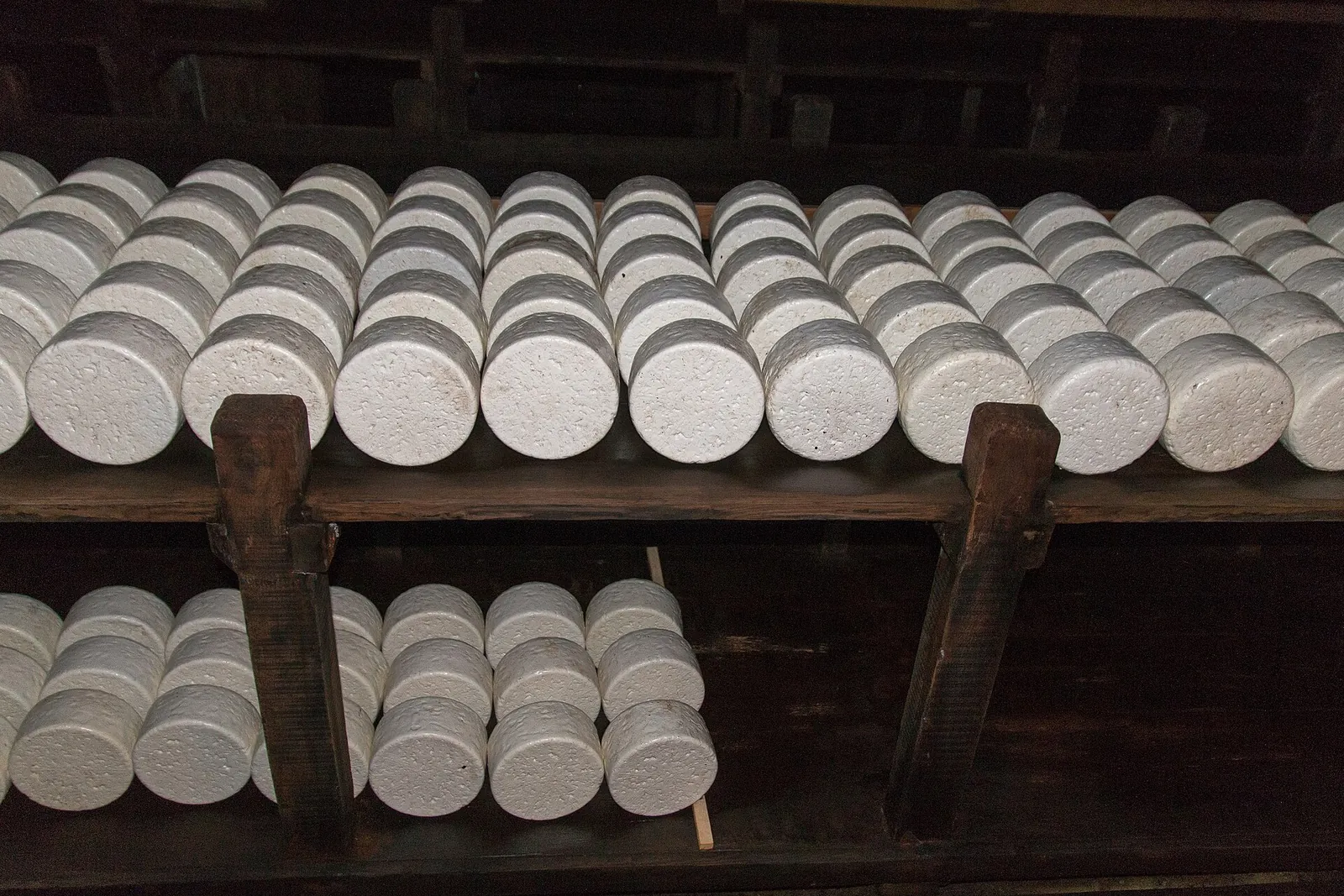
Each family has a handful of famous names, and dozens of those names are legally protected.
This page maps those families, lists the main cheeses with their milk and style, and points to the guides that go region by region.
French cheese at a glance
Here is French cheese at a glance: the main cheeses, the milk each one uses and the style that sets it apart.
| Cheese | Milk | Style | Protected name |
|---|---|---|---|
| Brie (Brie de Meaux, Brie de Melun) | Cow | Soft, bloomy rind | AOP for the two named Bries |
| Camembert | Cow | Soft, bloomy rind, earthier than Brie | AOP only as Camembert de Normandie |
| Comté | Cow | Hard, Alpine, nutty | AOP |
| Époisses | Cow | Washed rind, spoonable | AOP |
| Munster | Cow | Washed rind, pungent | AOP |
| Reblochon | Cow | Washed rind, Savoie | AOP |
| Roquefort | Sheep | Blue, salty | AOP |
| Crottin de Chavignol | Goat | Small drum, soft to hard with age | AOP |
| Valençay | Goat | Ash-dusted pyramid | AOP |
| Cantal | Cow | Semi-hard, tangy | AOP |
Brillat-Savarin, Mimolette and fresh chèvre are not in the table: read the pack for any protected name rather than assuming one.
The French cheese tradition
The French cheese tradition is large enough that nobody agrees on its size. President Charles de Gaulle is quoted in 1962 asking how a country with 246 varieties of cheese could be governed, while modern estimates run between 1,000 and 1,600 distinct types.
The gap exists because a cheese can be counted as one type or as dozens of local versions. What stays fixed is the pattern: nearly every region has a milk, a mold or a rind treatment, and a cave or cellar it depends on. Normandy has cows, apples and cream, so its cheeses are bloomy and washed. The Alps have summer pasture and big wheels. The Loire has goats. The south has sheep and limestone caves.
The French cheese guide covers all of this by region, and the Normandy and Auvergne guides go deeper on two of the richest areas.
French cheese by milk
French cheese by milk splits into three groups, and the protected names follow the same split.
- Cow's milk is the largest group: Abondance, Beaufort, Bleu d'Auvergne, Brie de Meaux, Cantal, Chaource, Comté, Époisses, Fourme d'Ambert, Livarot, Morbier, Munster, Pont-l'Évêque, Reblochon, Saint-Nectaire and many more appear on the protected list.
- Goat's milk covers the Loire and Poitou cheeses: Chabichou du Poitou, Crottin de Chavignol, Picodon, Rocamadour, Sainte-Maure de Touraine and Valençay.
- Sheep's milk is a short list: Roquefort, Ossau-Iraty, Brocciu from Corsica and Pérail.
Soft and bloomy cheeses
Soft and bloomy cheeses are the French cheese most Americans meet first. Brie is buttery and mild; Camembert is deeper and more mushroomy, and the Brie versus Camembert page sorts out the difference. Triple creams such as Brillat-Savarin go further, with more cream in the milk and a richness closer to dessert.
Washed-rind cheeses
Washed-rind cheeses are the smelly ones, rubbed with brine, beer or brandy while they ripen. Époisses is washed in brandy and is soft enough to eat with a spoon; Munster from Alsace and Livarot from Normandy are close behind. The smell is stronger than the taste, which is usually savory and gentle.
Alpine and mountain cheeses
Alpine and mountain cheeses are the wheels made for slicing and melting. Comté is the best known, and Reblochon is the cheese behind tartiflette. Tomme de Savoie, Cantal and Saint-Nectaire are the rustic cousins, earthier and often cheaper.
Goat and blue cheeses
Goat and blue cheeses are the sharp end of the board. Crottin de Chavignol turns from soft and tangy to hard and nutty as it ages, and fresh chèvre stays bright and spreadable. Roquefort is the salty sheep's-milk blue, ripened in the caves of Roquefort-sur-Soulzon.
How the French eat cheese
How the French eat cheese is a course of its own: a typical meal has a starter, a main course, then cheese or dessert, sometimes with a salad before the cheese, according to a summary of French meal structure.
For a home version, serve three or four cheeses that differ in milk and texture, for example a bloomy Brie, a firm Comté, a goat cheese and a blue. Let them sit out of the fridge for about 30 minutes so the flavors open up. The cheese board guide and the board builder work out amounts, and cheese in cooking is covered by cheese fondue and gougères.
Finding French cheese in the US
Finding French cheese in the US starts with the label, since a name is only a promise if it is a protected one. A protected name such as Comté or Roquefort means a set area and method; a generic "brie" may come from anywhere. The PDO and PGI guide explains the labels.
A rule that matters at the counter: under FDA standards such as the one for soft ripened cheese, cheese made from unpasteurized milk must be cured at 35°F or above for at least 60 days. Young raw-milk cheeses are therefore hard to bring in, while aged wheels like Comté and Roquefort are common. A cheese counter with a cutter is the best place to ask for a taste before you buy.
What most French cheese guides get wrong
Most French cheese guides get one thing wrong: they treat "French cheese" as a single taste. It is six families with different rules, and the beginner mistake is buying one of each soft cheese and wondering why the board is all cream.
The fix is contrast. Pair one bloomy cheese with one firm Alpine wheel, one goat cheese and one blue, then add a washed rind only if everyone at the table wants a strong one. Serve them from mildest to strongest.
Questions about French cheese
These are the most common questions about French cheese.
What is the most famous French cheese?
The most famous French cheese is usually Brie or Camembert, with Roquefort and Comté close behind.
How many types of French cheese are there?
The count of French cheese types has no agreed answer: de Gaulle's quote said 246, and modern estimates run from 1,000 to 1,600 types.
What is the smelliest French cheese?
The smelliest French cheese is usually a washed rind such as Époisses, Munster or Livarot, whose aroma is stronger than their taste.
Is French cheese made from raw milk?
French cheese is often made from raw milk, and in the US, cheese from unpasteurized milk must be cured at least 60 days.
What French cheese is good for beginners?
A good French cheese for beginners is Brie, Comté or fresh chèvre, all mild and easy to like.
Where to start with French cheese
Start with French cheese by buying a wedge of Comté and a small Brie, then add a goat cheese. Next, read up on the regions, and use the cheese cards below to open each cheese.
Sources
- List of French cheeses, Wikipedia (variety estimates, de Gaulle quote, protected cheeses by milk)
- French cuisine, Wikipedia (meal structure and the cheese course)
- 21 CFR 133.182, soft ripened cheeses, Legal Information Institute, Cornell Law School (60-day cure for unpasteurized milk)