
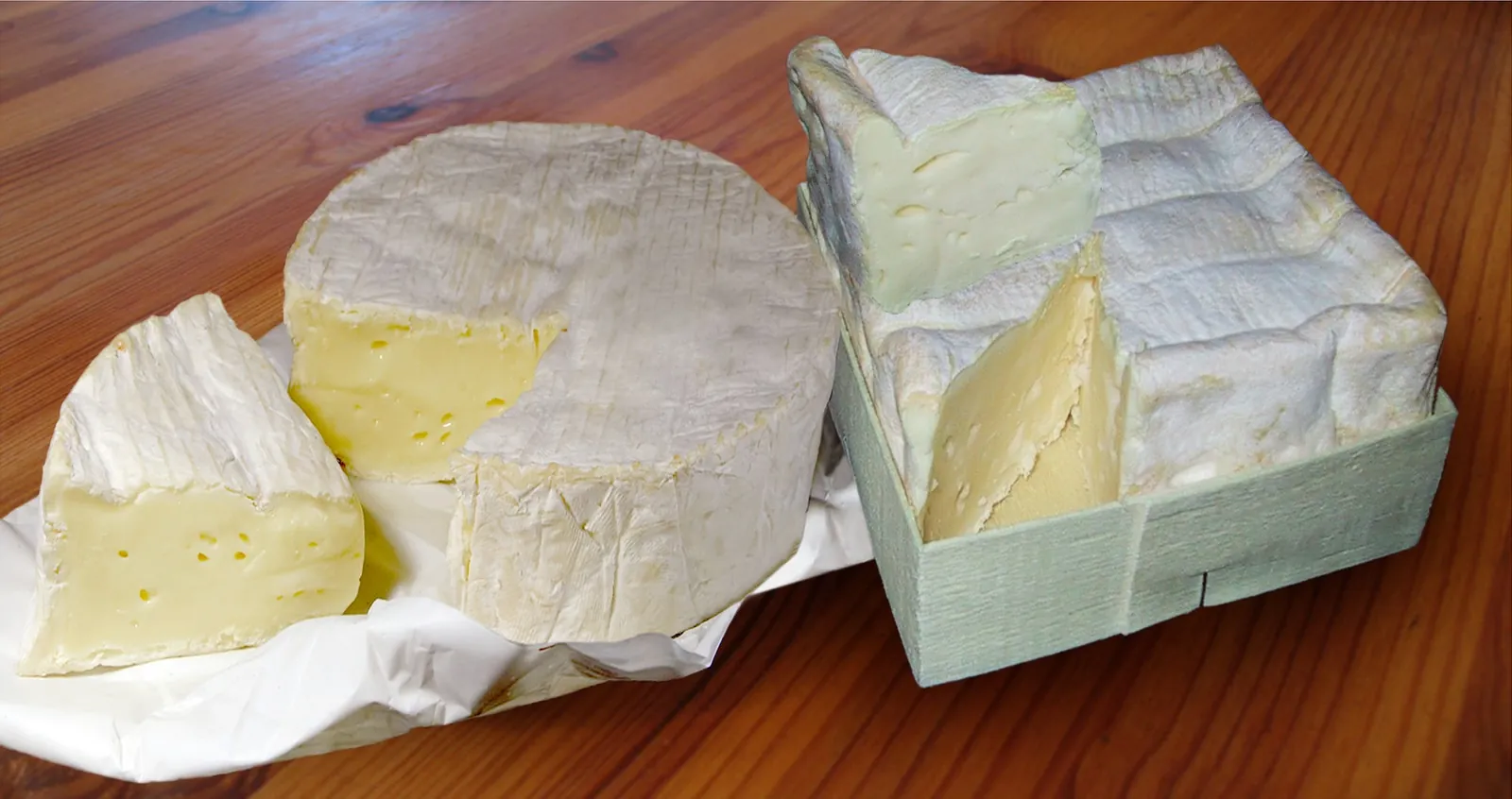
One is bloomy and mild, two are washed-rind and loud, and the fourth is a heart-shaped cousin of Camembert.
Each one has a protected name, which is why a Normandy cheese tastes different from the generic version of the same style. For the wider picture, see the French cheese guide and the France country page.
Normandy cheeses at a glance
This table of Normandy cheeses compares the four by style and size.
| Cheese | Style | Typical size | Ripening | Try it with |
|---|---|---|---|---|
| Camembert de Normandie | Bloomy rind, raw milk | about 4 in (10.2 cm) wide, about 9 oz (250 g) | at least 3 weeks | Baguette, tart apples |
| Livarot | Washed rind, reed bands | about 16 oz (450 g) | 6 to 8 weeks | Dry cider, pears |
| Pont-l'Évêque | Washed rind, square | about 4 in (10 cm) per side, about 14 oz (400 g) | 4 to 6 weeks | Cider, crusty bread |
| Neufchâtel | Bloomy rind, several shapes | 100 g to 600 g | 8 to 10 weeks | Apples, walnuts |
Camembert de Normandie
Camembert de Normandie is the region's best known cheese and the only camembert with a protected name. The AOC version must be made from raw milk of Normande cows, and the curd is ladled into low cylindrical molds. It dates as an appellation to 1983, and at least three weeks of ripening are required. AOC cheese is only an estimated 10 percent of all camembert made.
Our Camembert page has the full rules and the US buying advice. The short version is that a pasteurized "camembert" from a supermarket is a different cheese, milder and more uniform. Our Brie vs. Camembert comparison explains the difference between the two famous rounds.
Livarot
Livarot is a washed-rind cow's milk cheese from Normandy, nicknamed "the Colonel" because the reed bands around it look like the stripes on a colonel's uniform. The bands are three to five rings of dried reedmace, or sometimes green paper. The orange rind comes partly from annatto and from bacteria, and the cheese ripens for six to eight weeks.
It smells strong and tastes savory and meaty, and the smell is usually bolder than the flavor, so a small first taste is a safe way in. Our Livarot page covers it in depth. Livarot received its AOC in 1975.
Pont-l'Évêque
Pont-l'Évêque is a square, washed-rind cow's milk cheese that has been made in Normandy since at least the 12th century. The AOC was recognized on August 30, 1972. It is about 4 inches on a side and weighs around 14 ounces.
It is the gentler of the two Normandy washed rinds, so it is the one to start with if Livarot sounds like too much. Serve it in thin slices with the rind on, since the rind carries much of the savory flavor. See the Pont-l'Évêque page. Only about 2 percent of production is fermier, or farm made, so most of what you find is dairy-made.
Neufchâtel
Neufchâtel is a bloomy-rind cow's milk cheese with a dry white edible rind, made in six shapes: Carré (square), Briquette (brick), Bondon (plug), Cœur (heart), Double bonde and Grand cœur. Its AOC was granted on May 3, 1969, and it ripens for 8 to 10 weeks.
William Lawrence created American cream cheese in 1872 by adding cream to a Neufchâtel recipe. American "Neufchâtel" in the dairy case is a reduced-fat cream cheese and a different product. Real Neufchâtel is a ripened cheese, mushroomy and slightly salty. See cream cheese for the American product.
Buying Normandy cheeses in the US
Buying Normandy cheeses in the US is trickier for the raw-milk ones, because raw-milk cheese must be aged at least 60 days to be sold here, as our raw-milk cheese page explains. A raw-milk Camembert de Normandie that leaves France at three weeks cannot be imported at that age. Expect pasteurized versions, or older ones, and ask your cheesemonger which you have.
Check the cut before you pay, because ripeness varies a lot from one wedge to the next. A ripe soft cheese gives under a finger and the rind is intact, with no ammonia smell and no wet slime. For washed rinds, an orange rind that is tacky but not weeping is right.
How to serve Normandy cheeses with cider
How to serve Normandy cheeses starts with the temperature: take them out of the fridge 30 to 60 minutes ahead. Normandy is apple country, and dry cider is the classic drink, since its acidity cuts through the cream. Our cider and cheese guide covers styles. Crisp apples, pears, walnuts and a baguette are all the plate needs.
Normandy cheese mistakes that cost you flavor
Normandy cheese mistakes are mostly timing. Buying a soft cheese too young leaves a chalky center, and keeping it too long turns it ammoniated. Wrapping washed rinds in plastic traps the smell, so use cheese paper or a loosely closed container. Cutting the rind off Camembert or Pont-l'Évêque removes much of the flavor; our rind guide says which rinds to eat.
Questions about Normandy cheeses
These questions about Normandy cheeses come up most often.
What cheeses are from Normandy?
Normandy cheeses include Camembert de Normandie, Livarot, Pont-l'Évêque and Neufchâtel, all made with cow's milk.
Which Normandy cheese is the smelliest?
The smelliest Normandy cheese is usually Livarot, though Pont-l'Évêque is similar in style and a little milder.
Is Neufchâtel the same as cream cheese?
Neufchâtel in France is a ripened bloomy-rind cheese, while American Neufchâtel is a reduced-fat cream cheese.
What drink goes with Normandy cheeses?
The classic drink with Normandy cheeses is dry Normandy cider, and apple brandy (Calvados) is the traditional after-dinner partner.
Can you buy real Camembert de Normandie in the US?
Real Camembert de Normandie is hard to find in the US as raw milk, because the 60-day aging rule applies, so check the label and ask.
Where to start with Normandy cheeses
Start with a Camembert de Normandie and a Pont-l'Évêque, buy them a few days before you plan to serve them, and serve both ripe with dry cider and apples, and add Livarot once you want something stronger.
Sources
- Camembert de Normandie, Wikipedia
- Livarot cheese, Wikipedia
- Pont-l'Évêque cheese, Wikipedia
- Neufchâtel cheese, Wikipedia
- 21 CFR Part 133: Cheeses and Related Cheese Products, Electronic Code of Federal Regulations