
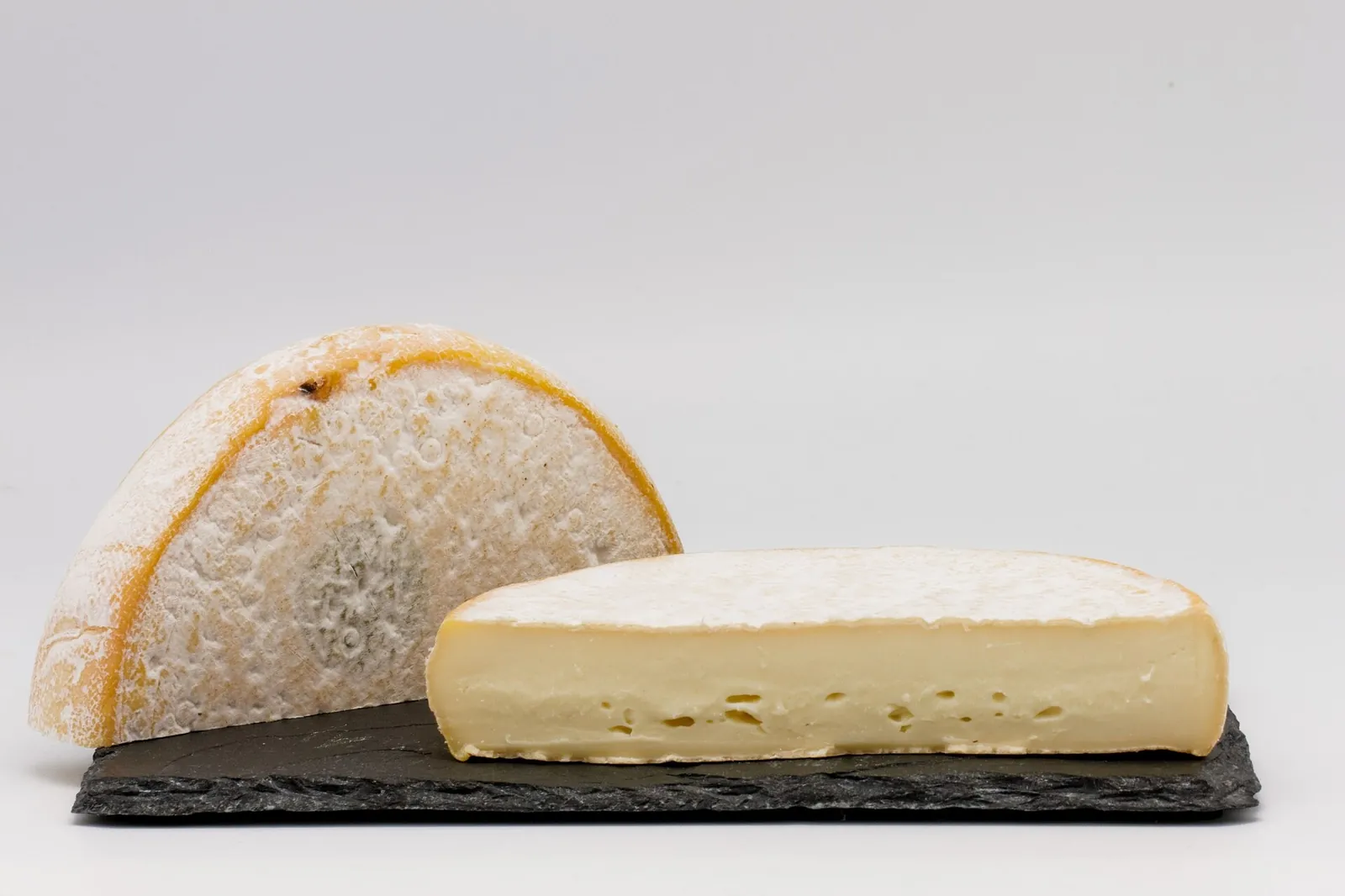
Its paste is supple and creamy, its rind is a saffron-yellow skin with a thin white bloom, and it is best known as the cheese melted over potatoes in tartiflette.
The wheel is small, about a pound, and it is meant to be eaten young, soft and slightly sticky. That is also the reason it is rare in the US, which the buying section explains.
Reblochon cheese at a glance
This is Reblochon cheese at a glance, taken from the Reblochon producers' site and the national dairy PDO body.
| Detail | Reblochon |
|---|---|
| Milk | Raw whole cow's milk (Abondance, Montbéliarde, Tarine breeds), never above 37 C (99 F) |
| Made in | Haute-Savoie and Savoie, France |
| Protected name | AOC 1958; EU AOP (Reblochon or Reblochon de Savoie) |
| Style | Pressed, uncooked, soft |
| Aging | At least 18 days, up to 35 to 40 for farmhouse wheels |
| Wheel | About 500 g (1 lb), 13 to 14 cm wide; a 250 g small size exists |
| Flavor | Hot milk, hazelnut, peanut, a little animal |
Where Reblochon cheese comes from
Reblochon cheese comes only from the Savoie mountains, and the name has been protected for decades: the product sheet of the French dairy PDO body dates the designation to 1958. The producers' site traces the cheese to the 13th century and counts 620 farms in the zone. Its story of the name is a good one, involving farmers who held back some milk from the landlord's count.
There are two kinds. Farmhouse (fermier) cheese is made after a single herd's milking, and dairy-made (laitier) cheese uses milk from several farms. A small plaque of casein pressed into the rind tells you which: green for farmhouse, red for dairy. The guide to PDO and PGI labels explains what the protected name promises.
How Reblochon is made
Reblochon is made from whole raw milk, set with rennet, and the curd is pressed but never cooked. The cheeses are then rubbed and turned in a cool cellar, which builds the orange rind. Because the curd stays moist and the aging is short, the paste stays soft instead of turning firm like its Alpine neighbors Beaufort or Abondance. The Alpine cheeses guide shows where it sits in the family.
The fat content is around 27 percent of the whole cheese according to the producers, which is low for a cheese this creamy.
What Reblochon cheese tastes like
Reblochon cheese tastes mild to medium: the official tasting notes list hot milk, hazelnut and peanut with a faint barnyard edge. The paste is ivory, smooth and a little elastic. Eaten young it is milky and sweet; with another week or two in the cellar the rind gets more savory and the center runs softer. The thin rind is edible and carries most of the earthy character.
How to buy Reblochon cheese in the US
Buying Reblochon cheese in the US is hard, because genuine AOP Reblochon is raw milk aged only weeks, and FDA rules want raw-milk cheese cured at least 60 days. Real wheels are generally not sold here. A "Reblochon" in a US shop is likely a pasteurized version made elsewhere, so read the label for the AOP seal and the casein plaque. Ask a cheesemonger for a Reblochon style, or go straight to the substitutes below.
How to serve and cook with Reblochon cheese
Serve Reblochon cheese at room temperature, after about an hour out of the fridge, so the paste is soft and the rind smells of hazelnut instead of cold. A whole round on a board with walnuts, apple and crusty bread needs nothing else.
Cooking is where it earns its name. Cut the round in half through the middle, lay the halves rind side up on potatoes, onions and bacon, and bake. The Reblochon and tartiflette page has the full recipe with a US-friendly swap. Reblochon also melts well on a baked potato or toasted open sandwich.
What to serve with Reblochon cheese
What to serve with Reblochon cheese follows the Savoie table: potatoes, lardons and crusty bread, with apple, grapes or walnuts for the board. A white from Savoie such as Chignin suits it, and Pinot Noir works if you want red. Saison, amber ale and brown ale all handle the creamy paste. The pairing guide has more to try.
Substitutes for Reblochon cheese
The best substitutes for Reblochon cheese are Taleggio and fontina, both of which melt as smoothly in a gratin. Taleggio is the closer match for rind and savor; fontina is milder and nuttier. Neither is identical, but either works in tartiflette. The substitute finder lists other options.
How to store Reblochon cheese
Store Reblochon cheese in its paper or wax paper in the lowest part of the fridge, and eat it within about a week of buying, since it is young and keeps ripening. Do not wrap it tightly in plastic, which traps moisture on the rind. The storing cheese guide covers wraps.
What most Reblochon advice gets wrong
Most Reblochon advice gets two things wrong.
Reblochon is not a stinky cheese
Reblochon is not a stinky cheese, despite the orange rind, because the aging is short and the official notes call it medium intensity. If a wheel smells of ammonia, it is overripe.
Cut the rind off before baking is a mistake
Cutting the rind off before baking is a mistake: the rind crisps in the oven and holds the halves together, so lay the cut side down on the potatoes with the rind up.
Questions about Reblochon cheese
These are the questions about Reblochon cheese that come up most.
Is Reblochon cheese the same as Taleggio?
Reblochon cheese is not the same as Taleggio: Reblochon is French and made from raw cow's milk, while Taleggio is an Italian washed-rind cheese, though both melt well.
Is Reblochon cheese made from raw milk?
Reblochon cheese is made from raw milk under its AOP, which is why genuine wheels are not sold in the US.
Can you eat the rind on Reblochon cheese?
You can eat the rind on Reblochon cheese, and most people do, since it is thin and carries the hazelnut and earthy flavor.
What is Reblochon cheese used for?
Reblochon cheese is used mostly for tartiflette, the Savoie gratin of potatoes, onions and bacon, and it also works on a cheese board.
Your first Reblochon cheese
For your first Reblochon cheese, bake a round or its closest substitute over potatoes, then taste a piece raw with a walnut. If you cannot find Reblochon, start with Taleggio.
Sources
- Reblochon de Savoie, Syndicat interprofessionnel du Reblochon
- Reblochon de Savoie AOP/AOC specifications, Syndicat interprofessionnel du Reblochon
- Reblochon PDO, French dairy PDO interprofession (CNAOL)