
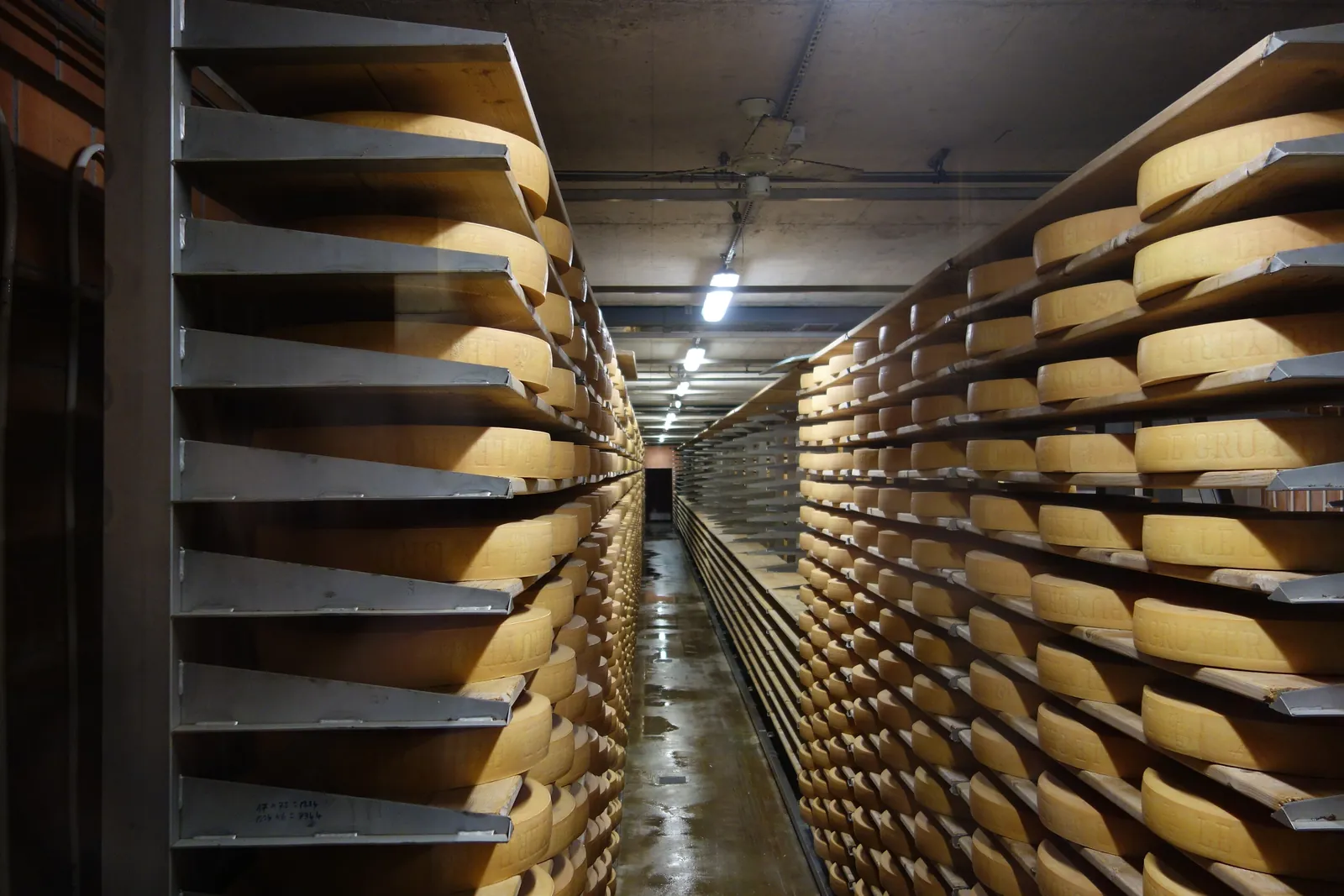
Gruyère, Comté, Beaufort and Emmentaler define the style, and Fontina, Montasio, Raclette and the Bergkäse of Austria and Germany fill out the family.
The method came before the map. The Comté interprofession says the whole point of its recipe is a big cooked and pressed wheel that keeps a long time. That is why a Wisconsin cheese can be Alpine in style, and why the word describes a way of making cheese more than an address.
Alpine cheese at a glance
This table shows the main Alpine cheese names at a glance, with the protection each carries and the rule that matters most at the counter.
| Cheese | Country | Protected name | Style | Key rule | Use it for |
|---|---|---|---|---|---|
| Le Gruyère | Switzerland | AOP (2001) | Cooked, pressed, 55 to 88 lb | Raw milk, 5 to 18 months | Fondue, onion soup, gratins |
| Emmentaler | Switzerland | AOP | Cooked, pressed, big holes | Made only in Switzerland | Fondue, sandwiches |
| Sbrinz | Switzerland | AOP (2002) | Extra-hard, up to 99 lb | 600+ liters of raw milk per wheel | Grating, shaving |
| L'Etivaz | Switzerland | AOP (2000) | Hard, made on alpine pastures | Made only May 10 to October 10 | Snacking, fondue |
| Raclette du Valais | Switzerland | AOP (2007) | Semi-hard, about 11 lb | Raw milk, 3 months minimum | Raclette |
| Comté | France (Jura) | AOP | Cooked, pressed, about 88 lb | 4 months minimum | Snacking, fondue, gratins |
| Beaufort | France (Savoie) | AOP | Cooked, pressed, concave rind | 5 months minimum | Gratins, snacking |
| Abondance | France (Haute-Savoie) | AOP | Semi-cooked, about 22 lb | 100 days minimum | Snacking, tartiflette swap |
| Reblochon | France (Savoie) | AOP | Uncooked, soft, about 1 lb | 18 days minimum | Tartiflette |
| Tomme de Savoie | France (Savoie) | IGP | Uncooked, 2.6 to 4.4 lb | 4 weeks minimum | Everyday table cheese |
| Fontina | Italy (Aosta Valley) | DOP | Semi-cooked | One milking, Valdostana cows | Fonduta, melting |
| Montasio | Italy (Friuli, Veneto) | DOP | Cooked | Sold medium or well aged | Frico, grating |
| Asiago | Italy (Veneto, Trentino) | DOP | Semi-cooked | Fresh or aged types | Sandwiches, grating |
| Bergkäse | Austria, Germany | PDO (several) | Cooked, pressed | Raw milk, no silage | Käsespätzle, snacking |
What makes a cheese Alpine
What makes a cheese Alpine is a method built for mountain dairies: cook the curd, press it into a big wheel, salt it, and give it months. Heating the curds drives out whey, and a drier, larger wheel lasts longer. Austria's Vorarlberger Bergkäse heats its curd to about 124 to 127°F (51 to 52.5°C), while the rules for semi-cooked Fontina ask only for more than 97°F (36°C).
Size follows. A wheel of Comté takes 400 liters (about 106 gallons) of milk and weighs around 88 pounds (40 kg), and a 99-pound (45 kg) Sbrinz needs a little over 600 liters. Those wheels then age: at least 4 months for Comté, with some kept 12, 18 or 24 months, and well over a year for Sbrinz.
The feed rules come next, and they are strikingly similar. Comté, Sbrinz, Raclette du Valais and Vorarlberger Bergkäse all ban silage, most protected Alpine cheeses use raw milk, and producers credit the grass and hay for much of the flavor.
The last ingredient is altitude. Beaufort Chalet d'alpage must be made in mountain chalets above 1,500 m (about 4,900 feet) with the milk of a single herd, and L'Etivaz AOP is made only from May 10 to October 10, on summer pastures between 1,000 and 2,000 m, in copper kettles heated over a wood fire.
Swiss Alpine cheese and the legal meaning of Alp
Swiss Alpine cheese is where the word itself gets legal teeth, because Swiss law decides who may print "Alp" on a label. Under the federal Mountain and Alp Designations Ordinance, a food may be called "Alp" only if its raw materials come from the summer grazing area and it is made there; for cheese, only the ripening may happen down in the valley. "Berg" (mountain) is the looser tier, covering mountain farming zones, and even the word "Alpen" may go on a dairy product only if it meets one of the two standards.
That law explains the alp cheeses you may see from Switzerland. Berner Alpkäse AOP is made daily from raw milk during the summer grazing season in the Bernese Oberland, in copper kettles heated by wood, and its best wheels are dried into thin-shaved Hobelkäse. Raclette du Valais AOP comes only from the canton of Valais, from raw milk, with no silage and at least 3 months of aging; cheese was already being melted there in 1574.
The headliners are Le Gruyère AOP, made mainly in Fribourg, Vaud, Neuchâtel, Jura and parts of Bern, and Emmentaler AOP, the holey one. One surprise: Appenzeller, for all its fame, does not appear on the Swiss register of protected designations at all.
French Alpine cheeses
French Alpine cheese comes from two mountain ranges, the Jura and the Savoie Alps, which means Comté is not technically from the Alps at all. Comté is made in the Jura massif, in about 140 village dairies, only from Montbéliarde and French Simmental cows. Each producer needs at least 3.2 acres (1.3 hectares) of forage per cow, and each dairy collects milk within a circle 25 km (about 16 miles) across.
Beaufort is the high-mountain wheel of the Beaufortain, Tarentaise, Maurienne and Val d'Arly: raw milk from Tarine and Abondance cows, wheels around 88 pounds (40 kg) with a concave rind, at least 5 months of aging and a fruity, floral flavor. Look for the summer versions, Beaufort d'été and Beaufort Chalet d'alpage.
Abondance is smaller, about 22 pounds (10 kg), and semi-cooked, with fruity notes the producers compare to hazelnut, pineapple or citrus. Savoie also protects uncooked cheeses that belong to the Alpine family without the cooked-curd method: Reblochon, a soft 1-pound disk aged at least 15 days; Tomme de Savoie, with "Savoie" marked on the rind; and Raclette de Savoie, a 13-pound (6 kg) melting wheel.
Italian, Austrian and German Alpine cheeses
Italian Alpine cheese runs along the southern slopes of the range, and each name is a protected DOP in the EU geographical indications register. Fontina comes only from the Aosta Valley, made from whole milk of a single milking from the local Valdostana breed, with the curd semi-cooked. Montasio takes its name from a mountain group in the Julian Alps and is made across Friuli Venezia Giulia and part of the Veneto, sold both medium and well aged. Asiago, named for the Asiago plateau, comes in two types: a mild pressed one (pressato) from whole milk and a more mature one from partly skimmed milk.
Bergkäse simply means "mountain cheese." The EU protects three: Allgäuer Bergkäse from Germany and Tiroler and Vorarlberger Bergkäse from Austria. Vorarlberger Bergkäse is typical: raw milk from herds fed no silage, wheels of 18 to 77 pounds (8 to 35 kg) with pea-size eyes, rinds rubbed with brine, and ready at 3 to 6 months at the earliest.
American Alpine-style cheese
American Alpine-style cheese borrows the method without the mountain, and in the US the word carries no legal weight: none of the FDA's cheese standards of identity use the word "Alpine" at all. That makes the shopper's job simple. Read the label for milk type, age and maker rather than trusting the word.
The benchmark is Pleasant Ridge Reserve from Uplands Cheese in Dodgeville, Wisconsin, which the American Cheese Society named Best of Show in 2001, 2005 and 2010, describing it as made in the style of the mountain cheeses of the French Alps. It belongs on any board next to Beaufort or Comté.
How to taste and cook with Alpine cheese
Alpine cheese rewards a side-by-side tasting more than almost any other style. Buy two ages of the same name, such as a young and an old Comté or Gruyère, and let them sit out for 30 to 60 minutes before serving. The younger piece tastes of butter and cooked milk; the older one turns brothy, nutty and sometimes crunchy with tiny crystals.
In the kitchen, match the cheese to the dish:
- Fondue: Gruyère with Emmentaler or Vacherin Fribourgeois.
- Raclette: Raclette du Valais or Raclette de Savoie, melted and scraped over boiled potatoes. The raclette guide covers the gear.
- Tartiflette: Reblochon, rind and all, over potatoes, onions and bacon.
- Gratins and onion soup: Comté or Beaufort, which brown well and keep their flavor.
- Fonduta and frico: melt Fontina into warm milk and egg yolk for fonduta; crisp grated Montasio in a hot pan for frico.
For drinks, dry whites, light reds and dry cider all work, and an aged wheel can handle a nutty sherry.
What most Alpine cheese guides get wrong
Most Alpine cheese guides treat "Alpine" as a place, a recipe and a guarantee, and it is not reliably any of the three.
It is not always from the Alps. Comté comes from the Jura, and Pleasant Ridge Reserve comes from Wisconsin.
It is not always cooked and pressed. Reblochon, Tomme de Savoie and Raclette de Savoie are uncooked; Abondance and Fontina are semi-cooked. They still belong to the mountain family.
The season is on the label if you know where to look. Beaufort d'été, Beaufort Chalet d'alpage, L'Etivaz and any Swiss cheese called "Alp" are summer cheeses by rule. In a US store, "Alpine blend" or "Alpine-style" carries no legal promise.
Raw milk matters to some eaters. Most protected Alpine cheeses are made from raw milk. The CDC advises people who are pregnant, adults 65 and older, and anyone with a weakened immune system to avoid cheese made from raw milk, and it lists pasteurized hard cheeses such as Swiss and Gruyère among the safer choices.
Questions about Alpine cheese
Here are short answers to the most common questions about Alpine cheese.
What is Alpine cheese?
Alpine cheese is a mountain cheese from the Alps or the Jura, usually a large, firm wheel of cow's milk with cooked and pressed curd, aged for months. Gruyère, Comté and Beaufort are the best-known examples.
What does Alpine cheese taste like?
Alpine cheese tastes nutty, buttery and savory when young, then brothy, fruity and sometimes sharp with age. Long-aged wheels often have crunchy crystals.
What is a nutty Alpine cheese?
The nuttiest Alpine cheeses are Comté, Gruyère and Beaufort, especially past 12 months. Pleasant Ridge Reserve is the American pick.
What is Swiss Alpine cheese called?
Swiss Alpine cheese goes by many names, chiefly Le Gruyère, Emmentaler, Sbrinz, L'Etivaz, Berner Alpkäse and Raclette du Valais. On Swiss labels, "Alp" means the cheese was made on summer pastures.
What are the main French Alpine cheeses?
The main French Alpine cheeses are Comté, Beaufort, Abondance, Reblochon, Tomme de Savoie and Raclette de Savoie. Comté comes from the Jura; the rest come from Savoie.
What is Alpine cheese similar to?
Alpine cheese is similar to aged Gouda in its nutty sweetness, but it is usually firmer, less caramel-like and more savory. Within the family, Comté and Gruyère can stand in for each other.
Choosing your first Alpine cheese
Choosing your first Alpine cheese is easiest with one rule: start with a protected name and a stated age. A Comté aged 12 to 18 months or a young Gruyère is the safest first wedge, Beaufort is the step up, and Raclette is the one to buy for a party. Taste two ages side by side, then cook with the younger one.
Sources
- Verordnung über die Verwendung der Bezeichnungen Berg und Alp (Berg- und Alp-Verordnung, SR 910.19), Swiss Federal Council via Fedlex
- eAmbrosia, the EU geographical indications register, European Commission
- Register of the Swiss designations of origin and geographical indications, Swiss PDO-PGI Association
- Portrait d'un grand fromage, Comté interprofession (CIGC)
- AOP Beaufort, Les Fromages de Savoie
- 21 CFR Part 133, Cheeses and Related Cheese Products, Electronic Code of Federal Regulations
- 2010 ACS Judging and Competition Winners, American Cheese Society
- Preventing Listeria infection, Centers for Disease Control and Prevention
- The Reblochon PDO: specifications, Syndicat Interprofessionnel du Reblochon