
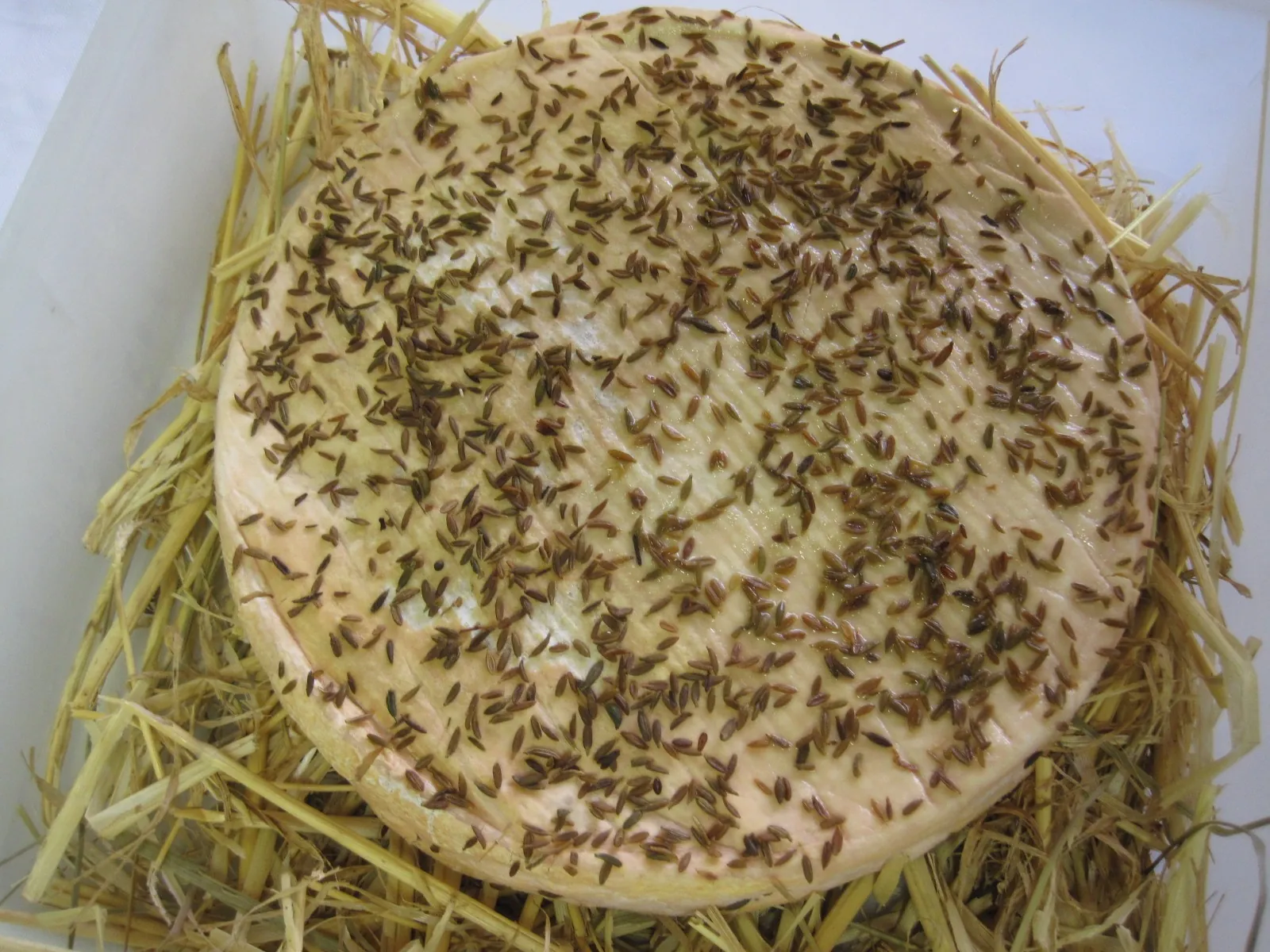
Under the orange rind the paste is creamy, savory and a little tangy, not the barnyard bomb the aroma promises.
The smell comes from the rind. Washing it with brine in humid rooms feeds the red surface bacteria that give Munster its color and its stink, while the inside stays gentle. If the smell has kept you away, this is one of the friendlier cheeses to start with.
Munster cheese: origin and the AOP
Munster cheese is made in seven French departments across Alsace and Lorraine: Bas-Rhin, Haut-Rhin, Haute-Saône, Meurthe-et-Moselle, Moselle, Territoire de Belfort and the Vosges, according to the French Ministry of Agriculture. It received its AOC in 1969 and the European AOP in 1996, under the full name Munster-Géromé, which covers the Alsace side (Munster) and the Lorraine side (Géromé) of the range.
The milk comes from cows raised in grassy country, with the Vosgienne breed named in the ministry text, and the flavor carries some of that pasture. Production peaks from June to November. The AOP specification sets three sizes and a minimum maturation of 14 or 21 days depending on the format, as Know the Cheese summarizes it.
The guide to PDO and PGI labels explains what the seal means. American Muenster is a different, much milder cheese, covered in Muenster vs Munster.
How Munster cheese is made
Munster cheese goes back centuries in the Vosges: by the 17th century, production centered on two places, Gérardmer in Lorraine and Munster in Alsace, which is where the two names come from. It is a soft-paste cheese with a washed rind, ripened in humid conditions from acidified curd, the ministry says. After the curd is molded and salted, the young rounds go into damp cellars where they are washed with brine and turned regularly. The washing keeps the surface moist and encourages the red-orange bacteria that make the cheese sticky and aromatic. The rind types guide shows how washed rinds differ from bloomy and natural ones.
Munster cheese by age
Munster cheese changes mostly in how far the softening has traveled. Young, it is firmer and cuts cleanly, with a mild, lactic flavor and a lightly salty rind. As it matures it softens first just under the rind, then evenly through the paste, and the savory, meaty notes and the smell deepen. At the age sold in the US it is soft and supple, and a ripe round sags slightly when pressed.
How to buy Munster cheese in the US
Buying Munster cheese in the US starts with the label: look for "Munster" or "Munster-Géromé" with the AOP mark, because a package that says only "Muenster" is usually the American cheese. Imported rounds are small, often 4 to 5 inches across in a wooden or paper box, and cheese sold in the US as raw-milk Munster would have to be aged 60 days, far past its usual age, so expect pasteurized milk and read the label.
Choose a round that is plump and evenly orange, not shrunken, cracked or leaking ammonia. A faint ammonia note means it is past its best. If the cheese counter will cut a wedge from a larger wheel, ask to smell it first.
How to serve and cook with Munster cheese
Serve Munster cheese at room temperature, after about an hour out of the fridge, so the paste turns creamy. The traditional plate is boiled potatoes, cumin or caraway seeds and rye bread. Cut a whole round like a cake so each slice has rind, softened paste and center.
It also cooks well. Slices melt over potatoes and onions, into a quiche or omelet, or onto a tart of bacon and onion. Because the rind is edible and part of the flavor, leave it on unless you dislike it.
What to serve with Munster cheese
What to serve with Munster cheese is mostly Alsace: Gewürztraminer, Pinot Gris and Riesling, whose fruit and slight sweetness stand up to the smell. Belgian dubbel, saison and bock work among the beers. Grapes, apples and walnuts give freshness, and cumin seeds, boiled potatoes and rye bread are the classic extras. The pairing guide lists more matches, and the beer and cheese guide covers the beer side.
Substitutes for Munster cheese
Substitutes for Munster cheese are other soft, washed-rind cheeses. Époisses is the closer match: stronger, wetter and more intense. Taleggio is the easier one to find, a little milder and fruitier. For a melting job both work. The substitute finder shows more options.
Storing Munster cheese
Store Munster cheese in its own paper or wax paper in a lidded container in the fridge, so the smell stays off other foods. Keep the fridge at or below 40°F (4°C), the FDA figure quoted by Know the Cheese, and use an opened round promptly. The storing cheese guide covers wraps.
What most Munster advice gets wrong
Most Munster cheese advice repeats two habits that sell the cheese short.
The smell is not the taste
The smell of Munster is not a warning about the taste. The ministry calls it milder than it seems and refined, and the stink lives on the rind, so a mature round can be quite gentle inside. Taste a small piece before you decide.
A cold round is a flat round
A cold Munster is a flat Munster, because chill firms the paste and mutes the savory notes. Give it an hour on the counter.
Questions about Munster cheese
These are the questions about Munster cheese that come up most.
Is Munster cheese the same as Muenster?
Munster cheese is not the same as Muenster: Munster is the French protected washed-rind cheese, while Muenster is a mild American semi-soft cheese. The two share a name and a history, but nothing else.
Can you eat the rind of Munster cheese?
You can eat the rind of Munster cheese, because it is a natural washed rind and part of the flavor. Leave it if the taste is too strong for you.
Why does Munster cheese smell so strong?
Munster cheese smells strong because brine washing in humid rooms feeds the surface bacteria that color and scent the rind. The paste inside is far milder.
What does Munster cheese taste like?
Munster cheese tastes savory, tangy and a little meaty, with a soft, creamy paste. Younger rounds are milder, and older ones deepen.
How long does Munster cheese last?
Munster cheese lasts a short time once ripe: finish an opened round promptly and watch for a sharp ammonia smell, which means it is past its best.
Your first Munster cheese
For your first Munster cheese, buy a small AOP round, let it warm up for an hour, and eat it with boiled potatoes, cumin and a glass of Riesling or Gewürztraminer.
Sources
- Le Munster-géromé AOP, French Ministry of Agriculture
- Munster Cheese: PDO, Ripeness, and Storage, Know the Cheese
- Munster cheese, Wikipedia