
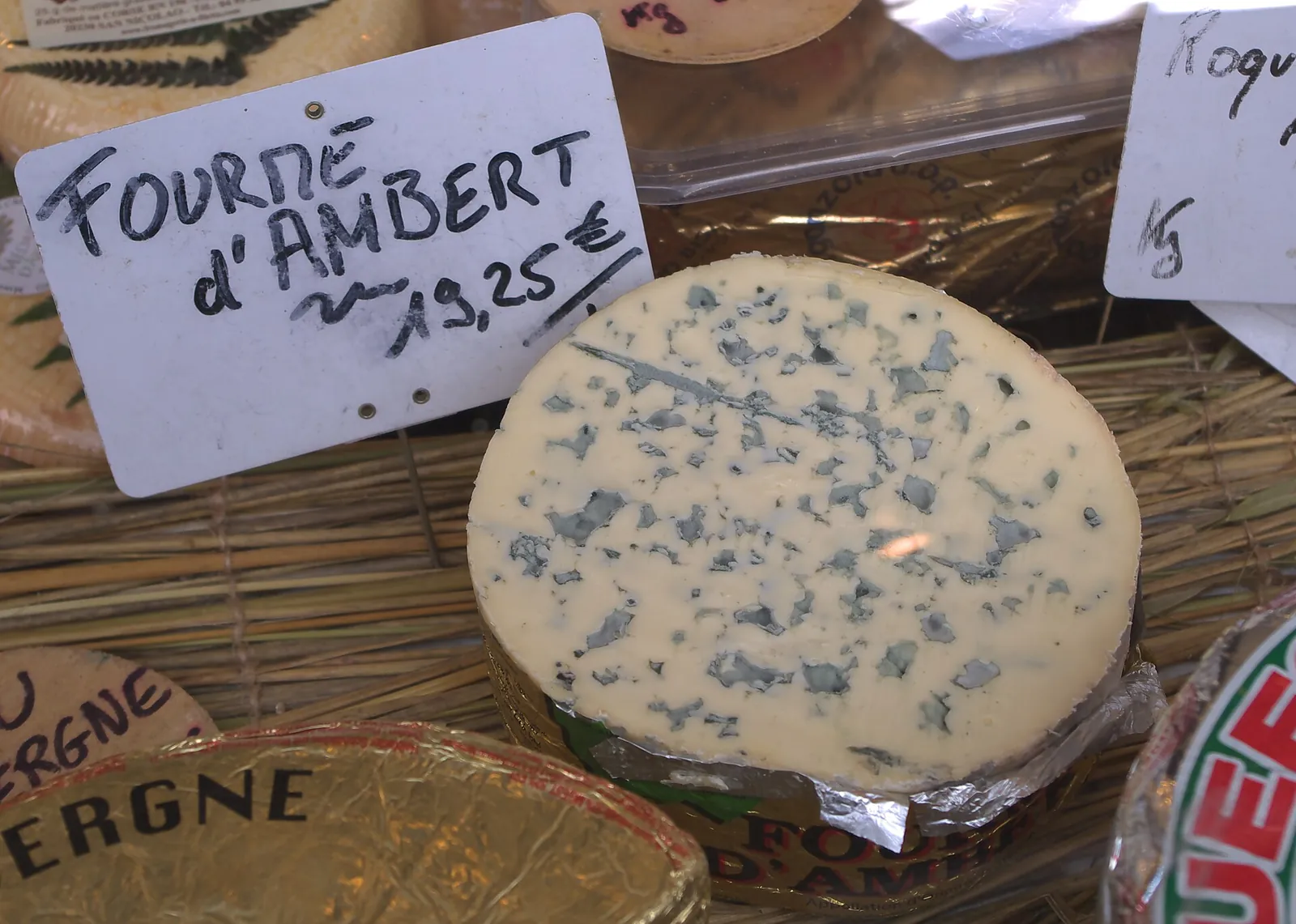
Two are firm and pressed, one is semi-soft and earthy, and two are blues, one sharp and one mild.
Most are made from milk of cows grazing mountain pasture, and the style leans rustic. This page compares the five and says what to buy. For the whole country, see the French cheese guide and the France country page.
Auvergne cheeses at a glance
This table of Auvergne cheeses compares the five.
| Cheese | Style | Aging | Protected name | Best use |
|---|---|---|---|---|
| Cantal | Firm, pressed | Jeune at least 30 days; entre-deux in between; vieux at least 8 months | AOC 1956 | Melting (young), board and grating (old) |
| Salers | Firm, pressed, raw milk | 3 months to as long as 45 | AOC 1961 | Board, grating |
| Saint-Nectaire | Semi-soft, washed natural rind | at least 28 days | AOC 1955 | Board, melting over potatoes |
| Bleu d'Auvergne | Moist blue | about 4 weeks | AOC 1975 | Board, salads, sauces |
| Fourme d'Ambert | Mild blue, tall cylinder | at least 28 days | AOC 2002 | Board, with honey or pears |
Cantal is sold at three ages: jeune, aged at least 30 days, entre-deux in between, and vieux, aged at least 8 months.
Cantal
Cantal is a large, firm, raw-milk-capable cow's cheese that is one of the oldest in France, and it comes in three ages. Young Cantal is milky and mild and melts well. Aged Cantal is sharper and drier, better for a board or grating. See the Cantal page for the AOP rules and cooking.
A good rule: buy jeune for sandwiches and sauces, and vieux when you want something to eat with fruit and wine. The middle age, entre-deux, is the all-rounder, firm enough to slice and still mild enough for a grilled sandwich, so it is the one to pick if you are buying a single wedge and have not decided how to use it.
Salers
Salers is the Cantal's mountain cousin, and it is made only between April 15 and November 15, from raw milk, traditionally in a wooden vessel called a gerle. The wheel weighs about 40 kilograms (88 pounds), and the AOC dates from 1961. Aging runs from three months to as long as 45.
The summer pasture shows in a grassy, tangy flavor. Salers is rarer than Cantal in the US, so ask a good cheese counter, and expect it to cost more because of the long aging. The 60-day rule explained on our raw-milk cheese page is not a problem for it, since it ages longer than that.
Saint-Nectaire
Saint-Nectaire is a semi-soft cow's milk cheese aged on rye straw, with a mottled natural rind. The standard size is 20 to 24 cm wide, with a minimum of 28 days of aging, though five to six weeks is typical. Its AOC dates from 1955.
The flavor is mushroom, hazelnut and cellar. The Saint-Nectaire page explains the fermier (raw milk, farm) and laitier (pasteurized, dairy) versions. It is the best Auvergne cheese for melting over boiled potatoes.
Bleu d'Auvergne
Bleu d'Auvergne is a moist cow's milk blue, and Antoine Roussel is credited with developing it in the mid-1850s after noticing that mold from rye bread created blue veining. It ages about four weeks in cool, damp cellars, and the AOC dates from 1975.
It is sharper than Fourme d'Ambert and creamier than Roquefort, which is sheep's milk. Our Roquefort page covers that one, and choosing blue cheese helps with picking a good wedge. It crumbles into salads and melts into a sauce for steak.
Fourme d'Ambert
Fourme d'Ambert is the mildest of the Auvergne blues, a tall narrow cylinder made from cow's milk and inoculated with Penicillium roqueforti. It ages at least 28 days and shared an AOC with Fourme de Montbrison from 1972 until 2002, when each got its own.
It tastes creamy and gently blue, not sharp. A drizzle of honey and a few walnuts are all it needs, and it is the one to hand to someone who says they do not like blue cheese. For pairing ideas, see the blue cheese pairing guide.
Buying Auvergne cheeses in the US
Buying Auvergne cheeses in the US works best at a counter that cuts to order. Cantal and Saint-Nectaire are the easiest to find, Bleu d'Auvergne appears at larger shops, and Fourme d'Ambert and Salers are the hardest. Look for the AOP name on the rind label or the wrapper. Ask for a taste before you commit to a large piece, since a counter will usually cut a sample without fuss. Age changes Cantal so much that two wedges can taste like different cheeses.
Auvergne cheese mistakes that cost you flavor
Auvergne cheese mistakes are mostly about age and temperature. Melting vieux Cantal makes it greasy, so use jeune. Serving a blue straight from the fridge mutes it, so give it 30 minutes. Cutting a Saint-Nectaire rind away removes the mushroom and cellar flavor, which is the point of the cheese. Storage matters too: wrap each wedge in cheese paper rather than plastic, and keep the blue away from the milder cheeses so the blue mold does not spread to them.
Questions about Auvergne cheeses
These questions about Auvergne cheeses come up most often.
What are the cheeses of the Auvergne?
The cheeses of the Auvergne are Cantal, Salers, Saint-Nectaire, Bleu d'Auvergne and Fourme d'Ambert, all made from cow's milk.
Which Auvergne blue cheese is mildest?
The mildest Auvergne blue cheese is Fourme d'Ambert, which is creamy and gently veined, so it suits people new to blue.
What is the difference between Cantal and Salers?
The difference between Cantal and Salers is the season and the milk: Salers is made only between April 15 and November 15 from raw milk.
Which Auvergne cheese melts best?
The Auvergne cheese that melts best is young Cantal, with Saint-Nectaire second.
Where to start with Auvergne cheeses
Where to start with Auvergne cheeses is simple: buy a wedge of Saint-Nectaire and a piece of Cantal, add Fourme d'Ambert if you like blue, and serve them with bread, walnuts and a glass of red. For wine ideas, see the wine and cheese pairing guide.
Sources
- Cantal cheese, Wikipedia
- Salers cheese, Wikipedia
- Saint-Nectaire cheese, Wikipedia
- Bleu d'Auvergne, Wikipedia
- Fourme d'Ambert, Wikipedia
- 21 CFR Part 133: Cheeses and Related Cheese Products, Electronic Code of Federal Regulations