
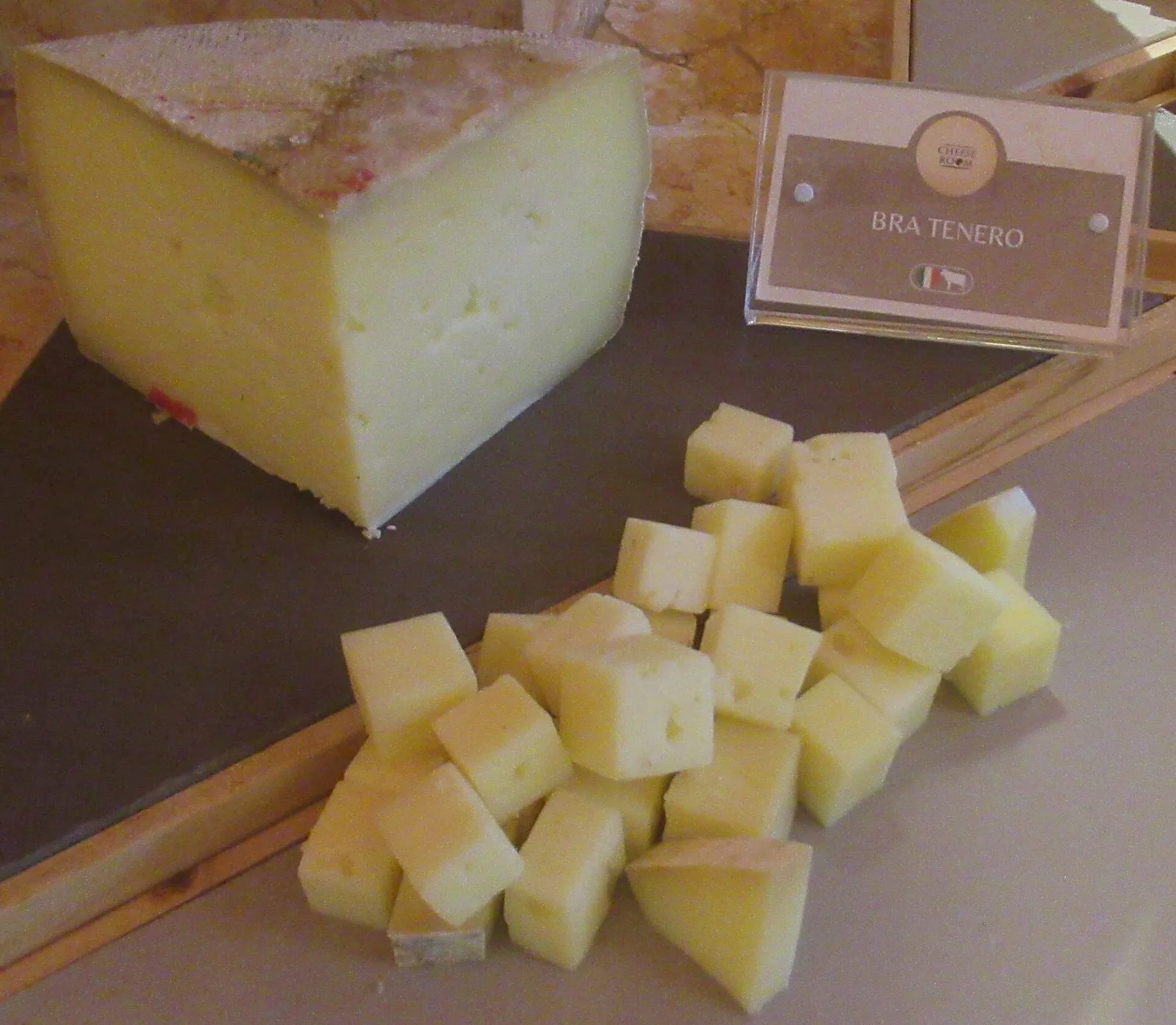
The big names are Castelmagno, Bra, Raschera, Toma Piemontese, Murazzano and Robiola di Roccaverano.
Most are made in small quantities and sold young or modestly aged, which makes them a good fit for a shopper who wants something different from the usual Italian hard cheeses. Several carry DOP status, the Italian form of the EU's protected designation of origin. For the wider picture, start with the Italian cheese guide or the Italy country page.
Piedmont cheeses at a glance
Piedmont cheeses at a glance, using details from the pages listed under Sources.
| Cheese | Milk | Texture | Aging | Protected |
|---|---|---|---|---|
| Castelmagno | Cow, raw, sometimes a little sheep or goat | Semi-hard, crumbly | 60 days minimum | DOP, 1996 |
| Bra | Mostly cow, small amounts of sheep or goat allowed | Tenero soft, Duro hard | Tenero 45 days, Duro six months | DOP |
| Raschera | Cow, small amounts of sheep or goat allowed | Semi-hard, elastic | 30 days or more | DOP, 1996 |
| Toma Piemontese | Cow | Soft to semi-hard, melts well | Varies | PDO |
| Murazzano | Sheep, at least 60% | Soft, small cylinder | At least 6 days | DOP, 1996 |
| Robiola di Roccaverano | Goat | Soft, no rind | Peak after about two weeks | DOP |
Castelmagno
Castelmagno is Piedmont's rarest and most prized cheese, made in three municipalities of the Valle Grana in the province of Cuneo: Castelmagno, Pradleves and Monterosso Grana. Its earliest known mention dates to 1277, when it was given as payment to the Marquis of Saluzzo.
It is made from raw cow's milk, aged at least 60 days, and crumbly rather than creamy. Young wheels are delicate and lightly salty; older ones turn strong. The full story is on the Castelmagno page. Melted over gnocchi or polenta is the classic use, and a few drops of honey on a plain wedge also works.
Bra and Raschera
Bra and Raschera are the everyday mountain cheeses of Cuneo, and both are semi-hard cow's milk wheels with small amounts of sheep or goat milk permitted.
Bra comes in two forms. Bra Tenero is the soft one, aged at least 45 days, and Bra Duro is the hard one, aged six months. Raschera is a 7 to 9 kg cylinder or square, aged 30 days or more, with an ivory interior dotted with small holes and a red-gray rind. It is savory and salty, a bit like Muenster, and moderately sharp when aged. If a label says Raschera "d'alpeggio," it was made in mountain pastures.
Use Tenero or young Raschera for the table, and Duro for grating or shaving over pasta.
Toma Piemontese
Toma Piemontese is the region's all-purpose cow's milk cheese, soft to semi-hard, with a fat content of 45 to 52 percent. It has PDO status and melts well.
That melt is the reason to buy it. Toma is the right choice for a fondue-style dish, a baked potato gratin or a grilled sandwich where you want mild and stretchy. Other tomas made in the Aosta Valley and elsewhere share the name but not the protection, so look for "Piemontese" on the label.
Robiola di Roccaverano and Murazzano
Robiola di Roccaverano and Murazzano are the two small cheeses of the Langhe hills, one made of goat's milk and one of sheep's milk.
Robiola di Roccaverano is made in the Langa Astigiana, in the province of Asti. According to the Slow Food Foundation, it has a minimum aging of four days, peaks after a couple of weeks, and tastes of yogurt, green grass and hazelnut when fresh, with spicy, musky notes when older. The broader robiola guide explains the wider family, including cow's milk robiolas that carry no protection.
Murazzano is a PDO from about 50 communes of the Alta Langa. The Cuneo provincial site says it is made from at least 60 percent sheep's milk, mainly from the native Pecora delle Langhe, and sells as a small cylinder weighing 300 to 400 grams. It ages at least six days, with the wheels washed daily in lukewarm water. The taste is delicate and fragrant.
Other Piedmont cheeses
Other Piedmont cheeses include Gorgonzola, which is made in Lombardy and Piedmont. The Gorgonzola page covers the dolce and piccante styles. Piedmont also produces many local tomas, robiolas and small farmhouse cheeses that rarely leave the region.
Buying Piedmont cheeses in the US
Buying Piedmont cheeses in the US is mostly a matter of luck and a good counter. Castelmagno and Raschera turn up at specialty cheese shops and Italian importers, and robiola and Gorgonzola are easier to find. Ask for the DOP name; the PDO and PGI guide explains why that matters.
Soft fresh cheeses like Robiola di Roccaverano are best bought close to the date you plan to eat them, since they are young cheeses meant to be eaten within weeks.
How to eat Piedmont cheeses
How to eat Piedmont cheeses comes down to a few classic partners: honey, hazelnuts, crusty bread, and the region's reds. Barolo and Barbaresco are the traditional match for aged cheeses and are guidance rather than a rule; the red wine and cheese guide covers how to choose.
A simple Piedmont board uses a young Raschera or Bra Tenero, a Toma, a robiola, and a wedge of Castelmagno, with honey and hazelnuts.
Piedmont cheese mistakes that cost flavor
Piedmont cheese mistakes that cost flavor are mostly about temperature and age. Cold cheese tastes flat, so take it out of the fridge about 30 minutes before serving. Do not treat "robiola" as one cheese, since the name covers fresh, bloomy and protected versions with very different tastes. And do not cook Castelmagno hard: melt it gently into a warm sauce.
Questions about Piedmont cheeses
These questions about Piedmont cheeses come up often.
What is Piedmont's most famous cheese?
Piedmont's most famous cheese is Castelmagno, a crumbly raw cow's milk DOP cheese from the Valle Grana, aged at least 60 days.
What is the difference between Bra Tenero and Bra Duro?
The difference between Bra Tenero and Bra Duro is age: Tenero is the soft one at a minimum of 45 days, and Duro is the hard one at six months.
Is Toma Piemontese the same as other toma cheeses?
Toma Piemontese is not the same as other toma cheeses, because it is the version with PDO protection. Other tomas, such as Toma di Gressoney, are recognized under a different traditional-product list.
What is Robiola di Roccaverano made from?
Robiola di Roccaverano is made from goat's milk in the Langa Astigiana, and the Slow Food presidium specifically promotes 100 percent goat's milk.
What is Murazzano cheese?
Murazzano cheese is a small DOP cheese made from at least 60 percent sheep's milk in the Alta Langa, weighing 300 to 400 grams.
Try Piedmont cheeses
To try Piedmont cheeses, begin with one hard wedge (Castelmagno or aged Raschera) and one fresh round (robiola), and pour a local red. Then explore the Sardinia and Sicily cheese guide for Italy's island side.
Sources
- Castelmagno cheese, Wikipedia
- Raschera, Wikipedia
- Bra cheese, Wikipedia
- Toma cheese, Wikipedia
- Murazzano PDO, Province of Cuneo
- Roccaverano Cheese, Slow Food Foundation