
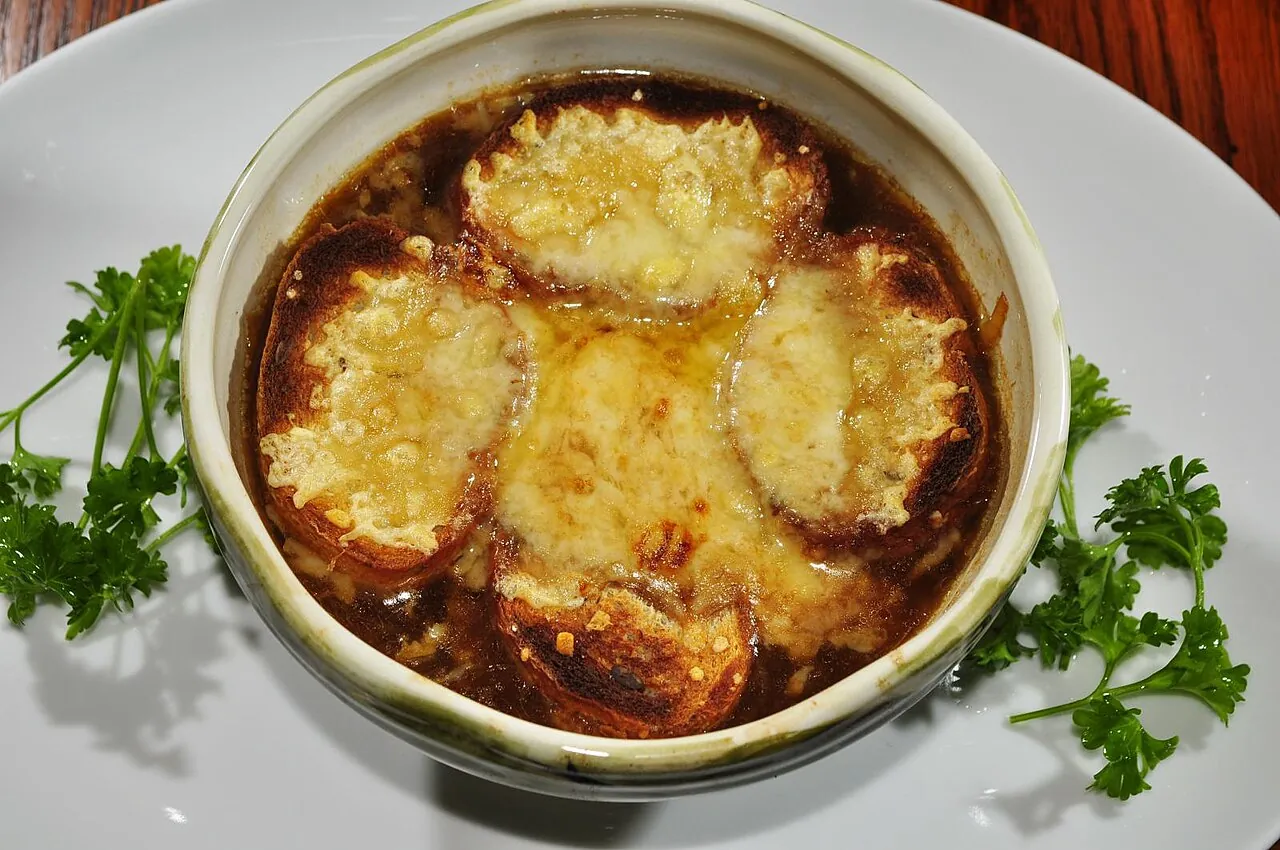
The cheese is the second half of the dish, not a garnish: it seals in heat, soaks into the bread and gives you something to pull apart with the spoon.
The soup works because of two separate jobs. Slow cooking turns onion sugars brown and savory, and the cheese on top adds salt, fat and a crust. Get both right and a handful of cheap ingredients tastes like a bistro.
French onion soup at a glance
This French onion soup table gives the numbers to plan around before you start.
| Yield | 4 servings |
| Active and total time | About 30 minutes active, about 1 hour 50 minutes total |
| Pan and oven | Heavy pot over medium-low heat; broiler on high, rack 6 inches (15 cm) from the heat |
| Best cheese | Gruyère or Comté, with a little Parmesan if you like a darker top |
| Make ahead | Soup keeps 3 to 4 days; add bread and cheese and broil just before serving |
How to make French onion soup
This French onion soup recipe makes four bowls, and nearly all the time is unattended onion cooking.
Ingredients for French onion soup
These ingredients for French onion soup are plain pantry items plus the cheese.
- 3 tablespoons (42 g) unsalted butter
- 2 tablespoons olive oil
- 3 pounds (1.4 kg) yellow onions, halved and sliced thin
- 1 teaspoon kosher salt, plus more to taste
- 3 cloves garlic, minced
- 1/2 cup (120 ml) dry white wine or dry sherry
- 6 cups (1.4 L) good beef stock
- 4 sprigs fresh thyme and 1 bay leaf
- 1 tablespoon sherry vinegar or red wine vinegar, optional
- Black pepper
- 8 slices baguette, about 1/2 inch (1.3 cm) thick
- 8 oz (225 g) Gruyère or Comté, coarsely grated
- 1 oz (28 g) Parmesan, finely grated, optional
Steps for making French onion soup
These steps for making French onion soup start with the onions, because they set the flavor of everything else.
- Melt the butter with the oil in a wide, heavy pot over medium heat, add the onions and salt, and stir until they begin to collapse, about 10 minutes.
- Lower the heat to medium-low and cook 45 to 60 minutes more, stirring every 5 minutes and scraping the bottom, until the onions are the color of dark brown sugar and jammy.
- Stir in the garlic for 1 minute, then pour in the wine and scrape up the browned film on the bottom until the liquid has almost cooked away.
- Add the stock, thyme and bay leaf, bring to a simmer, and cook partly covered for 30 minutes.
- Remove the thyme and bay leaf, taste, and add pepper, more salt if needed, and the vinegar if the soup tastes flat or too sweet.
- Heat the broiler on high and toast the baguette slices on a sheet pan for 1 to 2 minutes per side, until dry and lightly golden.
- Ladle the soup into four ovenproof crocks set on a sheet pan, float two toasts on each, and pile the Gruyère over the top, letting it overhang the rim a little.
- Broil 3 to 5 minutes, watching closely, until the cheese is melted, bubbling and spotted brown at the edges, then rest the bowls 2 minutes before serving.
The best cheese for French onion soup
The best cheese for French onion soup is Gruyère, the Swiss cow's milk cheese that has long been the default for the dish. Its mild fat and moisture let it melt into a smooth blanket instead of breaking into grease, and its nutty, salty flavor stands up to a sweet broth. For soup, buy the younger Classic style, aged 6 to 9 months, rather than Réserve: older wheels have more flavor but are drier and turn grainy or greasy when melted.
Comté is the closest alternative, a French cow's milk cheese that melts almost the same way and tastes a little fruitier and nuttier. Emmental melts easily but tastes milder, so it makes a good blend partner, and the comparison of Swiss, Gruyère and Emmental shows how they differ. Britain and America often reach for provolone or white cheddar, which stretch well but taste flatter. For other options, see the best melting cheeses.
Grate the cheese yourself. Bagged shreds carry anti-caking starch that keeps them from fusing into a single crust, and how to shred cheese for the best melt explains the rest. Use about 2 ounces (55 g) per bowl, and put a thin layer of Parmesan underneath or on top if you want deeper browning.
French onion soup mistakes and fixes
These French onion soup mistakes nearly all come from rushing the onions or crowding the bowl.
- Pale onions, thin soup. If the onions are blond when you add the stock, the soup tastes like boiled onion. Keep going until they are dark and sticky, and add a splash of water if the bottom of the pot scorches before the onions color.
- Sweet and flat. Deep browning leaves sugar and little acid. A spoonful of vinegar or extra wine at the end fixes it, and so does salt.
- Soggy bread that vanishes. Toast the bread until it is dry through. Fresh bread dissolves; dry bread holds its shape under the cheese.
- Cheese that slides off or burns. Pile the cheese so it touches the rim of the crock and gets anchored there, and keep the rack lower than you think. Cheese on top of toast burns in under a minute if it sits too close to the element.
- Greasy top. An old, dry wedge sheds oil as it melts. Choose a younger Gruyère or Comté and do not pile on more than 2 ounces.
- Cracked bowls. Only use crocks marked ovenproof or broiler safe, and never put cold bowls straight under a hot broiler.
French onion soup variations
French onion soup variations change the broth or the topping without changing the method.
Swap half the beef stock for chicken stock for a lighter soup, or use mushroom stock and a spoonful of soy sauce for a vegetarian version with similar depth. A tablespoon of brandy or cognac with the wine adds warmth. For a no-crock option, bake the toasts topped with cheese on a sheet pan and float them on the soup. A quick shortcut is a mix of yellow and sweet onions, but all-yellow gives a more savory result.
On origins, French onion soup has been made in France since the Middle Ages, and the gratinéed version took its modern shape at the Les Halles market in Paris in the mid-1800s. A tale about King Stanislas and Louis XV appears in Dumas's 1873 dictionary, but it is one of several competing accounts, so treat it as a story rather than fact.
Making French onion soup ahead, storing and reheating
Making French onion soup ahead works well because the broth improves overnight. Cook it through step 5, cool it, and refrigerate it within 2 hours of cooking. USDA's leftovers guidance says leftovers keep 3 to 4 days in the refrigerator or 3 to 4 months frozen, and that soups should be brought to a rolling boil when reheated, with leftovers reaching 165°F (74°C). Freeze the soup without bread or cheese; add them fresh when you reheat, then broil.
Questions about French onion soup
These questions about French onion soup cover the cheese, the onions and the broiler.
What cheese is best for French onion soup?
The best cheese for French onion soup is Gruyère, with Comté as an equally good French option. Both melt smoothly and brown nicely, while a handful of Emmental or Parmesan can round out the blend.
How long should you caramelize onions for French onion soup?
For French onion soup, plan on 55 to 70 minutes of cooking in total, with the first 10 over medium heat and the rest over medium-low. Stop when the onions are dark brown and jammy, not when they are first golden.
Can you make French onion soup without wine?
French onion soup works without wine if you replace it with extra stock and a spoonful of sherry or red wine vinegar. The acid is what matters, since it balances the sweetness of the onions.
Do you need ovenproof bowls for French onion soup?
French onion soup can be finished without crocks: broil the cheese on toasted bread on a sheet pan, then float the toasts on the hot soup. If you use bowls, make sure they are marked ovenproof.
Can you freeze French onion soup?
French onion soup freezes well for 3 to 4 months without the bread and cheese. Thaw it in the refrigerator, bring it to a rolling boil, then top and broil.
Making French onion soup your own
French onion soup rewards patience and a good wedge of Gruyère more than any trick. Start the onions early, keep the heat low, and grate cheese you bought in a block. If you cannot find Gruyère, ask for Comté, and ask for the Classic style, since age changes how it melts.
Sources
- French onion soup, Wikipedia
- Gruyère cheese, Wikipedia
- Why Young Cheese Melts Better Than Aged Cheese, America's Test Kitchen
- Leftovers and Food Safety, USDA Food Safety and Inspection Service