
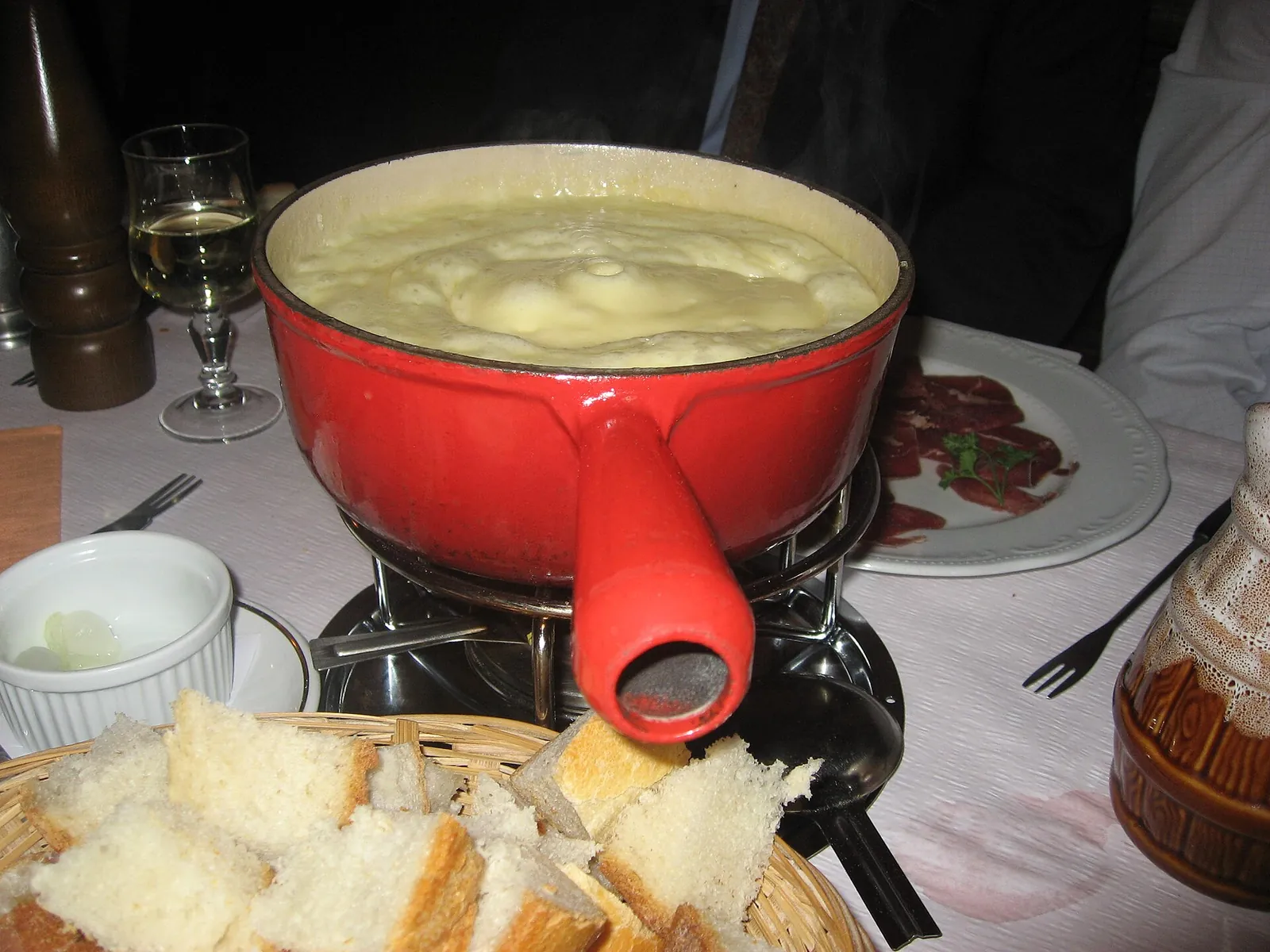
It is also one of the easiest dishes to ruin: heat it too hard or skimp on acid, and it turns stringy, grainy or oily within a minute.
What holds it together is chemistry you can control. Wine brings acid and alcohol, starch keeps the fat and water from parting, and low, steady heat keeps the cheese proteins from tightening. The recipe below uses those three levers.
Cheese fondue at a glance
This cheese fondue table covers the numbers to plan around.
| Cheese fondue | |
|---|---|
| Yield | 4 servings as a meal |
| Active time | 15 minutes |
| Total time | About 30 minutes |
| Pan temperature | Medium-low; never a rolling boil |
| Best cheese | Half Gruyère, half Emmental, grated fresh |
| Make-ahead | Grate the cheese and toss with starch a day ahead; melt just before serving |
How to make cheese fondue
This cheese fondue recipe makes a classic Swiss-style pot, and it serves four when fondue is the meal.
Ingredients for cheese fondue
These ingredients for cheese fondue are enough for four people, at about 4 ounces of cheese each, in line with the cheese per person guide.
- 8 oz (225 g) Gruyère, coarsely grated
- 8 oz (225 g) Emmental, coarsely grated
- 2 tablespoons (16 g) cornstarch
- 1 garlic clove, halved
- 1 cup (240 ml) dry white wine, such as Sauvignon Blanc or dry Riesling
- 1 tablespoon fresh lemon juice
- 1 tablespoon kirsch (optional)
- 1/4 teaspoon freshly grated nutmeg
- Freshly ground black pepper
- 1 baguette or country loaf (about 12 oz, 340 g), cut in 1-inch cubes with some crust on each
- 1 1/2 lb (680 g) small boiled potatoes, 2 apples or pears, sliced, and cornichons for dipping
Steps for making cheese fondue
These steps for making cheese fondue take about 30 minutes, most of it slow stirring.
- Toss the grated Gruyère and Emmental with the cornstarch in a bowl until every shred is lightly dusted.
- Rub the inside of a heavy saucepan or fondue pot with the cut garlic, then discard the garlic.
- Pour in the wine and lemon juice and warm over medium-low heat until steaming with small bubbles at the edge, not a boil.
- Add the cheese a handful at a time, stirring in a figure eight or zigzag, and wait until each handful has melted before adding the next. This takes 8 to 10 minutes.
- When the pot is smooth and just barely bubbling, stir in the kirsch, nutmeg and pepper.
- Move the pot to a tabletop burner set low, and serve right away with the bread, potatoes, fruit and cornichons. Stir the pot between dips so it stays smooth.
The best cheese for cheese fondue
The best cheese for cheese fondue is a blend of Alpine cheeses that melt without turning greasy, and Gruyère leads that list. Our Gruyère page explains that Classic wheels aged 6 to 9 months melt smoothly, while older Réserve wheels bring more flavor but can turn grainy or greasy in a sauce. Pick Classic for the pot. The Le Gruyère AOP page lists maturation periods of 5 to 18 months, so the age on the label matters.
Emmental is the traditional partner. It melts into stretchy strands, so used alone it clings to the fork. Mixed half and half with Gruyère, you get its mild sweetness and the depth of Gruyère. The Swiss, Gruyère and Emmental comparison is useful when the label just says Swiss: deli Swiss follows the American standard and tastes flat in fondue, so look for the AOP names.
Other Alpine cheeses can fill in. Swiss fondue often uses Vacherin Fribourgeois, and a study of Swiss fondue used equal parts Gruyère and Vacherin, the so-called moitié-moitié blend. Appenzeller adds a herby edge, and Comté is a close French match for Gruyère. For a ranked list of other options, see the best melting cheeses, and for the region, the cheeses of the Alps.
Both Gruyère and Emmental AOP are made from raw milk. A fondue that steams and bubbles reaches the temperature the Gruyère page describes for raw-milk cheese, but check cheese during pregnancy if that applies to you.
Why cheese fondue separates
Cheese fondue separates when the proteins, fat and water stop staying together. A peer-reviewed study of Swiss fondue found that without enough starch the fondue split into a protein phase, a watery phase and an oil phase, while enough starch held everything in a jammed suspension. The same paper found that wine lowers the pH, which loosens the casein, but if the pH drops below the casein's isoelectric point of about 4.7, the fondue also becomes unstable. That is why a splash of lemon helps and a half cup extra does not.
In practice, that gives you three rules: use the starch, add acid in measured amounts, and keep the pot under a boil. The study ran its measurements at 70°C (158°F), described as the temperature at which fondue is eaten, which is hot to the touch but well under a boil.
Cheese fondue mistakes and fixes
These cheese fondue mistakes cover almost every failure.
It is stringy and clumpy. The cheese went in too fast or the heat was too high. Take the pot off the burner, add a splash of warm wine with a little lemon juice, and whisk hard.
It is oily on top. The fat has split out. Stir 1 teaspoon cornstarch into 1 tablespoon of wine or kirsch, whisk it in over low heat and keep stirring until it recombines.
It is too thick. Whisk in warm wine a tablespoon at a time.
It tastes flat. Deli Swiss, pre-shredded cheese or too young a cheese will do that. Grate a Classic Gruyère yourself and add a grate of nutmeg and a squeeze of lemon.
It is scorched at the bottom. Thin, cheap pots hot spots. Use a heavy-bottomed pot and keep the burner low. The browned layer that sometimes forms at the bottom of a traditional pot is a treat, not a failure, if it is golden and not burnt.
Cheese fondue variations
These cheese fondue variations change the flavor without changing the method. For no alcohol, replace the wine with an equal amount of apple cider or a light stock plus 2 tablespoons of lemon juice, since the acid matters more than the alcohol. For a Fribourg-style pot, swap a quarter of the cheese for Vacherin Fribourgeois. For a smokier pot, add 4 oz (115 g) of smoked Gouda in place of some Emmental. For dipping, try roasted broccoli, blanched green beans or small cubes of ham next to the traditional bread.
Make-ahead, storing and reheating cheese fondue
Make-ahead cheese fondue is best done in two parts: grate the cheese and toss it with the starch up to a day ahead, and melt it just before serving. Leftover fondue is a different case, because it sets firm as it cools.
For storing cheese fondue, USDA's Food Safety and Inspection Service recommends refrigerating leftovers within 2 hours and using them within 3 to 4 days. Scrape it into a covered container. To reheat, warm it in a saucepan over low heat with a splash of white wine, whisking constantly, until it is steaming hot at 165°F, the USDA's reheating temperature. Leftover fondue also spreads on toast and melts over potatoes.
Serving cheese fondue
Serving cheese fondue is a slow, social meal, so plan on about an hour. Set the burner low, give each guest a long fork, and put out bread, boiled potatoes, apples, pears and cornichons, whose acidity cuts the richness. Crisp dry white wine, black tea or kirsch go with it. The wine and cheese pairing guide lists other options.
Questions about cheese fondue
These questions about cheese fondue come up most often.
What cheese is best for cheese fondue?
The best cheese for cheese fondue is Gruyère, usually blended with Emmental and sometimes Appenzeller, Vacherin Fribourgeois or Comté, grated fresh.
Why add cornstarch to cheese fondue?
Cornstarch in cheese fondue keeps the fat and water together. A study of Swiss fondue found that without enough starch the mixture separated into protein, water and oil.
Why does cheese fondue separate?
Cheese fondue separates from too much heat, too little starch or acid that is out of balance. Keep the pot below a boil, use the cornstarch and measure the lemon.
Can you make cheese fondue without wine?
Cheese fondue without wine works if you replace it with apple cider or stock and add lemon juice, because the acid is doing the work.
Can you make cheese fondue without a fondue pot?
Cheese fondue does not need a fondue pot: a heavy saucepan works for melting, and a small slow cooker set to low keeps it warm at the table.
Your first cheese fondue
Your first cheese fondue should use half Classic Gruyère and half Emmental, the amounts above, and a pot you can keep over very low heat. Grate it yourself, add it slowly, and stop stirring only when it is smooth. Then move on to a Vacherin or Appenzeller swap.
Sources
- Rheology of Swiss Cheese Fondue, Bertsch, Savorani and Fischer, ACS Omega (2019), via PubMed Central
- Le Gruyère AOP, Swiss PDO-PGI Association
- Leftovers and Food Safety, USDA Food Safety and Inspection Service