
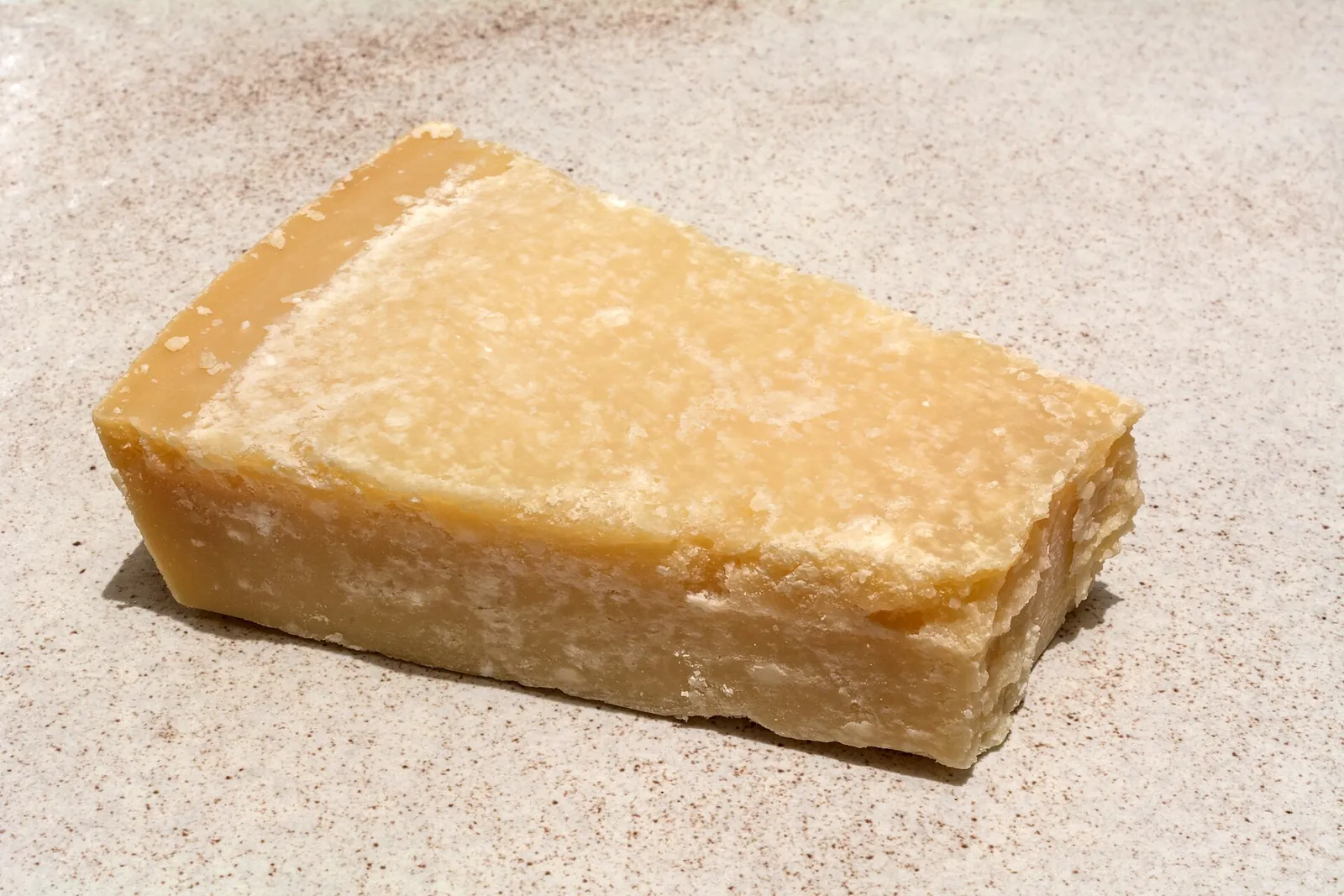
Two things set the number. Most lactose leaves in the whey when the curds are drained, and the bacteria in the cheese eat much of what is left. A cheese that keeps more whey, or has less time to ripen, keeps more milk sugar. This page is general information, not medical advice. NIDDK says about 36 percent of people in the United States have lactose malabsorption, so the question is common.
Lactose in cheese by type
This table of lactose in cheese comes from a 2020 review in the Journal of Translational Medicine by Facioni and colleagues, which lists grams of lactose per 100 grams of each food.
| Food | Lactose per 100 g | Rough amount per ounce (28 g) |
|---|---|---|
| Whole milk (for comparison) | 4.9 g | 1.4 g |
| Ricotta | 3.5 g | 1.0 g |
| Cottage cheese | 3.2 g | 0.9 g |
| Feta | 1.4 g | 0.4 g |
| Fontina (PDO) | 0.8 g | 0.2 g |
| Mozzarella | 0.7 g | 0.2 g |
| Cheddar | 0.5 g | 0.1 g |
| Gorgonzola (PDO) | under 0.1 g | under 0.03 g |
| Emmentaler (PDO), Gruyère (PDO) | under 0.1 g | under 0.03 g |
| Parmigiano-Reggiano, Grana Padano, Pecorino Romano | under 0.01 g | under 0.003 g |
| Lactose-free fresh cheeses | 0.01 to 0.1 g | 0.003 to 0.03 g |
The per-ounce column is simple arithmetic from the review's per-100-gram figures, not a separate measurement. Brands and batches differ, so treat each number as typical, not exact.
Why aging lowers lactose in cheese
Aging lowers lactose in cheese in two steps, and the review describes both. First comes whey drainage: whey is drained off before the cheese is finished, so a good share of the lactose goes with it. Curds for hard cheeses hold less whey than curds for soft ones, so soft cheeses start with more lactose.
Second comes fermentation. In hard and matured cheeses, the review says, lactic acid bacteria consume the lactose that remains, and the longer a cheese matures, the less is left. That is why a young, wet cheese such as ricotta sits near the top of the table and a long-aged Grana Padano sits at the bottom. For the wider contrast, see fresh vs aged cheese.
The cheeses lowest in lactose
The cheeses lowest in lactose in the review are the long-aged hard ones: Parmigiano-Reggiano, Grana Padano and Pecorino Romano, all under 0.01 gram per 100 grams. Next come Emmentaler, Gruyère and Gorgonzola, all under 0.1 gram.
Cheddar, at 0.5 gram per 100 grams, is not far behind, and NIDDK names hard cheeses such as cheddar and Swiss as lower in lactose than other milk products. Our guides to Parmigiano-Reggiano and aged vs young cheddar cover those two in depth.
Cheeses with more lactose
The cheeses with more lactose are the fresh, high-moisture ones: ricotta at 3.5 grams per 100 grams and cottage cheese at 3.2 are the highest in the table, both closer to milk than to cheddar. Ricotta is made from whey, and cottage cheese is a washed curd that holds liquid.
Feta, at 1.4 grams, sits in the middle. Mozzarella is listed at 0.7 gram, lower than many people assume for a fresh cheese, so do not sort by freshness alone. Check the figure for the exact cheese when it matters. Processed cheese and cheese spreads are not in the review, so no number is given for them here.
How much lactose people can handle
How much lactose people can handle is more than many expect. NIDDK says research suggests many people could have 12 grams of lactose, the amount in about a cup of milk, with no symptoms or only mild ones. The Facioni review is more cautious, saying most people with lactose intolerance can tolerate up to 5 grams in a single dose, about 100 milliliters of milk.
Both figures are for milk, and individuals differ. Even by the stricter 5-gram figure, an ounce of cheddar at roughly 0.1 gram or an ounce of ricotta at roughly 1 gram fits easily. Practical steps for people with symptoms are on the cheese for lactose intolerance page.
What most lactose in cheese charts get wrong
Most lactose in cheese charts flatten a range into a label. Three habits mislead.
They sort by "hard" and "soft" only. The table shows the real driver is whey and time: feta, a brined cheese, has twice the lactose of mozzarella, and Fontina has more than cheddar.
They say "zero" or "lactose-free." The review gives under 0.01 gram for Parmigiano-Reggiano, which is very low but is a measured upper limit, not a guarantee for every wedge. A "lactose-free" claim on a label is a separate matter, and the review gives 0.01 to 0.1 gram per 100 grams for lactose-free fresh cheeses.
They ignore portion. A smear of ricotta and a bowl of it are different amounts of lactose. Per ounce, even ricotta is roughly 1 gram.
Questions about lactose in cheese
These are short answers on lactose in cheese, based on the figures above.
Which cheese has the least lactose?
The cheese with the least lactose in the review is a tie among long-aged hard cheeses: Parmigiano-Reggiano, Grana Padano and Pecorino Romano, each under 0.01 gram per 100 grams.
Does aged cheese have less lactose?
Aged cheese has less lactose because whey drains off and bacteria consume what remains, and the review says the longer a cheese matures, the less lactose is left.
Is there lactose in cheddar cheese?
There is a small amount of lactose in cheddar: 0.5 gram per 100 grams in the 2020 review, roughly 0.1 gram per ounce, and NIDDK lists cheddar among the lower-lactose hard cheeses.
Does cottage cheese have a lot of lactose?
Cottage cheese has more lactose than hard cheese: 3.2 grams per 100 grams in the review, with ricotta at 3.5. Lactose-free fresh cheeses list 0.01 to 0.1 gram.
Does mozzarella have lactose?
Mozzarella has some lactose: 0.7 gram per 100 grams in the review, below ricotta, cottage cheese and feta.
Picking cheese by lactose
Picking cheese by lactose is simple: the long-aged hard cheeses are the safest bet, cheddar and Swiss-style cheeses come next, and fresh wet cheeses are the ones to measure. Start with a small portion of a hard cheese, then move up the table. If symptoms persist even with low-lactose cheeses, talk to your doctor or a registered dietitian.
Sources
- Facioni MS, Raspini B, Pivari F, Dogliotti E, Cena H. Nutritional management of lactose intolerance: the importance of diet and food labelling, Journal of Translational Medicine, 2020
- Eating, Diet, & Nutrition for Lactose Intolerance, National Institute of Diabetes and Digestive and Kidney Diseases
- Definition & Facts for Lactose Intolerance, National Institute of Diabetes and Digestive and Kidney Diseases