
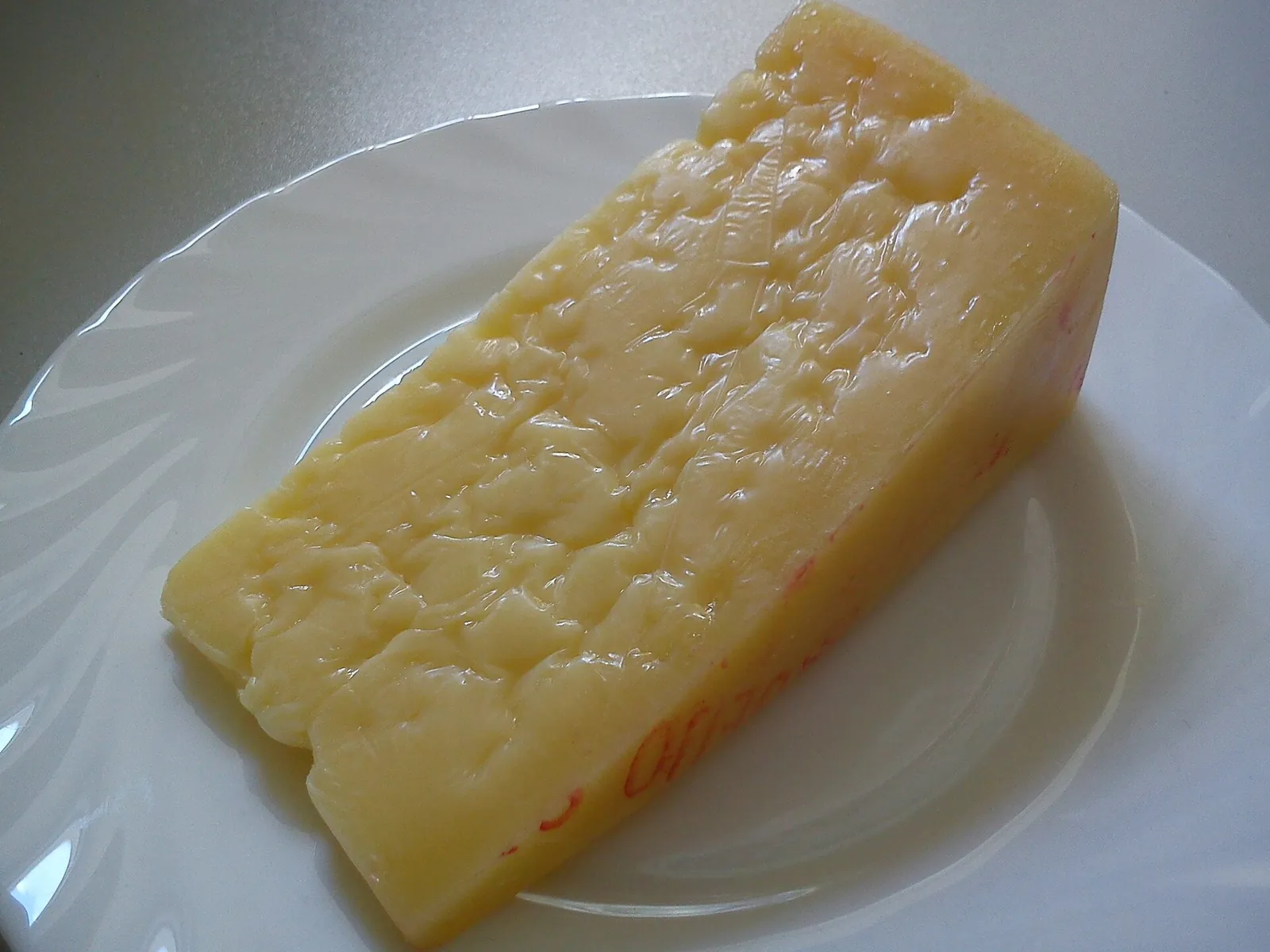
Its flavor is strong, clean and slightly spicy, closer to an aged cheddar than to the soft sheep's cheeses of mainland Portugal.
The island's makers press their curd and age the wheels in two stages, and the result is a dense, yellowish paste that slices cleanly, grates well and grows sharper the longer it sits.
São Jorge cheese at a glance
Here is São Jorge cheese at a glance, from Portugal's register of traditional products.
| Detail | São Jorge |
|---|---|
| Milk | Raw cow's milk |
| Made in | São Jorge island, Azores, Portugal |
| Protected name | PDO (Queijo São Jorge DOP) |
| Coagulant | Natural rennet |
| Ripening | At least 90 days: 30 days at natural temperature, then 60 days at controlled temperature |
| Size | 25 to 35 cm (about 10 to 14 inches) across, 10 to 15 cm (4 to 6 inches) high |
| Texture | Hard or semi-hard, yellowish |
| Flavor | Strong, clean, slightly spicy |
What São Jorge cheese is and where it comes from
São Jorge cheese is a protected designation of origin (PDO) cheese made only on São Jorge island, one of the nine islands of the Azores. The register of traditional Portuguese products dates the cheese to about the mid 15th century and says the methods have stayed practically unchanged for 500 years.
Each wheel carries a casein label and the maker's code on one side. The Portuguese cheese guide sets it next to the mainland cheeses, and the PDO and PGI guide explains what the seal means.
How São Jorge cheese is made
São Jorge cheese is made by setting raw cow's milk with natural rennet, after adding whey from the previous batch to promote acidification, according to the register. The whey is drained, the curd is placed in molds and pressed, and the wheel rests for 30 days at natural temperature before 60 days of ripening at 12 to 14 degrees C (54 to 57 degrees F) and 80 to 85 percent humidity.
That whey starter is why São Jorge tastes tangy rather than just salty: acidity builds early, and the long ripening adds the sharp, slightly spicy edge. Pressing makes the paste dense, which is why the cheese slices cleanly and grates without gumming.
São Jorge cheese by age
São Jorge cheese changes in strength more than in kind. At the 90-day minimum it is firm, yellowish and clean with a slight spice. With more months the paste gets harder and more crumbly, and the tang and piquancy build. The facts box gives three to 12 months, which is the range most shoppers meet; special aged editions run much longer. The sibling guide to Portuguese cheeses notes editions up to 36 months, so check the label.
How to buy São Jorge cheese in the US
Buying São Jorge cheese in the US is easier than buying most Portuguese cheeses, because it is a firm, aged cheese that travels well and Portuguese and Azorean communities import it. Look for "Queijo São Jorge DOP", the casein label on the rind, and a yellowish, dense paste without cracks.
Ask how long it has aged. A younger cut is milder and better for snacking; an older one is better for grating. Since the cheese is raw milk and aged beyond the 60-day mark that US rules require, it can be sold legally, but confirm the label if you are pregnant or immune-compromised, and see the FDA or CDC guidance.
How to serve and cook with São Jorge cheese
Serve São Jorge cheese cut into rough chunks or thin slices at room temperature, after about an hour out of the fridge, with bread and red wine. The warmth lets the tang and spice come forward.
It also cooks well. Grate it over potatoes, soups and baked dishes, or melt it on toast; a hard, dense cheese melts slowly and browns well. Shave older wheels over salads the way you would a sharp cheddar.
What to serve with São Jorge cheese
São Jorge cheese pairs with fruity reds and fortified wines. Touriga Nacional, Madeira and Verdelho are the wine matches in our pairing data; for beer, an amber ale, a pale ale or a porter. Apple, grape and fig give sweetness, and crusty bread, olives and sweet potato fit the plate. The pairing guide lists more, and the red wine and cheese guide explains the logic.
Substitutes for São Jorge cheese
Substitutes for São Jorge cheese are firm, tangy cow's milk cheeses: Cheddar, Gouda and Gruyère. A sharp cheddar is the nearest match in bite, an aged Gouda brings a sweeter, caramel edge, and Gruyère gives a nuttier melt. None has the whey-starter tang, so expect a slightly different cheese. The substitute finder shows more.
What most São Jorge cheese advice gets wrong
Most São Jorge cheese advice mixes it up with the soft Portuguese cheeses.
It is not a spoonable cheese
São Jorge is not spoonable like Serra da Estrela, because it is a hard pressed cheese from cow's milk. Slice it instead.
It is not the same as Queijo do Pico
São Jorge is not the same as Queijo do Pico, another Azorean cheese from a different island, so check the label for the island name.
Serving São Jorge cheese cold
Serving São Jorge cheese straight from the fridge hides its spice. Give it an hour on the counter.
Questions about São Jorge cheese
These are the questions about São Jorge cheese that come up most.
What does São Jorge cheese taste like?
São Jorge cheese tastes strong, clean and slightly spicy, with tang and a salty, nutty edge that deepens with age.
Is São Jorge cheese made with raw milk?
São Jorge cheese is made with raw cow's milk, according to the register of traditional products.
What is a São Jorge cheese substitute?
As a São Jorge cheese substitute, use sharp cheddar, aged Gouda or Gruyère, depending on whether you want tang, sweetness or nuttiness.
How long is São Jorge cheese aged?
São Jorge cheese is aged at least 90 days: 30 days at natural temperature plus 60 days at controlled temperature.
How do you store São Jorge cheese?
Store São Jorge cheese in wax or parchment paper in a lidded container in the fridge. The storing cheese guide covers hard cheeses.
Your first São Jorge cheese
For your first São Jorge cheese, buy a small wedge with the DOP label, let it warm up for an hour, and eat it with crusty bread, a few olives and a glass of Touriga Nacional.
Sources
- Queijo São Jorge PDO, Produtos Tradicionais Portugueses, DGADR
- São Jorge Cheese: Where To Buy And Taste It In The Azores, Visit Azores
- Portuguese Cheeses You Should Know, cheese.help