
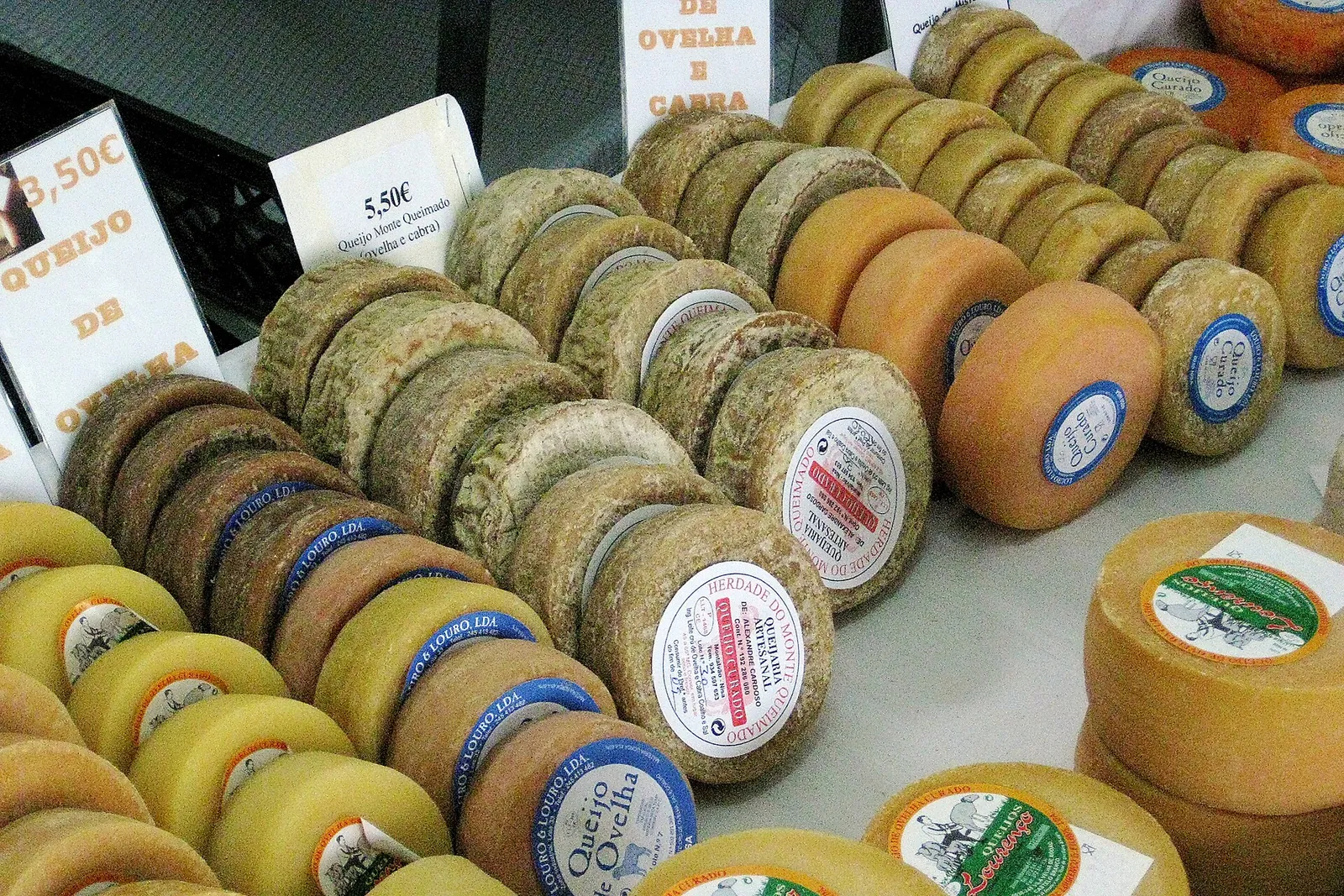
The soft camp is the one people remember, because you cut the top off a ripe wheel and eat the inside with a spoon.
What ties the mainland cheeses together is the thistle. Several are set with a plant coagulant instead of animal rennet, which gives a faint bitterness and a runny paste. The Portugal overview is on the Portugal country page.
Portuguese cheeses at a glance
This table of Portuguese cheeses lists the main names, with the key facts for each.
| Cheese | Milk | Region | Protected name | Texture |
|---|---|---|---|---|
| Serra da Estrela | Sheep | Serra da Estrela mountains | DOP, 1996 | Semi-liquid young, sliceable older |
| Azeitão | Sheep | Setúbal, Palmela, Sesimbra | Not stated in the source | Soft |
| Nisa | Sheep | Alto Alentejo | DOP, 1996 | Semi-hard |
| São Jorge | Cow | São Jorge island, Azores | DOP, 1986 | Hard |
Serra da Estrela and the thistle-set cheeses
Serra da Estrela is the best known of the thistle-set Portuguese cheeses, a sheep's milk cheese set with the local Cynara cardunculus thistle rather than rennet. It has had DOP status since 1996, ripens at least 30 to 45 days depending on the listing, and is made mostly from November to March in a defined zone around the Serra da Estrela. It is very soft and semi-liquid when young and soft but sliceable when older, with a thin straw-yellow rind traditionally bound in cloth.
The full profile is on the Serra da Estrela page. If you want the experience, buy a young wheel and eat it with a spoon and bread. If you want a cheese to slice, ask for an older one.
Azeitão and other soft Portuguese cheeses
Azeitão is a soft sheep's milk cheese from the Setúbal area, produced in Setúbal, Palmela and Sesimbra, and it was named one of the 50 best gastronomic products in the world at the Great Taste Awards in 2014. It is small and pungent, and the old guidance applies: serve it ripe, with bread, at room temperature.
Serpa and Évora from the Alentejo belong to the same soft, thistle-set family, though their rules are not stated here without a source.
Nisa and other firmer Portuguese cheeses
Nisa is a firmer Portuguese cheese from the Alto Alentejo, a sheep's milk cheese made from raw milk and set with a thistle infusion. It has held a DOP since 1996, comes in small wheels of 200 to 400 g or larger ones of 800 to 1,300 g, and has a yellowish-white color with a strong flavor and a slightly acidic finish.
Fresh cheese, queijo fresco, is the everyday Portuguese cheese, eaten young with bread and olives. Quality varies by maker, so buy it from a shop with high turnover and eat it within a few days.
São Jorge, the Azores cheese
São Jorge is the Azores cheese, a hard raw cow's milk cheese from the island of the same name. It has had DOP status since 1986, ages at least 3 months (special editions up to 36 months), and weighs 18 to 26 pounds (8 to 12 kg). The bouquet is strong and slightly spicy, and it grows stronger with age.
It is the easy cheese to find in the US and the one to slice, shave or grate. Pair it with quince paste. The São Jorge page has the profile.
How to serve Portuguese cheeses
How to serve Portuguese cheeses depends on the texture. For a ripe Serra da Estrela or Azeitão, leave it at room temperature for about an hour, cut off the top, and scoop it onto bread. For São Jorge and Nisa, slice thin. Portuguese reds and fortified wines such as Port suit the soft cheeses, and quince paste (marmelada) suits all of them. See the wine and cheese pairing guide for the principles.
Allow about 2 ounces a person as an appetizer. A ripe thistle-set cheese is rich, so a small wheel serves several.
What most Portuguese cheeses advice gets wrong
What most Portuguese cheeses advice gets wrong is the idea that every soft Portuguese cheese is made the same way. Serra da Estrela is set with thistle rather than rennet, and Nisa with a thistle infusion, but not every Portuguese cheese is made that way, so read the label if the coagulant matters to you.
The second mistake is buying a soft wheel too young and cutting it like a firm one. A ripe wheel is meant to be scooped. The third is the US rule: raw-milk cheese must age at least 60 days to be sold, so the youngest, runniest wheels you find in the US may be pasteurized. The raw-milk cheese page explains the rule and the advice for pregnancy. Ask for a small taste first, because the rind and paste change quickly as a wheel ripens.
Questions about Portuguese cheeses
These questions about Portuguese cheeses cover the common ones.
What is the most famous of the Portuguese cheeses?
The most famous of the Portuguese cheeses is Serra da Estrela, a soft sheep's milk cheese set with thistle.
Why are Portuguese cheeses set with thistle?
Portuguese cheeses are set with thistle because the plant is a traditional local coagulant used instead of animal rennet, and it adds a slight bitterness.
What is São Jorge cheese?
São Jorge cheese is a hard raw cow's milk cheese from the Azores island of São Jorge, aged at least 3 months.
Do you eat Portuguese cheeses with a spoon?
You eat the soft Portuguese cheeses, such as ripe Serra da Estrela, with a spoon after cutting off the top.
Can you buy Portuguese cheeses in the US?
You can buy Portuguese cheeses in the US at specialty shops, and São Jorge is usually the easiest to find.
Try Portuguese cheeses
To try Portuguese cheeses, start with a São Jorge for slicing and a Serra da Estrela or Azeitão for the spoon, with bread and quince paste. More on Iberian cheese is in Spanish cheeses.
Sources
- Serra da Estrela cheese, Wikipedia
- Queijo de Azeitão, Wikipedia
- Queijo de Nisa, Wikipedia
- São Jorge cheese, Wikipedia
- 21 CFR Part 133: Cheeses and Related Cheese Products, Electronic Code of Federal Regulations