
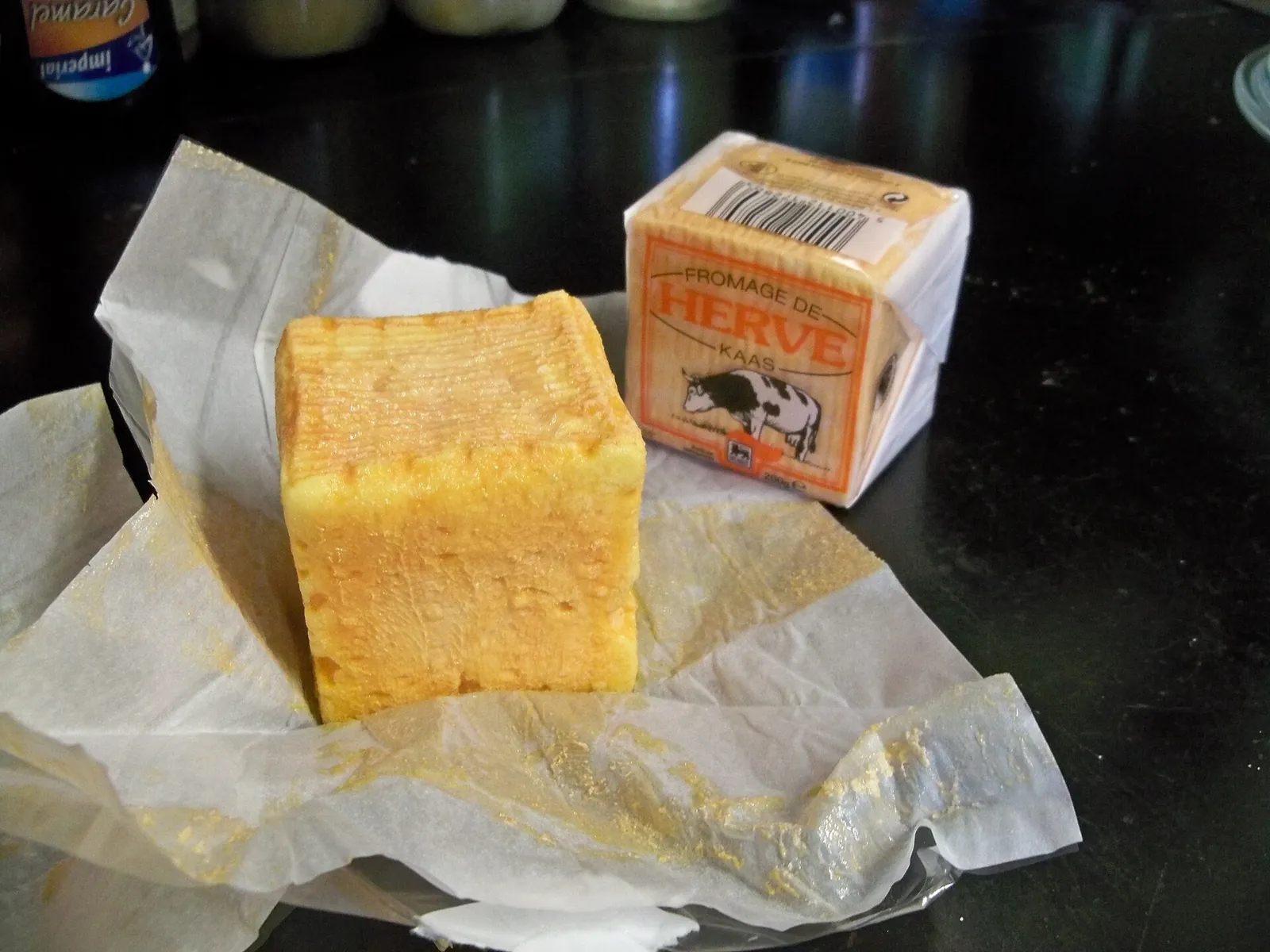
It is cubic, with a firm, creamy paste, and its smell is among the strongest in Europe.
Like Limburger and Munster, Herve gets its aroma from bacteria that grow on a moist, washed rind, not from anything inside the cheese. The paste underneath is spicy and savory, and it is easier to eat than to sniff.
Herve cheese: origin and protected name
The origin of Herve cheese is fixed by its protected name: it must be made in the Pays de Herve in Liège province, an area bounded by the Vesdre river to the south, the Netherlands to the north, the Meuse to the west and Germany to the east, according to the Walloon agency APAQ-W. The milk must come from the same area and the cheese must follow the set method.
The European Commission registered the name as a protected designation of origin in 1996, and the Pays de Herve tourism site calls it the only Belgian cheese with that protection. The milk may be raw or pasteurized, and the rules require a minimum of 45 percent fat. The guide to PDO and PGI labels explains what the seal promises, and Belgium has the rest of the country's cheeses.
How Herve cheese is made
Herve cheese is a soft-paste cheese with a washed rind, and its character comes from the bacterium Brevibacterium linens, written bacterium linens on the Pays de Herve site. After the curd is molded and cut into its square shape, the cheeses are ripened and washed so the rind stays damp and turns a brick orange. The rind types guide compares washed rinds with other kinds.
Three styles are made: doux (mild), piquant (stronger) and remoudou, a third variety named by the same sources. Longer ripening and more washing push a Herve from mild to fierce.
Herve cheese taste and texture
Herve cheese tastes pungent, spicy, savory and salty, with a smooth, firm and creamy paste. A younger, mild piece stays gentler and a little milky. A longer-ripened piquant one grows sticky, the rind stronger and the interior softer, with a sharper bite. The rind is edible, though many people trim it to tame the smell.
How to buy Herve cheese in the US
Buying Herve cheese in the US takes a little hunting, because it is a small Belgian export and often needs a specialty shop or a mail order cheesemonger. Look for the words "Herve" and the protected-name mark on the label, and for a block with an even brick-orange rind. A mild piece in good shape is a better buy than an aged one that has gone damp or smells of ammonia. Check whether the milk is pasteurized, since many imports are.
How to serve Herve cheese
Serve Herve cheese at room temperature, with dark rye or whole-grain bread and a smear of mustard or Sirop de Liège, the thick apple and pear syrup of the region. Cut off the rind if you like, and give the cheese an hour out of the fridge so the paste turns supple. Keep a window open if you cook with it; it melts well over potatoes or into a Belgian-style savory tart.
What to serve with Herve cheese
What to serve with Herve cheese is anything sweet, fruity or malty to calm the heat. Gewürztraminer, Riesling and Port suit the spice, and Belgian dubbel, bock and brown ale echo the savory rind. Pear, apple and fig soften the salt, and dark bread, Sirop de Liège and mustard are the classic extras. The pairing guide has more, and the beer and cheese guide covers the beer side.
Substitutes for Herve cheese
Substitutes for Herve cheese are other strong washed-rind cheeses. Limburger is the closest in smell and in the cubic shape, Époisses is richer and runnier, and Munster is easier to find and milder. The substitute finder lists more.
Storing Herve cheese
Store Herve cheese in wax paper or parchment inside a lidded container, in the fridge, so its smell stays off the butter and the eggs. Use it within a week or two once cut. The storing cheese guide covers wraps in more detail.
What most Herve advice gets wrong
Most Herve cheese advice repeats two ideas that keep people from enjoying it.
The stink is not the cheese
The stink is not the cheese, because the smell of Herve is not its flavor: the aroma sits on the washed rind and the paste is milder. Taste a small piece of the interior first, then decide about the rind.
Not every Herve is the same strength
Not every Herve is the same strength: doux, piquant and remoudou are different styles. If a piquant is too much, ask for a doux.
Questions about Herve cheese
These are the questions about Herve cheese that come up most.
What does Herve cheese taste like?
Herve cheese tastes pungent, spicy, savory and salty, with a creamy, firm paste. The rind is stronger than the inside.
Is Herve cheese made from raw milk?
Herve cheese may be made from raw or pasteurized cow's milk, and both are allowed under the protected name. Check the label.
Is Herve cheese the same as Limburger?
Herve cheese is not the same as Limburger, though the two are close relatives with similar smells. Herve is a protected Belgian cheese from the Pays de Herve.
Can you eat the rind of Herve cheese?
You can eat the rind of Herve cheese, since it is a natural washed rind. It carries most of the smell, so trim it if it is too strong.
Your first Herve cheese
For your first Herve cheese, ask for a mild piece, serve it with dark bread, mustard and a Belgian dubbel, and keep the rind on the side.
Sources
- Fromage de Herve AOP, APAQ-W (Walloon Agency for the Promotion of Quality Agriculture)
- Fromage de Herve, Pays de Herve tourism
- Limburger (includes Herve cheese), Wikipedia