
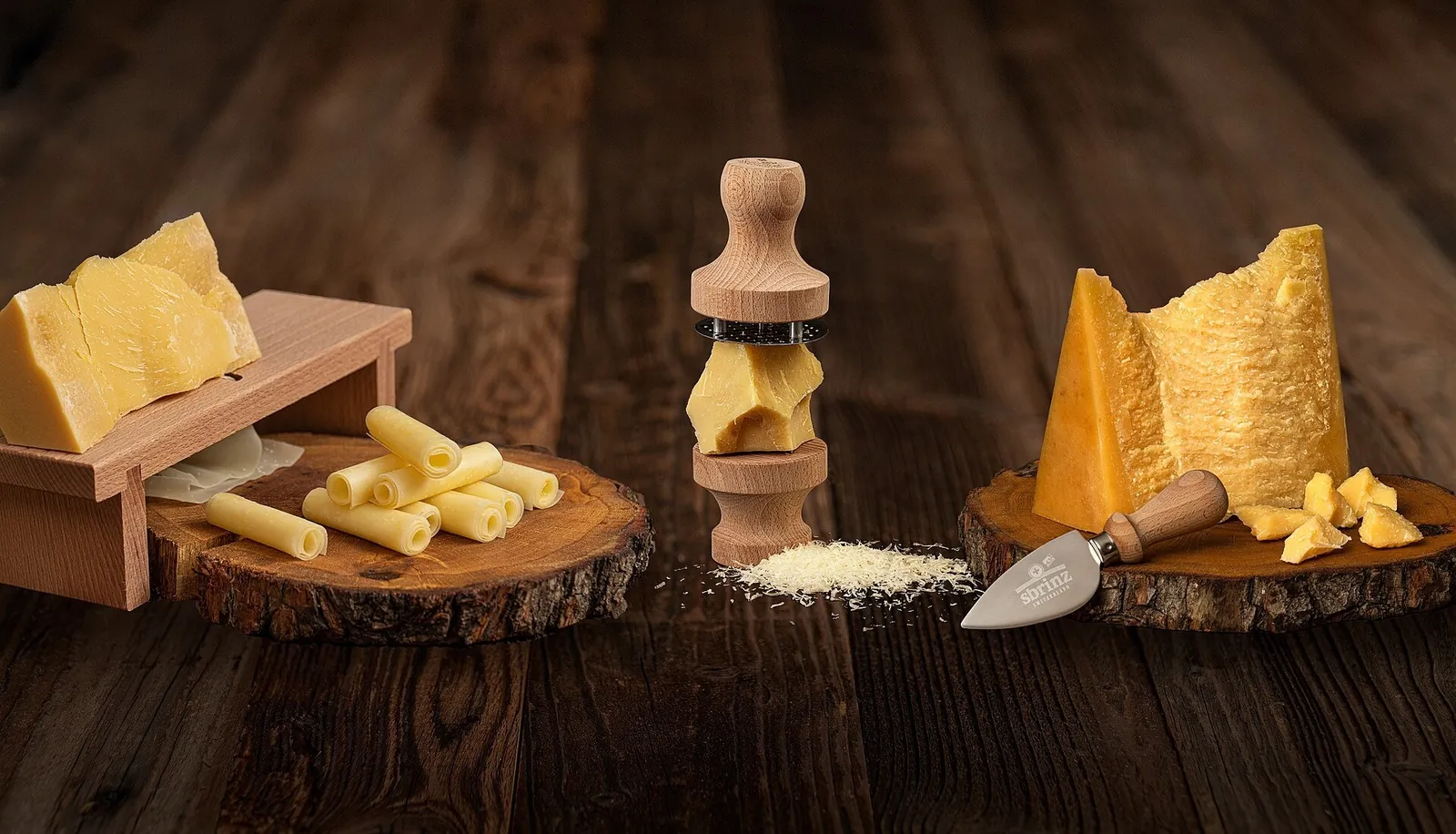
It is grated, shaved or broken into chunks rather than melted, and a little goes a long way.
It is one of the oldest Swiss cheeses, with roots in the 16th century. The Swiss cheese guide puts it beside Gruyère and Emmentaler.
Sbrinz cheese at a glance
This is Sbrinz cheese at a glance, taken from the Sbrinz producers and the Swiss PDO-PGI Association.
| Detail | Sbrinz |
|---|---|
| Milk | Raw cow's milk, mainly Swiss Brown cows |
| Made in | Central Switzerland (Lucerne, Schwyz, Obwalden, Nidwalden, Zug and nearby areas) |
| Protected name | AOP, registered April 24, 2002 |
| Wheel | 25 to 45 kg, 45 to 65 cm wide, 14 to 17 cm thick |
| Aging | 18 months before sale, 22 months for full flavor (producers) |
| Fat | 45 percent in dry matter |
| Style | Extra-hard, full-fat |
Sbrinz cheese compared with Parmigiano
Sbrinz cheese gets compared with Parmigiano-Reggiano constantly, and the comparison is fair on use but not on make. Both are extra-hard cheeses aged more than a year, and both are grated over pasta. Sbrinz, though, is a full-fat cow's milk cheese from Swiss Brown cows fed grass and hay, with a salt bath of at least 15 days after making, and its flavor runs toward butter and spice rather than the pineapple note some Parmigiano shows. If a recipe asks for one, the other works, and you may want a little less salt in the dish.
Where Sbrinz cheese comes from
Sbrinz cheese comes from central Switzerland, and the producers say the name comes from the Italian "lo sbrinzo", which points to the cheese's old export trade south over the Alps. About 25 valley and alpine dairies make it, according to the producers. The AOP area covers the cantons around Lucerne and a few communities in neighboring regions. The Alpine cheeses guide compares it with the other Alpine wheels, and the guide to PDO and PGI labels explains the seal.
How Sbrinz cheese is made
Sbrinz cheese is made from raw milk, salt and rennet, with no additives. A 45 kg wheel takes just over 600 liters of milk, and the cows eat grass in summer and hay in winter, with silage banned. After making, the wheels sit at least 15 days in a salt bath, then mature in a moderately warm cellar and finally age dry, upright, in a colder cellar. The producers say a warehouse in Lucerne can hold up to 60,000 wheels.
What Sbrinz cheese tastes like
Sbrinz cheese tastes nutty, savory and sharp, getting more aromatic and spicy with age, according to its makers. The texture is hard and granular, with the crystalline crunch of long-aged cheese. It is closer to Parmigiano-Reggiano than to Gruyère, though a little more buttery.
How to buy Sbrinz cheese in the US
Buying Sbrinz cheese in the US means a specialty shop or a good cheese counter, since it is imported and less common than Gruyère. The aging far exceeds the FDA's 60-day rule for raw-milk cheese, so milk is not a barrier. Look for the AOP seal and ask for a piece cut from a wheel. Buy a small wedge, because it is expensive and keeps well.
How to serve and cook with Sbrinz cheese
Serve Sbrinz cheese in thin curls, grated, or in chunks. The producers name these three forms: grated, Röllchen (thin rolled curls) and chunks broken off with a special knife. Curls make an aperitif with a glass of white wine; Switzerland Cheese Marketing says the cheese is planed into rolls from about 18 months and cut into chunks at about 24 months. Grate it over pasta, risotto, gratins or salads, where it adds salt and depth.
What to serve with Sbrinz cheese
What to serve with Sbrinz cheese leans on fruit, nuts and cured meat: pear, apple, grapes, walnuts, cured ham and dark bread. Chasselas is the Swiss white, Pinot Noir and Riesling also work, and amber ale, bock or pilsner suit the beer side. The pairing guide has more.
Substitutes for Sbrinz cheese
Substitutes for Sbrinz cheese are Parmigiano-Reggiano, Grana Padano and Gruyère. Parmigiano-Reggiano is the best match for grating, and Grana Padano is milder and cheaper. Gruyère is creamier and melts, so use it where you want melt, not crunch. The substitute finder has other options.
How to store Sbrinz cheese
Store Sbrinz cheese wrapped in parchment, then loosely in plastic, in the fridge; hard aged cheese keeps for weeks once cut. Grate only what you need, since pre-grated cheese dries out fast. The storing cheese guide has more.
What most Sbrinz advice gets wrong
Most Sbrinz advice gets the age and the use wrong.
Sbrinz is not a melting cheese
Sbrinz is not a melting cheese, because aging dries it out; grate it on top of hot food instead of cooking it into a sauce.
The minimum age is not the best age
The minimum age is not the best age: the AOP page states at least 16 months, the producers sell it from 18 months, and they say 22 months gives its full flavor.
Questions about Sbrinz cheese
These are the questions about Sbrinz cheese that come up most.
Is Sbrinz cheese like Parmesan?
Sbrinz cheese is a lot like Parmesan: both are extra-hard, granular and savory, and Sbrinz is Switzerland's answer to it.
How do you eat Sbrinz cheese?
You eat Sbrinz cheese grated, in thin rolled curls or in chunks, with fruit, bread or a glass of wine.
Is Sbrinz cheese made from raw milk?
Sbrinz cheese is made from raw cow's milk, but its long aging puts it well past the FDA's 60-day rule.
How old is Sbrinz cheese when it is sold?
Sbrinz cheese is sold at 18 months or older according to the producers.
Your first Sbrinz cheese
For your first Sbrinz cheese, buy a small wedge, shave it into curls with a vegetable peeler, and eat it with a pear and a glass of white wine.
Sources
- Sbrinz AOP, Sbrinz Käse GmbH
- Sbrinz AOP, Swiss PDO-PGI Association
- Sbrinz AOP, Switzerland Cheese Marketing