
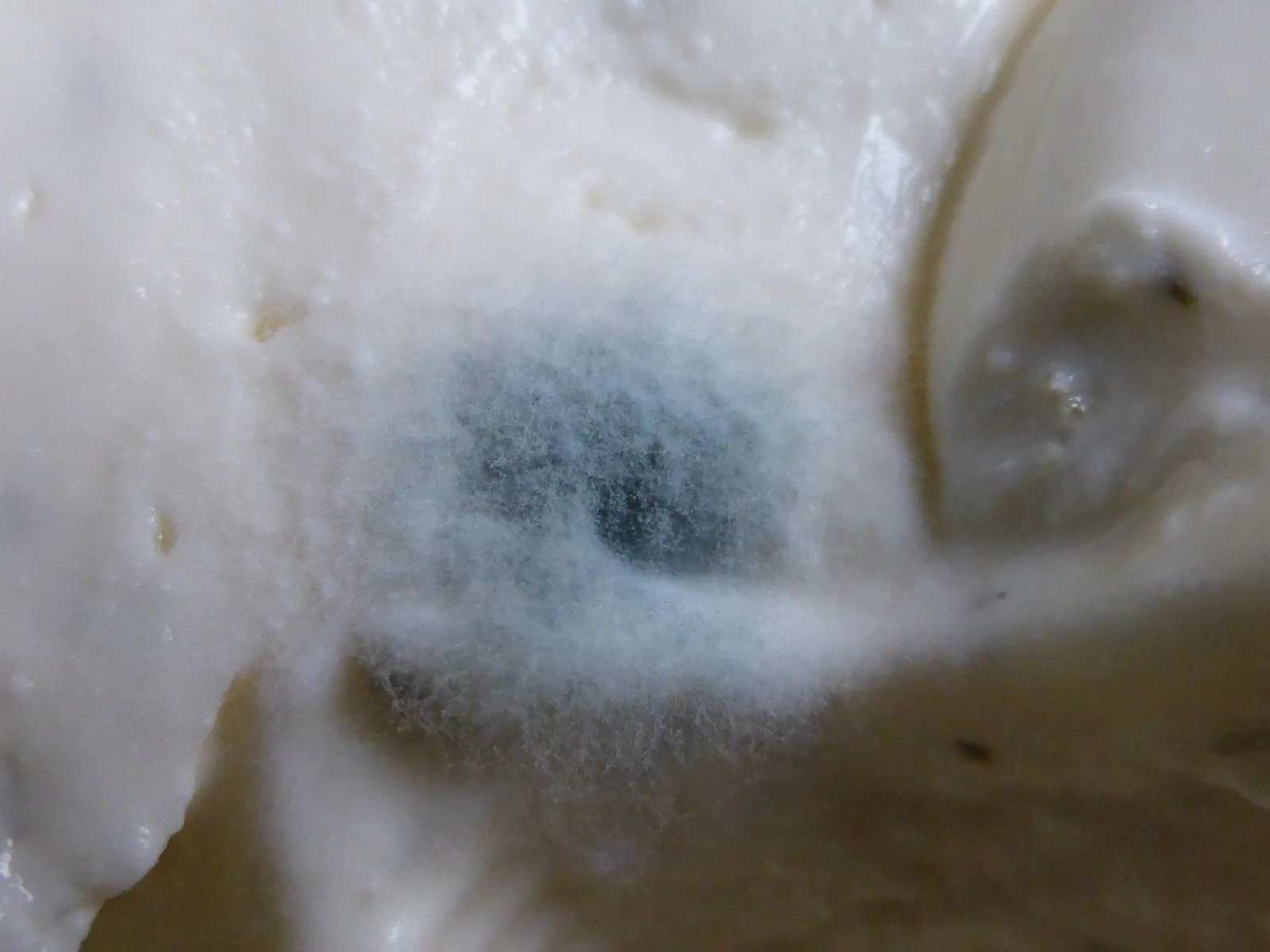
What you do next depends on the type of cheese. On a hard wedge, you can cut the mold out with a margin. On anything soft, shredded or sliced, you throw it away.
The reason is structure. Mold on dense cheese stays mostly at the surface, while soft, wet or shredded cheese lets it spread out of sight. That is the rule behind the USDA's guidance, and it is the whole logic of the table below.
Cheese gone bad: what to do with mold by type
This table shows what to do when cheese has gone bad with mold, by type of cheese, following the USDA FSIS page on molds on food.
| Cheese | Mold on it | What to do |
|---|---|---|
| Hard cheese (cheddar, Swiss, block Parmesan) | Surface spot | Cut off at least 1 inch around and below it; keep the knife out of the mold |
| Soft cheese (cottage, cream cheese, Neufchatel, chevre, Bel Paese) | Any mold | Discard |
| Crumbled, shredded or sliced cheese | Any mold | Discard |
| Brie or Camembert | Mold that is not part of the cheese | Discard |
| Gorgonzola or Stilton | Surface mold beyond the blue veining | Trim 1 inch like hard cheese |
| Cheese made with mold (blue veins, bloomy rind) | The mold used to make it | Safe |
Signs cheese has gone bad before you see mold
The signs cheese has gone bad often show up in the smell or feel first. Sniff the cheese against what it smelled like when you bought it. A hard cheese should smell milky or nutty, and a sour, rotten or sharp ammonia smell that was not there before is a warning. Fresh cheeses, such as cottage cheese and ricotta, should smell clean and mild, and a sour note is the clearest sign they are past it.
Texture tells you the rest. A slimy or sticky film on a cheese that was dry is a sign of bacterial growth. Watery pools, a sharp sour taste, or a color that has gone pink, yellow or gray in patches point the same way. This is guidance, not a lab test, so the rule is simple: when a smell or texture is wrong and you are unsure, do not eat it.
A stinky cheese is not a spoiled cheese. A washed rind like taleggio smells strong on day one, so judge it against its own usual smell and look for slime or a smell sharper than before.
Mold on hard cheese: how to cut it off
Mold on hard cheese is the case where you save the cheese. The USDA says to cut off at least 1 inch around and below the spot, and to keep the knife out of the mold so you do not spread it into the clean part. Then re-wrap the piece in fresh wrap and check it again before the next use.
The same trimming applies to surface mold on Gorgonzola or Stilton, per the FSIS page: 1 inch, like hard cheese. The Stilton and Gorgonzola pages cover the blue veining that is meant to be there. The USDA says the molds used to make cheeses are safe. The white mold on cheese guide covers the fuzzy white kind.
Mold on soft, shredded and sliced cheese
Mold on soft, shredded and sliced cheese means the whole package goes. The FSIS list of soft cheeses to discard includes cottage cheese, cream cheese, Neufchatel, chevre and Bel Paese, and it says to discard all crumbled, shredded or sliced cheese with mold. Do not scoop the mold off a tub and eat what is below.
Brie and Camembert are the one place a rule needs reading closely. The white bloom on the rind is part of the cheese. FSIS says to discard brie or Camembert with mold that is not part of the cheese, so a green, black or pink patch on the rind means it goes.
What most cheese spoilage advice gets wrong
What most cheese spoilage advice gets wrong is treating all mold the same. One camp says to toss anything with a spot and the other says to scrape it off, and both are wrong half the time. The right answer depends on the cheese: hard cheese gets a 1 inch margin, soft and shredded cheese gets thrown out.
The second mistake is trusting the date more than the cheese. A date on a package does not tell you how the cheese was stored. A wedge left on a warm counter or an opened tub kept for two weeks can be bad inside the date. The storage times by type are on the how long cheese lasts page.
The third is judging by smell alone with a cheese that always smells strong. Look and feel count too.
Questions about cheese gone bad
These questions about cheese gone bad cover what readers ask most.
Can you eat cheese with mold on it?
Cheese with mold on it can be eaten only if it is a hard cheese and you cut at least 1 inch around and below the spot, which is the USDA's rule.
How do you know if cheese has gone bad?
You know cheese has gone bad when it smells sour or like ammonia where it should not, feels slimy, or has mold that is not part of the cheese.
Is it safe to cut mold off cheese?
Cutting mold off cheese is safe for hard cheese and for surface mold on Gorgonzola or Stilton, as long as you cut 1 inch away and keep the knife out of the mold.
What cheeses should be thrown out if moldy?
Cheeses to throw out if moldy are soft cheeses such as cottage, cream cheese, Neufchatel, chevre and Bel Paese, and all crumbled, shredded or sliced cheese.
Is the white stuff on brie mold?
The white stuff on brie is the mold the cheese is made with and it is safe, but brie with mold that is not part of the cheese should be discarded.
What if cheese arrives warm in the mail?
Cheese that arrives warm should be reported to the company and not tasted, since mail-order cheese should arrive below 40°F, per the FSIS mail-order page.
When to throw cheese away
When to throw cheese away comes down to the type. Trim hard cheese with 1 inch of margin, discard soft and shredded cheese at the first mold, and drop anything slimy or sharply sour. For cheese you keep, rewrap it and use the guidance in storing cheese properly so you see less of this. For the white crunchy bits that look worrying but are not, read crystallized vs spoiled cheese.
Sources
- Molds on Food: Are They Dangerous?, USDA Food Safety and Inspection Service
- Mail-Order Food Safety, USDA Food Safety and Inspection Service
- FoodKeeper App, FoodSafety.gov (USDA)