
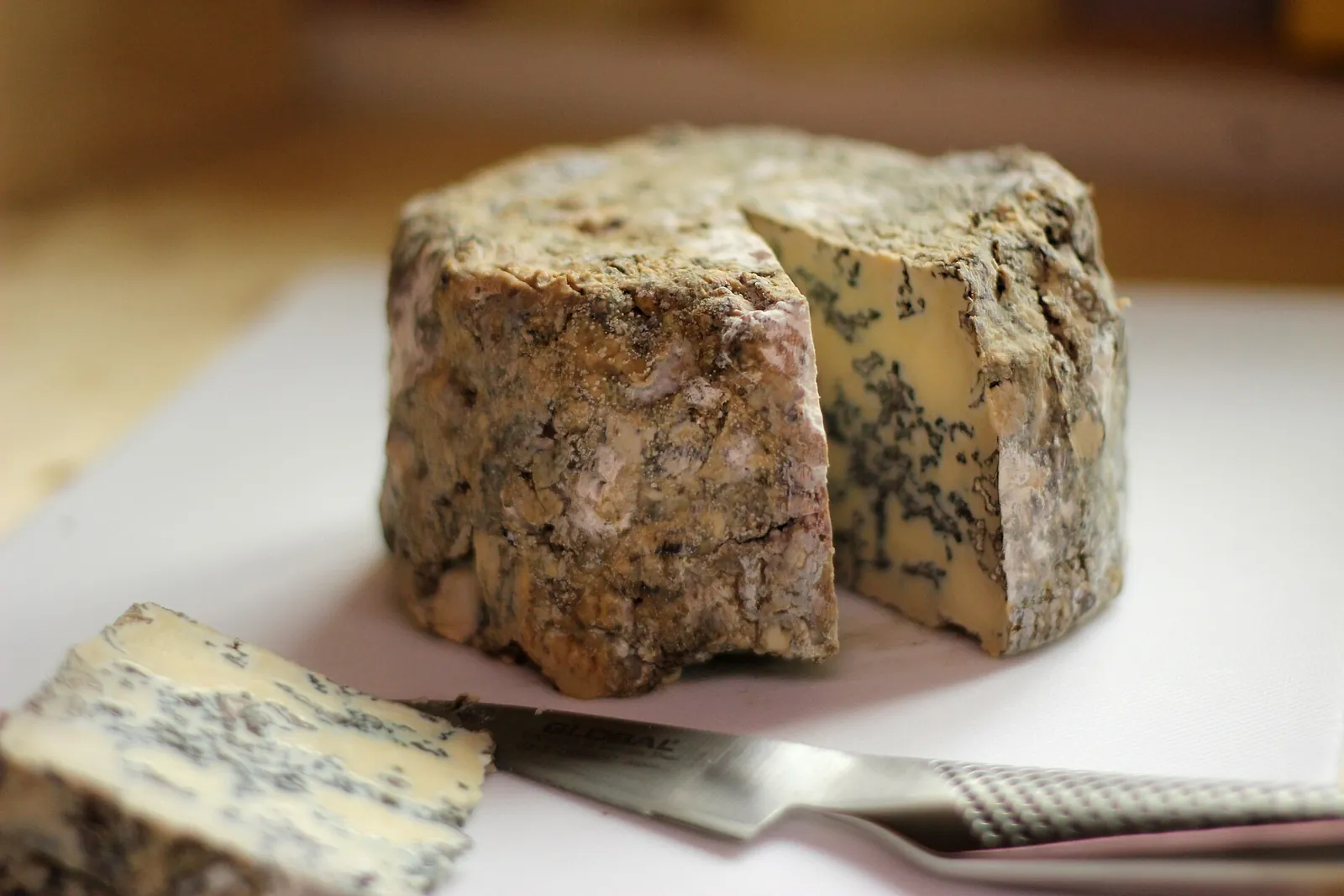
Blue is a family, not one cheese: Gorgonzola dolce is soft and mild enough for beginners, while Roquefort is sharp, salty and crumbly. Buying the wrong one is the usual reason people say they dislike blue cheese.
All blues share a mold. The federal standard for blue cheese describes spores of Penicillium roqueforti added during making, then a cure at about 50°F and high humidity until the characteristic mold has grown, and it requires the cheese to be at least 60 days old. Style, milk and salt do the rest, and the blue cheese guide explains how veins form.
Choose blue cheese by strength
To choose blue cheese by strength, sort the common styles from gentle to fierce.
| Strength | Examples | What to expect |
|---|---|---|
| Mild | Gorgonzola dolce, Saint-Agur, Cambozola | Creamy, soft, gentle tang |
| Medium | Stilton, Maytag Blue, Gorgonzola piccante | Firmer, more peppery, moderately salty |
| Strong | Roquefort, Cabrales | Sharp, salty, pungent |
Gorgonzola comes as soft dolce, sold from 50 days of age, or firmer piccante, from 80 days, and Roquefort is raw sheep's milk cured at least 90 days. The Gorgonzola page and Roquefort page go deeper, and blue cheese vs. Gorgonzola vs. Roquefort explains why a tub labeled only "blue cheese" is neither. If unsure, start milder: Saint-Agur and Cambozola are the usual gateway blues.
Blue cheese texture and use
Blue cheese texture decides what the cheese is good for, so match it to the job. Dairy Farmers of Wisconsin notes that blues run from creamy to crumbly, and the needling that lets air reach the mold is why many are open and crumbly.
- Sauces and spreading: soft, creamy blues such as Gorgonzola dolce melt smoothly into cream sauces and spread on bread.
- Salads and burgers: firm, crumbly blues such as Roquefort or Stilton crumble cleanly and keep their shape.
- Cheese board: pick one mild and one strong if guests differ. See the blue cheese pairing guide for honey, pears and port.
Stilton sits in between, crumbly to creamy depending on age.
How salty blue cheese is
Blue cheese is among the saltiest cheeses, so salt is part of choosing. Strong blues like Roquefort taste saltier and a little goes far, while creamy dolce styles read milder. If a recipe adds salt, taste the blue first. The sodium figures by style are in the guide linked above, and and blue sits well above cheddar in salt.
Signs a blue cheese is fresh
Signs a blue cheese is fresh are easy to read on the cut face. Look for veining spread through the paste rather than only in one patch, a moist or creamy paste appropriate to the style (not dried out, cracked or slimy), and a strong but clean smell. Pass on a wedge that smells of ammonia or looks gray at the edges, and be wary of brown, dried-out cut faces.
Pre-crumbled blue dries out and loses flavor faster than a wedge, so crumble your own. A thin yellowish film on a cut face is usually just oxidation, and slicing off the first layer fixes it.
Rind on blue cheese
The rind on blue cheese varies by style, so read it as a clue rather than a rule. Many blues have a natural rind that can be eaten or trimmed, while some, like foil-wrapped Roquefort and Gorgonzola, are sold with the wrapper off the edible parts. When in doubt, see can you eat cheese rind.
Blue cheese buying mistakes
Blue cheese buying mistakes usually come from skipping one of the checks above.
Starting with the strongest blue
Starting with the strongest blue is the quickest way to put someone off the style. Begin with a creamy dolce or Saint-Agur.
Treating "blue cheese" as a single product
Treating blue cheese as one product hides that generic blue can be cow, sheep or goat milk, and quality varies. Taste before you commit when you can. Named cheeses like Gorgonzola and Roquefort carry protected rules for milk, place and age.
Buying more than you will use
Buying more blue cheese than you will use wastes it, so buy a wedge you will finish in a week or two, wrapped loosely so the mold can breathe, since tight plastic traps moisture and off flavors.
Questions about choosing blue cheese
These are the questions people ask about choosing blue cheese.
What is the best blue cheese for beginners?
The best blue cheese for beginners is a mild, creamy one such as Gorgonzola dolce, Saint-Agur or Cambozola, ideally with honey or fruit.
What is the mildest blue cheese?
The mildest blue cheeses are creamy styles like Cambozola and Gorgonzola dolce, which taste gentler than Roquefort or Cabrales.
Which blue cheese is best for salads?
The best blue cheese for salads is a firm, crumbly one such as Roquefort or Stilton, which crumbles cleanly.
Which blue cheese is best for sauces?
The best blue cheese for sauces is a soft, creamy one such as Gorgonzola dolce, which melts smoothly into cream.
How can you tell blue cheese has spoiled?
Blue cheese has spoiled when it smells of ammonia, turns slimy, or grows fuzzy mold of an unexpected color. Its blue veins are normal, not a sign of spoilage.
Picking a blue cheese
Picking a blue cheese is a matter of three steps: choose a strength, match texture to use, and check the cut face. For a first try, buy a wedge of Gorgonzola dolce. Once you like it, step up to Stilton and then Roquefort.
At the counter, ask for a taste of two blues side by side, one creamy and one crumbly, and ask when the wedge was cut. A fresh cut face with even veining beats a bigger piece that has sat open. Wrap what you take home loosely in cheese paper or foil, keep it in a lidded box in the fridge, and bring it out about half an hour before serving so the flavor opens up.
Sources
- 21 CFR 133.106 Blue cheese, Legal Information Institute, Cornell Law School
- Blue Cheese, Dairy Farmers of Wisconsin
- 21 CFR Part 133, Cheeses and Related Cheese Products, eCFR (FDA standards of identity)