
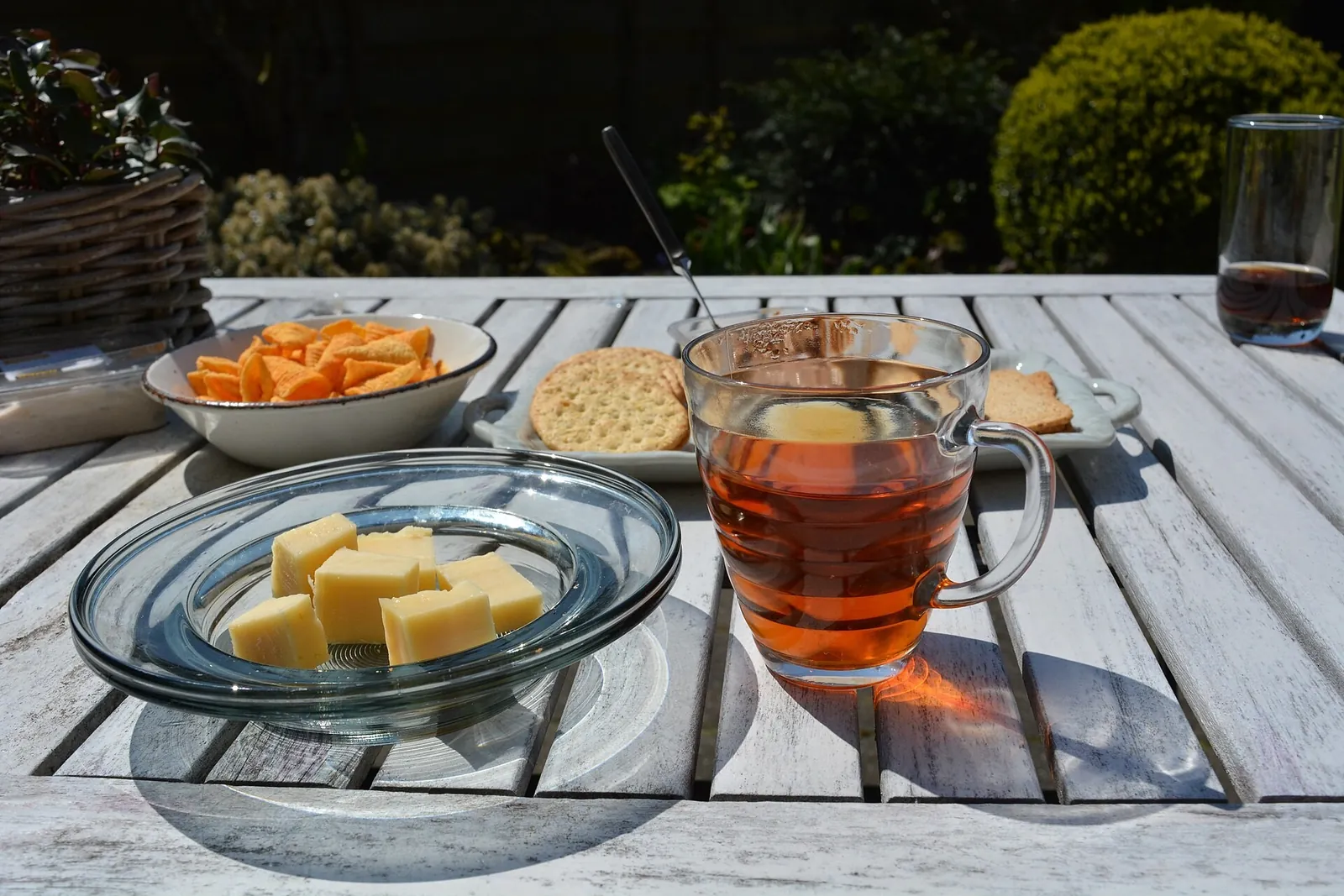
Tea has no alcohol and plenty of range, which makes it an easy choice for an afternoon tasting, a brunch, or a table where some guests do not drink. Buy loose or bagged tea of decent quality, since stale, dusty tea tastes of nothing and the cheese will dominate it.
All true tea starts as one plant. According to Wikipedia's entry on tea, tea comes from Camellia sinensis, and the types differ by processing: white tea is wilted and unoxidized, green is unoxidized, oolong is partially oxidized, black is fully oxidized, and pu-erh is post-fermented. That ladder, from light to heavy, is roughly the ladder of cheeses it pairs with.
Tea and cheese pairings at a glance
This tea and cheese table matches each tea type with cheeses that suit it, as guidance for a first tasting.
| Tea | Style | Cheeses | Why |
|---|---|---|---|
| White or green | Delicate, grassy | Chèvre, fresh mozzarella, ricotta | Fresh next to fresh, nothing overwhelmed |
| Oolong | Floral to toasty | Gruyère, Comté, aged Gouda | Roasted notes echo nutty cheese |
| Black (Assam, English Breakfast) | Brisk, malty | Aged cheddar | Body that stands up to sharpness |
| Bergamot-flavored black tea | Citrusy | Mild, creamy cheeses | Bergamot brightens richness |
| Lapsang Souchong | Smoky | Smoked or pungent cheeses | Smoke meets smoke |
| Pu-erh | Earthy | Strong, funky cheeses | Earth meets earth |
Black tea with cheese
Black tea with cheese is the closest match to red wine, because black tea is the heaviest and most astringent of the common teas. A brisk Assam or English Breakfast suits aged cheddar: the tea scrubs the palate between bites, and the malty flavor sits well with a sharp, crumbly cheese. The aged vs. young cheddar guide explains what to buy.
Black tea flavored with bergamot, a citrus, does well with creamy cheeses such as brie. Lapsang Souchong is a black tea that, per Wikipedia, is smoke-dried over a pinewood fire, which is where the smoky flavor comes from. It is best with a cheese that already has smoke or strong flavor. Serve black tea without milk if you can, since milk coats the tannic bite that makes the match work.
Green and white tea with cheese
Green and white tea with cheese works for the lightest cheeses. Both are unoxidized, and they taste grassy, vegetal and sometimes sweet. Fresh goat cheese, fresh mozzarella and ricotta are mild enough to let that show, and the tea's freshness balances the tang. Think of it as the tea equivalent of a crisp white wine; the white wine and cheese guide has the same logic.
Use water that has cooled a little from boiling, since scalding water makes green tea bitter, and keep the cheese plain. A strong flavored cheese will flatten a white tea.
Oolong and pu-erh with cheese
Oolong and pu-erh with cheese cover the middle and heavy end. Oolong is partially oxidized, and Wikipedia's oolong entry gives a range of 8 percent to 85 percent, so it can run from green and fresh through sweet and fruity to woody and roasted. Check the package: the lighter styles suit mild cheese, the roasted ones suit aged cheese. That range is why oolong is the most flexible tea to keep on hand for cheese. A roasted oolong echoes the nutty flavors of Gruyère, Comté and aged Gouda; see the Gruyère and Comté pages for what those cheeses taste like. A greener, floral oolong goes better with a mild, creamy cheese.
Pu-erh is a post-fermented tea, earthy and deep, and it holds up against washed-rind and other strong cheeses. Jasmine and chai are scented and spiced blends that suit simple, creamy cheeses, and chai is good with a mild cheddar. Herbal infusions such as chamomile are not tea, per Wikipedia, but they pair as a light alternative with fresh cheese.
Tea and cheese mistakes to avoid
Tea and cheese mistakes come down to strength, steeping and temperature, and each is easy to fix once you know to look for it.
Tea and cheese mistakes are usually about strength and temperature. Over-steeped tea turns bitter and makes every cheese taste thin, so follow the time on the package. A flavored tea with a strong cheese is a loser, too, as the perfume fights the cheese. And a very light tea with an aged cheddar disappears.
Serve the cheese at room temperature, which means taking it out of the fridge about 30 minutes ahead, and the tea warm rather than boiling hot. Taste the cheese, sip, and taste the cheese again: the second bite shows what the tea changed.
Questions about tea and cheese
These questions about tea and cheese cover the common matches.
Does tea go with cheese?
Tea goes with cheese when the weights match: delicate teas with fresh cheeses and brisk or roasted teas with aged ones.
What tea goes with aged cheddar?
The tea that goes with aged cheddar is a brisk black tea such as Assam or English Breakfast, whose body holds up against the sharpness.
What tea goes with goat cheese?
The tea that goes with goat cheese is a delicate green or white tea, which balances the tang the way a crisp white wine would.
What tea goes with blue cheese?
The tea that goes with blue cheese is a strong one, such as a dark oolong or a smoky Lapsang Souchong, with honey or a fig on the side.
Is tea a good non-alcoholic cheese pairing?
Tea is a good non-alcoholic cheese pairing. The non-alcoholic pairings page covers other drinks.
Start your tea and cheese tasting
Start your tea and cheese tasting with three teas and three cheeses, and keep the portions small, about an ounce of each cheese per person, so palates stay fresh through the whole round. Brew each tea just before tasting, since tea left to stand keeps extracting and turns bitter, and offer plain water between pairings.
For a first tea and cheese tasting, brew a black, a green and an oolong, set out aged cheddar, fresh goat cheese and Comté, and taste each combination. Take notes on which tea changed which cheese most. For serving ideas, read the cheese board guide.
Sources
- Tea, Wikipedia
- Oolong, Wikipedia
- Lapsang souchong, Wikipedia