
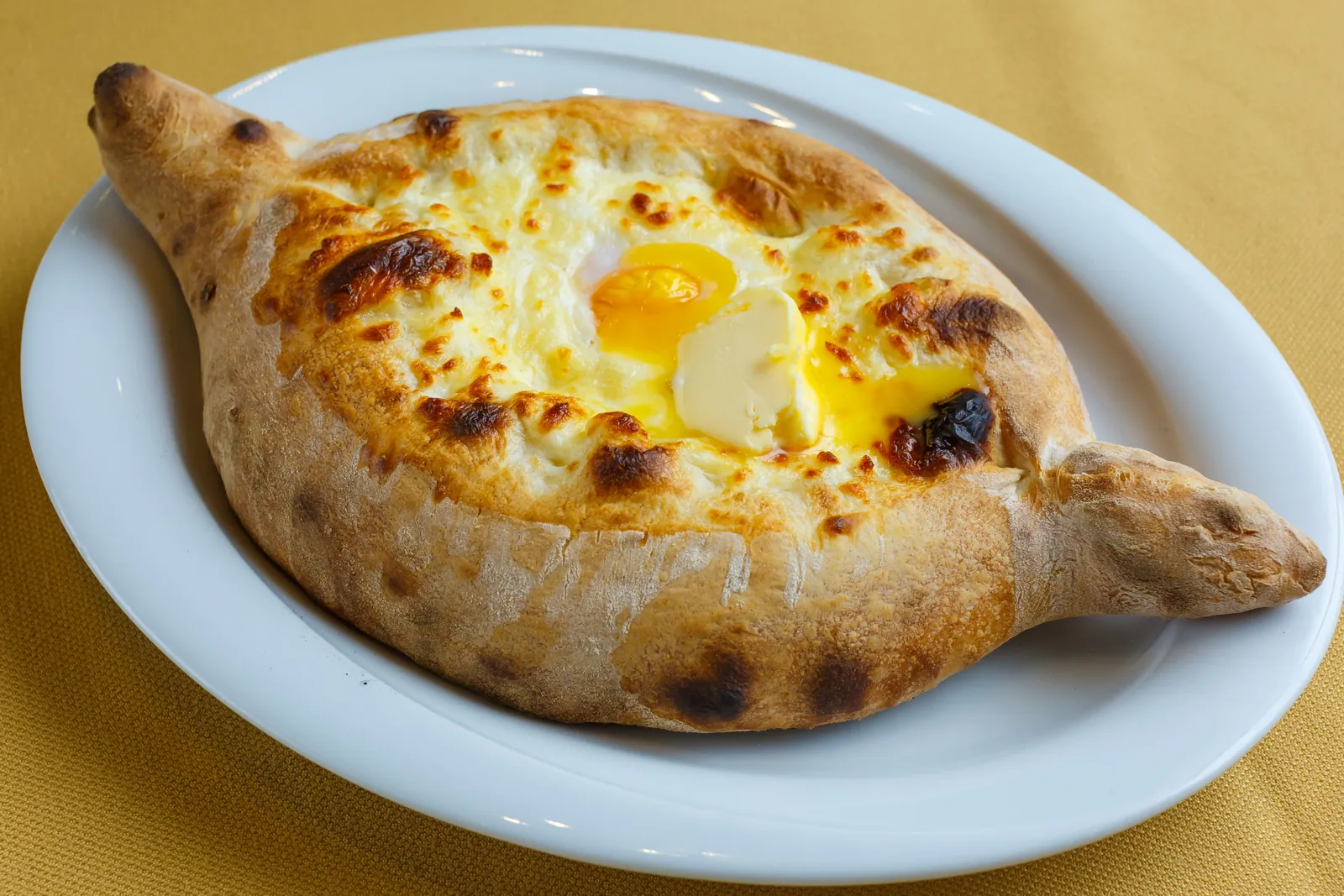
You tear off the crust and drag it through the middle.
The Georgian National Tourism Administration describes khachapuri as a traditional filled bread with about 40 regional variations, and says the Adjarian style takes its boat shape from the region's maritime heritage. The cheese does the real work, and at home it is a blend you assemble.
Khachapuri at a glance
This khachapuri table gives the yield, timing and cheese choice for the Adjarian boats below.
| Adjarian khachapuri | |
|---|---|
| Yield | 2 large boats, serving 4 |
| Active time | 30 minutes |
| Total time | About 2 hours, mostly rising |
| Oven | 475°F (245°C), pizza stone or inverted baking sheet |
| Best cheese | Sulguni with imeruli; at home, 2 parts low-moisture mozzarella to 1 part feta |
| Make ahead | Dough up to 24 hours in the refrigerator; bake and eat at once |
How to make khachapuri
How to make khachapuri starts with a soft, slightly enriched yeast dough and a salty, stretchy cheese filling. The egg goes in near the end of the bake, and the butter goes on after.
Ingredients for khachapuri
These ingredients for khachapuri make two Adjarian boats; the dough is a simple yeast dough.
- Dough: 3 1/4 cups (410 g) all-purpose or bread flour, plus more for dusting
- Dough: 1 packet (2 1/4 teaspoons, 7 g) instant yeast
- Dough: 1 teaspoon sugar
- Dough: 1 1/2 teaspoons kosher salt
- Dough: 1 cup (240 ml) warm whole milk, about 100°F (38°C)
- Dough: 1/4 cup (60 g) plain whole-milk yogurt
- Dough: 2 tablespoons olive oil or melted butter
- Filling: 8 oz (225 g) low-moisture whole-milk mozzarella, coarsely grated
- Filling: 4 oz (115 g) feta, crumbled
- Filling: 4 oz (115 g) fresh whole-milk mozzarella or mild farmer's cheese, torn
- Filling: 1 egg, lightly beaten, to bind
- Top: 2 egg yolks
- Top: 2 tablespoons (28 g) cold unsalted butter, cut into pats
- Wash: 1 egg beaten with 1 tablespoon milk
Steps for making khachapuri
These steps for making khachapuri give the rise, the shaping and the two stage bake that cooks the egg.
- Stir the flour, yeast, sugar and salt together, add the milk, yogurt and oil, and knead for 8 minutes by hand or 5 minutes with a dough hook until smooth and slightly tacky.
- Cover the bowl and let the dough rise in a warm spot for 1 to 1 1/2 hours until doubled.
- Heat the oven to 475°F (245°C) with a stone or inverted baking sheet on the middle rack.
- Mix the mozzarella, feta, torn cheese and the beaten egg for the filling, and divide the dough in two.
- Roll each piece into an oval about 10 inches (25 cm) long and 7 inches (18 cm) wide, and pile half of the filling down the center, leaving 2 inches (5 cm) clear on every side.
- Roll the long edges inward toward the filling to make walls, pinch the tapered ends together into points, and twist them slightly so the loaf looks like a boat.
- Brush the walls with the egg wash and slide the boats onto parchment, then onto the hot stone.
- Bake for 12 to 15 minutes until the crust is deep golden and the cheese is bubbling and starting to brown.
- Pull the boats out, make a well in the cheese, drop in a yolk, and return them for 2 to 3 minutes until the yolk is warm and just starting to set.
- Top each boat with butter and serve at once, stirring the yolk and butter into the cheese before tearing off the crust.
The best cheese for khachapuri
The best cheese for khachapuri is sulguni, and the closest US blend is low-moisture mozzarella with feta. Sulguni is a brined, stretched-curd cheese from western Georgia that melts like mozzarella, and the tourism agency's guide to Georgian cheeses names it and imeruli as traditional khachapuri cheeses, and its khachapuri page says Megrelian khachapuri pairs it with chkinti cheese. Imeruli is a fresh, mild brined cheese that adds milkiness.
Mozzarella supplies the melt and stretch, since it is also a stretched-curd cheese; read the mozzarella guide for why low-moisture melts and browns better than fresh. Feta supplies the salt and tang, and the feta page explains how to choose it. A good starting point is 2 parts mozzarella to 1 part feta. Low-moisture mozzarella has less salt than sulguni, so the feta is doing real work, and you can taste the blend before baking.
If you find real sulguni at a Georgian or Eastern European grocer, use it in place of the mozzarella, and taste before adding more feta. Skip cheeses that weep oil, like aged cheddar, and mild fresh ones that bring too much water, like ricotta.
Khachapuri mistakes and fixes
Khachapuri mistakes usually come down to wet cheese, a thin dough or an egg that cooks too far.
- Soggy bottom. Wet cheese leaks into the dough. Use low-moisture mozzarella, squeeze fresh mozzarella dry and bake on a preheated stone.
- Boat springs open. The walls were too thin or not pinched. Roll the sides tightly and pinch hard at the ends.
- Rubbery yolk. The egg went in too early. Add it for the last 2 to 3 minutes only, and take the boat out while the yolk is still glossy.
- Dense dough. Too little rise. Let it double, and use warm, not hot, milk, since heat kills yeast.
- Bland, greasy filling. Too much mozzarella and not enough feta. Taste the blend before it goes in.
- A cold yolk. Return the boat to the oven after adding it; do not just drop it on a cooled loaf.
Khachapuri variations
Khachapuri variations follow the regions. Imeretian khachapuri is a round, closed loaf stuffed with cheese, described by the Georgian tourism agency as the most widespread type, and the easiest at home: seal the filling inside a round of dough, flatten and pan-cook or bake it. Megrelian khachapuri adds a layer of cheese on top. Other regional forms include turban-shaped, millet-based and potato-and-cheese versions. For a quick weeknight version, wrap the filling in store-bought pizza dough, or use a flour tortilla in a skillet.
Making khachapuri ahead, and storing it
Making khachapuri ahead is limited to the dough and filling, since it is best eaten within minutes of leaving the oven, when the cheese is molten. The dough can rise slowly in the refrigerator for up to 24 hours, and the filling can be mixed a day ahead; shape and bake straight from the refrigerator. Leftover bread without the egg keeps covered in the refrigerator for a few days and reheats in a 350°F (175°C) oven until hot and crisp; refrigerate leftovers promptly. A runny yolk is the usual way to serve it, but anyone who wants it fully set can bake the egg a few minutes longer.
Questions about khachapuri
These questions about khachapuri cover the cheese, the egg and the shape.
What cheese is used in khachapuri?
The cheese used in khachapuri in Georgia is sulguni, often with imeruli. Outside Georgia, low-moisture mozzarella and feta in a ratio of about 2 to 1 gives a close result.
What does khachapuri mean?
Khachapuri combines two Georgian words, khacho for cheese curds and puri for bread, according to the Institute of Culinary Education.
How do you eat khachapuri?
Khachapuri is eaten by hand. Stir the yolk and butter into the molten cheese, then tear off the crust and dip it.
Can khachapuri be made without yeast?
Khachapuri can be made with a no-yeast dough of flour, yogurt and baking powder. The texture is closer to a flatbread, and the yeast version stays softer and more bread-like.
Is the egg in khachapuri raw?
Khachapuri's egg is added late in the bake, so the yolk is warm and soft, not fully cooked. Bake it a few minutes longer for a firm yolk, particularly when serving anyone pregnant, elderly or with a weakened immune system.
Next step for khachapuri
The next step for khachapuri is a soft dough, a stretchy and salty blend and a late egg. Start with the 2 to 1 mozzarella and feta mix, and look for the real cheese at a Georgian grocer once you want the Georgian flavor.
Sources
- Get a taste of khachapuri, Georgian National Tourism Administration
- Types of Georgian Cheese, Georgian National Tourism Administration
- Georgia's Khachapuri Combines Tradition, Egg and Cheese Bread, Institute of Culinary Education