
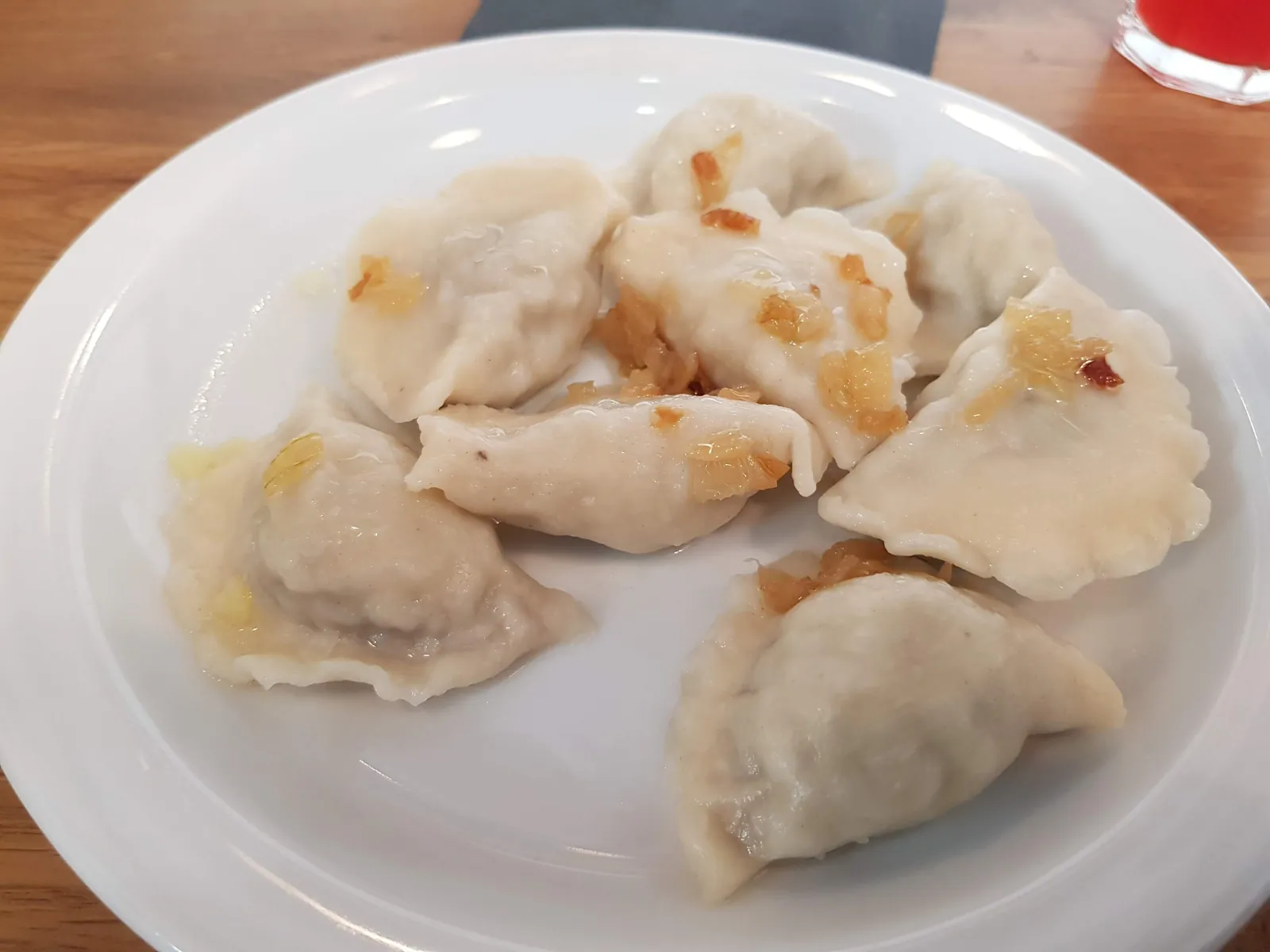
The Polish version is called pierogi ruskie, and it works because the dry, tangy cheese cuts through the mild potato, with fried onion adding sweetness.
Wikipedia describes pierogi as filled dumplings made by wrapping unleavened dough around a filling and cooking it in boiling water, and notes that pierogi ruskie combine potato, twaróg and fried onions. The dough and filling below are written for a US kitchen.
Cheese pierogi at a glance
This cheese pierogi table gives the numbers for one batch.
| Yield | About 28 pierogi, 4 servings of 6 to 7 |
| Active and total time | About 60 minutes active (including shaping), 90 minutes total with the dough rest |
| Cooking | Boil in salted water, then pan-fry in butter over medium heat |
| Best cheese | Dry farmer's cheese (twaróg); quark or drained ricotta as stand-ins |
| Make-ahead | Freeze uncooked pierogi on a tray, then bag; boil from frozen |
How to make cheese pierogi
This cheese pierogi recipe makes the dough, the ruskie filling and the finish in three stages.
Ingredients for cheese pierogi
These are the ingredients for one batch of cheese pierogi.
- Dough: 2 cups (250 g) all-purpose flour, plus more for dusting
- Dough: 1/2 cup (120 g) sour cream
- Dough: 1 large egg
- Dough: 1/2 teaspoon salt
- Dough: 2 to 4 tablespoons warm water, as needed
- Filling: 1 medium (about 8 oz or 225 g) russet potato, peeled and cubed
- Filling: 1 cup (about 8 oz or 225 g) dry farmer's cheese (twaróg), crumbled
- Filling: 1 small onion, finely diced
- Filling: 1 tablespoon butter, for the onion
- Filling: 3/4 teaspoon salt and 1/2 teaspoon black pepper
- To finish: 3 tablespoons butter and 1 sliced onion for pan-frying
- To serve: sour cream
Steps for making cheese pierogi
These steps make cheese pierogi from dough to plate.
- Whisk the flour and salt, add the sour cream and egg, and mix with a fork, adding warm water a tablespoon at a time until the dough just comes together.
- Knead for 5 minutes on a floured counter until smooth and soft but not sticky, then cover and rest for 30 minutes.
- Boil the potato in salted water for 15 minutes until a knife slides in with no resistance, drain well and mash with no milk or butter.
- Cook the diced onion in 1 tablespoon butter over medium-low heat for 8 minutes until golden, then mix into the potato with the farmer's cheese, salt and pepper until the filling holds together like thick dough.
- Roll half the dough about 1/16 inch thick, cut 3-inch rounds with a glass or cutter, and keep the rest covered.
- Place 1 tablespoon filling in each round, fold into a half-moon, and pinch the edge shut, pressing out air so no filling touches the seam.
- Boil a few at a time in a wide pot of simmering salted water for 3 to 4 minutes after they float, until the dough is tender, then lift out with a slotted spoon.
- Melt 3 tablespoons butter in a skillet over medium heat, fry the sliced onion for 8 minutes, then add the boiled pierogi in a single layer and fry 2 to 3 minutes per side until golden. Serve hot with sour cream.
The best cheese for cheese pierogi
The best cheese for cheese pierogi is a dry, crumbly fresh cheese, because wet cheese turns the filling soupy and the seams leak.
Twaróg is the Polish curd cheese used in ruskie filling. In the US, farmer's cheese sold in tubs or blocks is the nearest match; look for one that crumbles rather than spreads. Quark, which is known as twaróg in Polish shops, works the same way, though the tub style can be wetter and may need straining. Tub ricotta is the most common substitute, and it needs draining in a sieve for several hours so it is as dry as farmer's cheese. Dry-curd cottage cheese is another, since it has no creamy dressing; mash it or pulse it briefly. For other swaps, the substitute finder lists them.
Do not use a melting cheese such as mozzarella or cheddar. Ruskie filling is not meant to be gooey; it is tangy, salty and crumbly.
Cheese pierogi mistakes and fixes
Most cheese pierogi problems come from a wet filling or a bad seal.
- Bursting in the pot: too much filling, a seam with filling on it, or a hard boil. Use 1 tablespoon, press out air, and keep the water at a gentle simmer.
- A wet, loose filling: cheese or potato that was not dry. Drain ricotta, mash the potato dry and let the filling cool before shaping.
- Tough dough: too much flour or too thin a rest. Keep it soft and let it rest 30 minutes.
- Sticking together: crowded pot or no butter after boiling. Cook in small batches and toss with butter.
- Gummy potato: overworked mash. Mash just until smooth.
Cheese pierogi variations
Cheese pierogi change with the cheese, the fat and the finish.
- Sweet cheese pierogi: farmer's cheese mixed with 2 tablespoons sugar, an egg yolk and a little vanilla or lemon zest, served with sour cream and fruit.
- Cheese and sauerkraut: drained sauerkraut folded into the filling.
- Baked: brush boiled pierogi with butter and bake at 400°F for 10 to 15 minutes.
- Mushroom and onion: a good addition for the topping.
Make-ahead, freezing and reheating cheese pierogi
Cheese pierogi are one of the best make-ahead dumplings. Shape them, freeze in one layer on a floured tray until firm, then bag them. Boil straight from frozen for about 5 to 6 minutes after they float, then pan-fry.
Cooked leftovers should be refrigerated within 2 hours and eaten within 3 to 4 days. Reheat to 165°F, per USDA FSIS, in a skillet with butter so the surface crisps again.
Cheese pierogi origins
Cheese pierogi have a murky history. Wikipedia says the exact origin of the pierogi is unknown and unverifiable, and it lists competing theories without settling them. The word ruskie refers to the historical Ruthenian region, not Russia, and it is often mistaken for Russian.
Questions about cheese pierogi
These are quick answers to common questions about cheese pierogi.
What cheese is used in cheese pierogi?
Cheese pierogi use farmer's cheese, called twaróg in Polish, usually mixed with mashed potato and fried onion for pierogi ruskie.
Can you use ricotta for cheese pierogi?
Ricotta works for cheese pierogi once it is drained well, because wet ricotta makes the filling loose and the seams leak.
Do you boil or fry cheese pierogi?
Cheese pierogi are boiled first until they float and the dough is tender, and many cooks then pan-fry them in butter for a golden surface.
How do you keep cheese pierogi from bursting?
Cheese pierogi stay closed when you use a dry filling, about 1 tablespoon each, a clean seam and a gentle simmer instead of a hard boil.
Can you freeze cheese pierogi?
Cheese pierogi freeze well uncooked: freeze them on a tray, bag them, and boil from frozen.
Making cheese pierogi
Making cheese pierogi is mostly patience: a dry filling, a soft dough and a firm seal. Start with the ruskie version, and once the dough feels familiar, try the sweet cheese filling.
Sources
- Pierogi, Wikipedia
- Safe Minimum Internal Temperature Chart, USDA Food Safety and Inspection Service
- Cook to a Safe Minimum Internal Temperature, FoodSafety.gov