
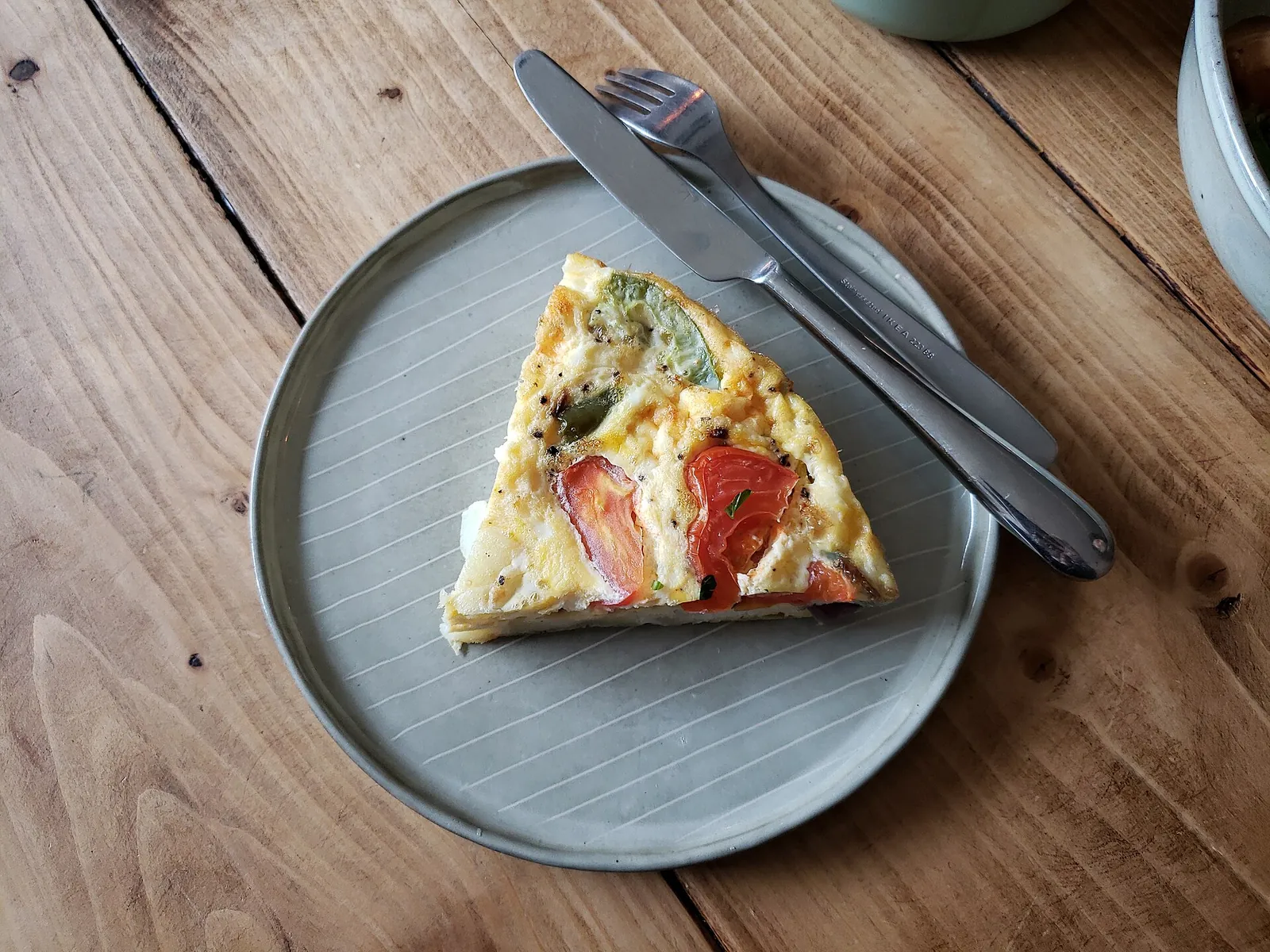
Make 3 ounces of that cheese a good melter such as Gruyère, young cheddar or fontina, and the last ounce Parmesan for salt and a browned top.
The hard part is the finish. USDA's food-safety agency says egg dishes should reach 160°F (71°C), measured with a food thermometer, and eggs cooked that far with no help can turn rubbery. The dairy and salt in the bowl are what keep a frittata tender when it gets there.
Best cheeses for a frittata
The best cheeses for a frittata either melt into the eggs or stay put in soft pockets, and the table shows which is which, with amounts for 8 eggs.
| Cheese | What it does in the eggs | Amount per 8 eggs | Good with |
|---|---|---|---|
| Gruyère | Melts smooth and nutty | 3 oz, shredded | Ham, onions, mushrooms |
| Young or medium cheddar | Melts smooth, mild tang | 3 oz, shredded | Potatoes, bacon, broccoli |
| Fontina, Monterey Jack | Melts creamy and mild | 3 oz, shredded | Spinach, peppers, sausage |
| Low-moisture mozzarella | Melts with a little stretch | 2 to 3 oz, shredded | Tomatoes, basil |
| Parmigiano-Reggiano, Pecorino Romano | Seasons and browns the top | 1 oz, finely grated | Any filling |
| Fresh goat cheese, ricotta | Stays in creamy pockets | 2 to 4 oz, in spoonfuls | Herbs, asparagus, leeks |
| Feta | Stays in salty crumbles | 2 to 3 oz, crumbled | Spinach, tomatoes, olives |
| Cottage cheese | Adds soft curds and protein | 1/2 cup, drained | Spinach, herbs |
Melting cheeses for a creamy frittata
Melting cheeses such as Gruyère, young cheddar, fontina and Monterey Jack disappear into the eggs and make every bite creamy. Serious Eats counts Gruyère, mozzarella and Jack among the reliable melters, and explains that as cheese ages its proteins clump tighter and hold fat and water less well, which is why an extra-aged cheddar melts grainy and greasy. Buy a young or medium block and shred it yourself; the full ranking is in the guide to the best melting cheeses.
Hard cheeses for flavor
Hard cheeses such as Parmigiano-Reggiano and Pecorino Romano are there for flavor, and an ounce is plenty. They are also salty: USDA lists hard Parmesan at 333 milligrams of sodium per ounce and Romano at 406, so cut the added salt if you use more. Save half for the top, where it browns into a savory crust in the oven.
Cheeses that stay in soft pockets
Cheeses that stay in soft pockets, such as fresh goat cheese, ricotta and feta, give a frittata bursts of tang instead of an even melt. Serious Eats explains that acid-set cheeses like fresh goat cheese and ricotta never melt: acid dissolves the calcium glue in the curd, so heat only drives out water. Cottage cheese, a favorite in high-protein frittatas, behaves the same way. Half a cup adds about 12 grams of protein (USDA lists 11.1 grams per 100 grams), but it is nearly 80 percent water, so drain it well first.
How much cheese per 8 eggs
How much cheese per 8 eggs depends on texture, and 3 to 4 ounces (about 1 cup shredded) gives a cheesy frittata that still slices cleanly. America's Test Kitchen uses 4 ounces of Monterey Jack for 12 eggs in its ham and Jack frittata, a third of an ounce per egg; a cheese frittata can run a little richer, to half an ounce.
Go much past that and two things happen. There is more cheese than egg to hold it together, and the fat starts to pool, because the University of Wisconsin's Center for Dairy Research explains that the faster and further a cheese flows, the more milkfat it releases. Stir three-quarters of the cheese into the eggs and scatter the rest on top.
Cheese egg frittata recipe
This cheese egg frittata recipe serves 4 as a main dish or 6 as part of a brunch, and takes about 25 minutes. You need a 10-inch oven-safe nonstick skillet and an instant-read thermometer.
Ingredients
- 8 large eggs
- 3 tablespoons half-and-half or whole milk
- 1/2 teaspoon fine salt
- 1/4 teaspoon black pepper
- 3 ounces (85 g) Gruyère, fontina or young cheddar, shredded (about 3/4 cup)
- 1 ounce (28 g) Parmigiano-Reggiano, finely grated (a heaping 1/4 cup)
- 1 tablespoon butter or olive oil
- 2 tablespoons chopped chives or parsley (optional)
Method
- Heat the oven to 400°F (200°C) with a rack in the upper-middle position.
- Whisk the eggs, half-and-half, salt and pepper for about 30 seconds, until no streaks of white remain. Stir in three-quarters of the shredded cheese, half the Parmesan and the herbs.
- Melt the butter in the skillet over medium heat until it foams. Pour in the eggs and stir, scraping the bottom with a silicone spatula, until large curds form but the eggs are still very wet, about 2 minutes. Smooth the top and cook without stirring for 30 seconds to set the bottom.
- Scatter the remaining cheese and Parmesan over the top and move the skillet to the oven. Bake for 6 to 10 minutes, until the frittata is puffed, the center springs back when pressed, and the thermometer reads 160°F (71°C) in the middle.
- Rest it in the skillet for 5 minutes (the handle is hot), then loosen the edges with the spatula, slide it onto a board and cut it into wedges.
Made with Gruyère, each of six wedges comes to about 15 grams of protein and 200 calories, by USDA figures for the eggs, half-and-half, cheeses and butter.
Why a frittata finishes in the oven
A frittata finishes in the oven because a skillet heats only from below, and by the time the top of a thick layer of eggs sets on the stove, the bottom has gone tough. Starting on the stove and finishing in the oven, America's Test Kitchen notes, sets a frittata evenly and helps it puff without burning or drying out. The first 2 minutes of stirring do their own job, building large, soft curds and getting heat into the middle before the pan moves. ATK also prefers nonstick, since a conventional skillet needs so much oil to release the eggs that the frittata turns greasy.
For a browner top, switch to the broiler for the last minute or two and stay at the oven door. No oven-safe pan? Cover the skillet and cook over low heat until the top sets and the center reaches 160°F, about 10 to 15 minutes; the top stays pale, but the texture holds.
Frittata mistakes that make eggs rubbery or watery
Most frittata mistakes that make eggs rubbery or watery come from guessing at doneness or adding water you didn't mean to.
Guessing at doneness. USDA's food-safety agency calls a food thermometer the only reliable way to know an egg dish is fully cooked. A frittata can look set at the edges while the center lags, and an extra 5 minutes "to be safe" is how it turns spongy. Check the middle and take it out at 160°F.
Leaving out the dairy and salt. In its herby potato frittata, America's Test Kitchen adds milk and salt so the eggs stay tender even when cooked to a relatively high temperature: the liquid dilutes the proteins so they coagulate less readily, and the salt weakens the bonds between them. At 160°F, that is the difference between custardy and bouncy.
Raw, wet fillings. Spinach, mushrooms, zucchini and tomatoes are mostly water. Cook them in the skillet until no liquid remains, as ATK does with broccoli, and chop them small so the eggs can surround them.
Fresh mozzarella in water. Under its federal standard of identity, mozzarella can hold up to 60 percent water, and a fresh ball sheds it into the eggs. Use low-moisture mozzarella, or tear the fresh kind and blot it dry.
Cheese frittata variations
These cheese frittata variations keep the 8 eggs, 3 tablespoons of dairy and 4 ounces of cheese, and swap in different cheeses with a cup or two of cooked filling. Cook the filling in the skillet first, then pour the eggs over it.
- Ham and Gruyère: 4 ounces diced ham, a sliced shallot and 3 ounces Gruyère.
- Potato and cheddar: 2 cups diced cooked potatoes browned in the skillet, 3 ounces of a young cheddar and chives.
- Spinach and feta: 5 ounces baby spinach, wilted and squeezed dry, with 3 ounces feta and 1 ounce Parmesan; cut the salt to 1/4 teaspoon.
- Mushroom and fontina: 8 ounces sliced mushrooms cooked until dry, 3 ounces fontina and fresh thyme.
- Tomato, basil and mozzarella: 1/4 cup chopped oil-packed sun-dried tomatoes, 3 ounces low-moisture mozzarella and basil.
- Goat cheese and herbs: 3 ounces fresh goat cheese in spoonfuls with chives, dill and parsley.
- High-protein cottage cheese: 1/2 cup drained cottage cheese whisked into the eggs, plus 2 ounces cheddar.
Odds and ends of several cheeses work too, and a frittata is one of the best ways to use up leftover cheese.
Questions about cheese frittatas
Here are quick answers to common questions about cheese frittatas.
What is the best cheese for a frittata?
The best cheese for a frittata is a reliable melter such as Gruyère, young cheddar or fontina, paired with an ounce of Parmesan for flavor. Choose goat cheese or feta if you want tangy pockets instead of an even melt.
How many eggs do you need for a frittata?
A frittata for four needs 8 large eggs in a 10-inch skillet. For a bigger one, 12 eggs fill a 12-inch skillet, the size America's Test Kitchen uses when its frittatas carry potatoes and greens.
What is the secret to a fluffy frittata?
The secret to a fluffy frittata is a little dairy and a hot oven. In its Parmesan and basil frittata, America's Test Kitchen explains that the water in the dairy turns to steam and puffs the eggs, while its fat keeps them tender.
How do you know when a frittata is done?
A frittata is done when it is puffed, the center springs back when pressed and a thermometer in the middle reads 160°F (71°C), the temperature USDA sets for egg dishes.
Can you make a frittata ahead of time?
You can make a frittata ahead of time: refrigerate it within 2 hours of cooking in a shallow container, as USDA advises, and eat it within 3 to 4 days, the window University of Minnesota Extension gives for cooked egg dishes. Reheat wedges to 165°F (74°C), or serve them cold.
What is the difference between a frittata and a quiche?
The difference between a frittata and a quiche is the crust and the custard: a quiche bakes a creamier egg-and-dairy custard in a pastry shell, while a frittata is mostly eggs, starts on the stove and has no crust. Here is the quiche version, and for a folded single serving, the cheese omelet.
Make your cheese frittata tonight
Your first cheese frittata needs nothing exotic: 8 eggs, a splash of half-and-half, a 3-ounce piece of Gruyère or young cheddar and a wedge of Parmesan. If you don't own an instant-read thermometer, buy one, because 160°F in the center is the whole trick. After that, change one cheese at a time.
Sources
- A Safer Way to Host Mother's Day Brunch (May 7, 2026), USDA Food Safety and Inspection Service
- America's Test Kitchen frittata recipes and notes: Herby Frittata with Potato, Pancetta, and Greens, Parmesan and Basil Frittata, Frittata with Mozzarella, Sun-Dried Tomatoes, and Basil, Ham and Jack Frittata, America's Test Kitchen
- Storage Times for Food in the Refrigerator and Freezer, University of Minnesota Extension
- The Science of Melting Cheese, Serious Eats
- The Melt and Stretch of Cheese, Dairy Pipeline, Winter 2000, University of Wisconsin Center for Dairy Research
- 21 CFR 133.155, Mozzarella cheese and scamorza cheese, eCFR (FDA standards of identity)
- USDA FoodData Central, SR Legacy rows: egg, whole, raw, half and half, Gruyère, Parmesan, hard, Romano, butter, salted, cottage cheese, creamed, USDA