
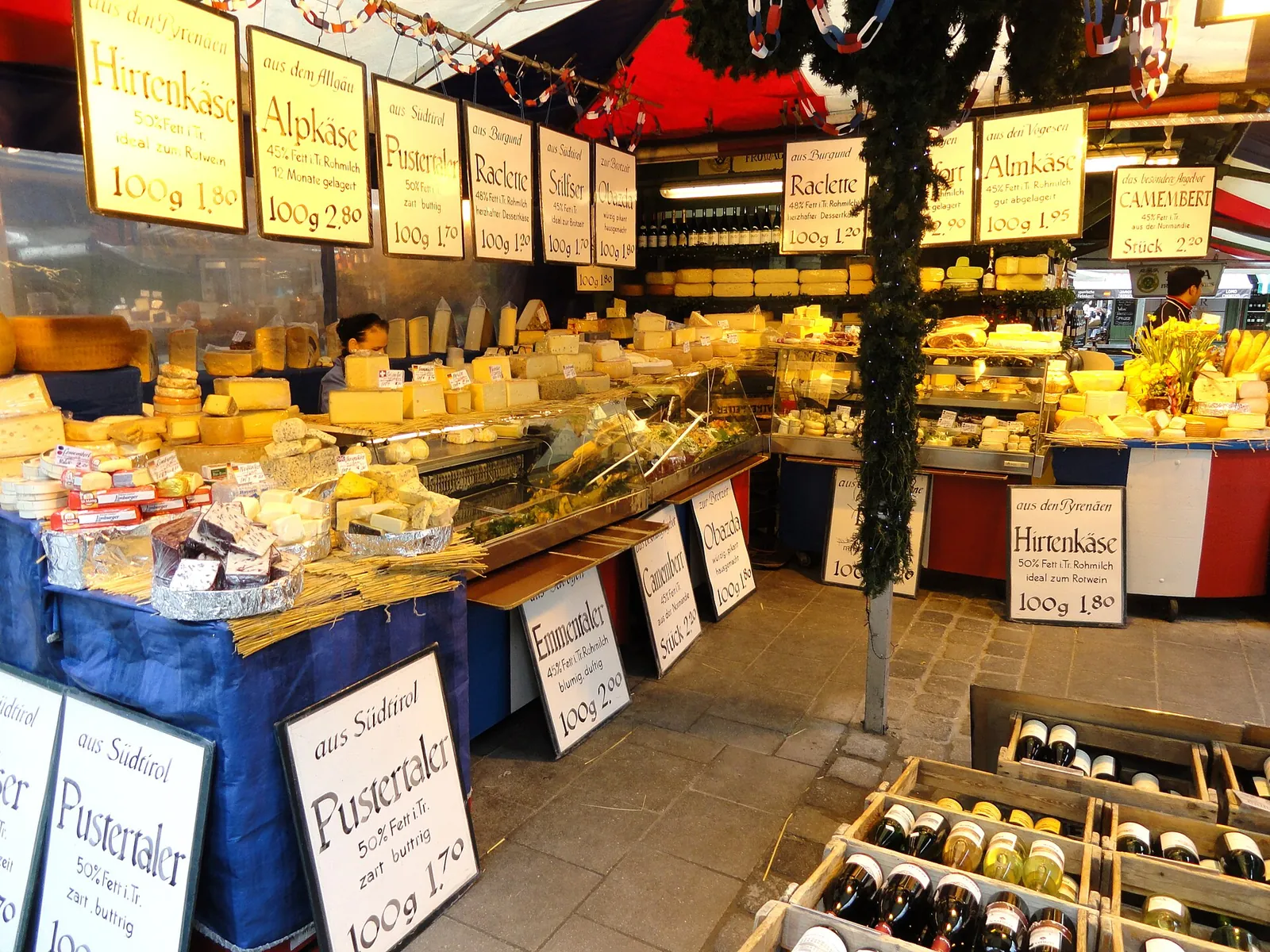
Several of the names are protected by the EU.
Germany borrowed many styles from its neighbors and then made them its own. The sections below sort the cheeses by style, so you know what to buy and what to put next to it.
German cheese at a glance
German cheese falls into four styles, and this table gives the cheese, its character and what to eat it with.
| Cheese | Style | Protected name | Try it with |
|---|---|---|---|
| Allgäuer Emmentaler | Firm, Alpine, raw cow's milk | PDO | Bread, fruit, light beer |
| Allgäuer Bergkäse | Smooth Alpine, raw cow's milk | PDO | Dark bread, Riesling |
| Limburger | Washed rind, pungent | None | Onions, mustard, rye |
| Romadur | Washed rind, pungent | None | Dark bread, beer |
| Butterkäse | Semi-soft, mild | None | Sandwiches, fruit |
| Tilsiter | Semi-hard, smear-ripened | Holsteiner Tilsiter PGI | Rye bread, beer |
| Quark | Fresh | None | Fruit, herbs, cheesecake |
| Hessischer Handkäse | Sour milk | PGI | Onions, vinegar, bread |
Alpine German cheese from the Allgäu
Alpine German cheese comes mostly from the Allgäu in Bavaria, where firm cheeses are made from raw cow's milk. Both Allgäuer Bergkäse and Allgäuer Emmentaler are PDOs, registered in 1997. The Emmentaler ripens for more than 3 months and the Bergkäse for at least 4.
Both are close cousins of the Swiss wheels in the Swiss cheese guide. If you cannot find one, a Gruyère works as a substitute. The Allgäuer Bergkäse page has the profile.
Pungent German cheese: Limburger and Romadur
Pungent German cheese means the washed-rind family, led by Limburger. Limburger was born in Belgium, and German production began in the 19th century. The smell of Limburger is stronger than the taste, and young Limburger is firm, crumbly and mild; the famous aroma comes at around 3 months.
Romadur is another cow's milk cheese with a pungent flavor, and one of the most popular cheeses in Germany. Weisslacker is a salted, surface-ripened cheese of the same bold type. Serve them the German way: thin slices with raw onion, mustard, dark bread and beer.
Mild German cheese: Butterkäse and Tilsiter
Mild German cheese is the everyday end of the range, and Butterkäse is its best example. It is a semi-soft cow's milk cheese, creamy and gentle, which is the kind to buy for kids and sandwiches. See the Butterkäse page.
Tilsiter sits between mild and sharp. It began in Tilsit in East Prussia in the mid 19th century, and it is a light yellow, semi-hard, smear-ripened cheese. Holsteiner Tilsiter is a PGI, registered in 2013. The Tilsit page covers the German and Swiss versions, and the PDO and PGI guide explains what the labels require.
Fresh and sour milk German cheese: quark and Handkäse
Fresh and sour milk German cheese is the daily-eating group. Quark is a fresh, mild cheese that sits between yogurt and cream cheese. The German tiers are Magerquark (under 10 percent), regular (20 percent) and Sahnequark (40 percent), all measured in dry matter. It is the base of German cheesecake, and the quark page has the details.
Sour milk cheeses are the more unusual find. Hessischer Handkäse is a hand-formed Frankfurt specialty with PGI status from 2010, as is Nieheimer Käse. Harzer is the low-fat version from the Harz mountains. They are tangy and firm, and traditionally eaten with onions and vinegar. Altenburger Ziegenkäse, a PDO from 1997, is made from cow's and goat's milk and flavored with caraway.
Modern German cheese: Cambozola and Obatzda
Modern German cheese includes Cambozola, a hybrid of Camembert and Gorgonzola from the Champignon company, produced industrially from the 1970s. The Cambozola page shows how to use it. It suits people who are wary of blue.
Obatzda is a Bavarian spread, made with about two thirds aged soft cheese and one third butter. It is a beer garden classic served with pretzels and radishes.
What to buy in the US
What to buy in the US is easier than you would think. Quark and Butterkäse turn up in well-stocked supermarkets and German delis, while Limburger in America comes from one Wisconsin factory, Chalet. Allgäuer cheeses appear in specialty shops and cheese counters. For protected names, check the label for PDO or PGI, which tells you the cheese was made in its home region by the registered method.
How to eat German cheese
German cheese is traditionally eaten simply. For a Brotzeit plate, combine Bergkäse, Butterkäse and a pungent cheese with dark rye bread, pickles, mustard and radishes. Pair the strong ones with beer, from crisp lagers to dark ales, and the Alpine ones with Riesling. Sweet quark with fruit works as breakfast or dessert.
What most German cheese advice gets wrong
Most German cheese advice gets Limburger wrong, because it treats it as a dare. A young Limburger is mild, and the strong smell arrives with age, so buy a younger brick first. Quark is also not always low-fat, since the tiers run to 40 percent fat in dry matter. And Tilsiter is two cheeses, one Swiss and one German.
Questions about German cheese
These questions about German cheese come up most often.
Is Germany known for cheese?
Germany is not famous for cheese, though it is a large producer with Alpine cheeses, washed-rind cheeses and fresh quark.
What is the most pungent German cheese?
The most pungent German cheese is Limburger, though Romadur and Weisslacker are close behind.
What is quark?
Quark is a fresh, mild German cheese between yogurt and cream cheese, used in sweet and savory dishes and in cheesecake.
Which German cheeses are protected?
Protected German cheeses include Allgäuer Emmentaler, Allgäuer Bergkäse, Altenburger Ziegenkäse, Hessischer Handkäse, Nieheimer Käse and Holsteiner Tilsiter.
What is Butterkäse?
Butterkäse is a mild, semi-soft German cow's milk cheese, popular for sandwiches.
Where to start with German cheese
To start with German cheese, buy a piece of Allgäuer Bergkäse and a tub of quark, then try a young Limburger when you want a challenge. The Germany country page lists more cheeses.
Sources
- List of German cheeses, Wikipedia
- List of European cheeses with protected geographical status, Wikipedia
- Quark (dairy product)), Wikipedia
- Geographical indications and quality schemes explained, European Commission