
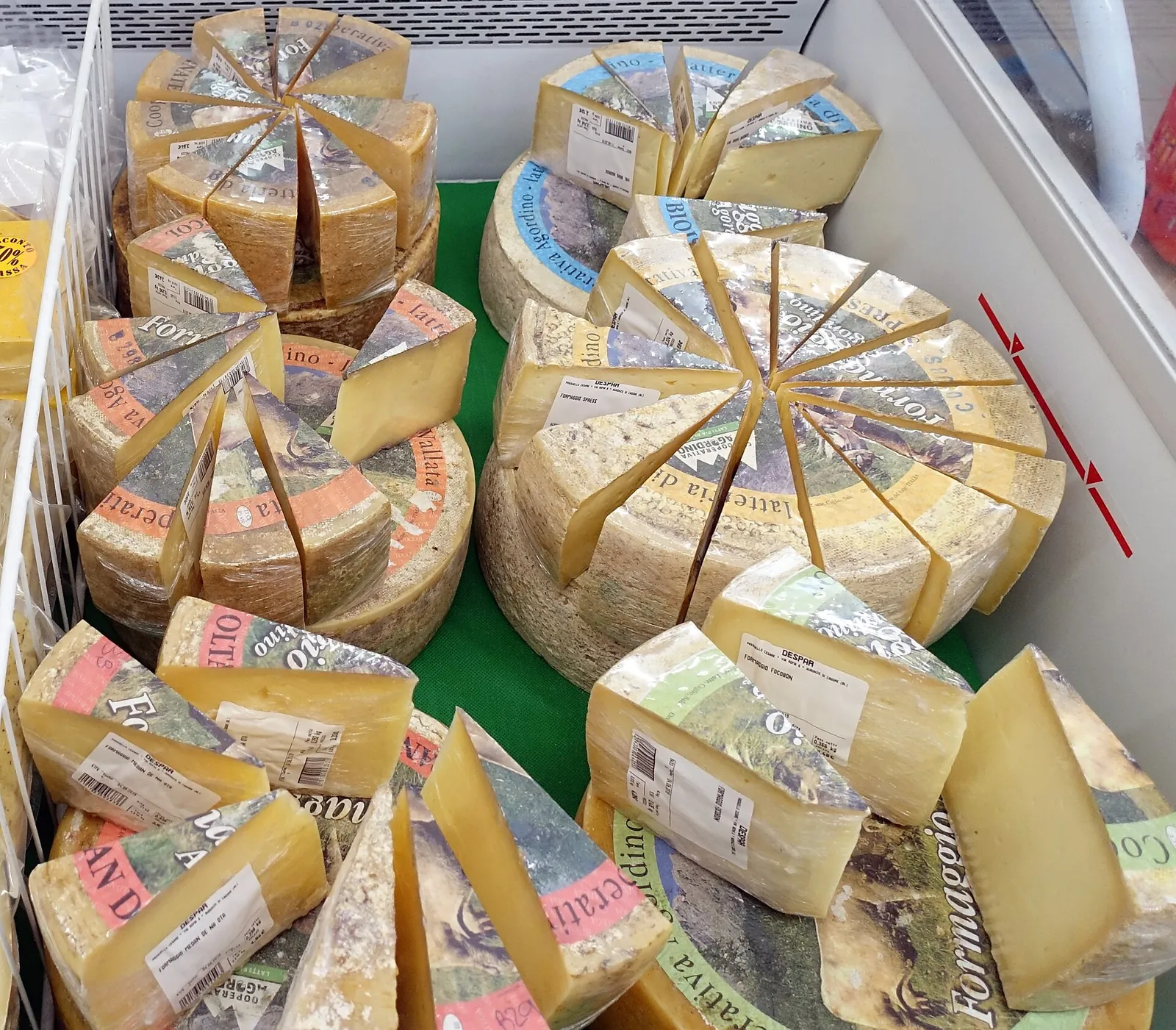
Their prices are not predictable from a name alone, so this page gives no price figures and explains the reasons a protected cheese can still be affordable.
A protected name guarantees where and how a cheese is made, not that it is expensive. Cost follows volume, how long the cheese ages and how easy the wheel is to ship, and a few imports are cheap on all three.
Value imported cheeses compared
This table compares the value imported cheeses by the reason each tends to cost less, what to check on the label and the best use.
| Cheese | Why it can be good value | What to check | Best use |
|---|---|---|---|
| Grana Padano | Made in huge volume, 9-month minimum age | Diamond-patterned rind lettering | Grating, soups, pasta |
| Emmental | Large wheels, ripened at least 4 months | "Emmentaler AOP" for the protected Swiss cheese | Sandwiches, fondue |
| Gouda Holland | Mild and young versions sell cheaply | Age on the label; "Gouda Holland" | Snacking, melts |
| Young Manchego | Ages 30 or 60 days instead of two years | Woven rind, casein plate, numbered label | Boards, tapas |
| Greek feta | Strong, so a little goes far | "Product of Greece" and PDO on a block in brine | Salads, baking |
| Jarlsberg | Large, steady production, no age to wait for | A wedge with big round holes | Sandwiches, melts |
Why some protected cheeses are affordable at volume
Some protected cheeses are affordable at volume because scale and speed lower the cost of every wheel. The clearest example is Italy's hard cheese pair. The Grana Padano consortium's 134 dairies made 6,053,690 wheels in 2025, and more than 2,757,000 were exported. Parmigiano-Reggiano production in the same year exceeded 4.19 million wheels, according to Italian trade reporting.
Rules matter too. Parmigiano-Reggiano must age at least 12 months and allows nothing added to the milk, while Grana Padano needs only 9 months and permits a small dose of egg-derived lysozyme, as the Parmesan vs. Grana Padano page explains. A wheel that spends fewer months in storage, in a bigger system, tends to cost less to bring to market. That is a general reason, not a price promise.
The best value imported cheeses
The best value imported cheeses below each get the reason, what to buy and the weak spot.
Grana Padano
Grana Padano is the best value import for grating and cooking because it gives you protected, hard Italian cheese at a shorter minimum age than its more famous cousin. It is a raw cow's milk cheese from the Po Valley, aged at least 9 months; see the Grana Padano page. Buy a wedge with the diamond-patterned rind lettering and grate it yourself. Weak spot: it tastes milder and less complex than a long-aged Parmigiano-Reggiano, so save the latter for shaving.
Emmental
Emmental is a good value import because it is made in large wheels and ripened for months rather than years. Emmentaler AOP is a raw cow's milk cheese ripened at least 4 months, and bacteria release gas as it ripens, forming holes of 3/4 to 1 1/2 inches. The Emmental page covers buying it. Weak spot: the mild flavor will not carry a strong sauce.
Gouda Holland and young Gouda
Gouda is a good value import when you buy it young, because a young wheel needs little time on the shelf and melts well. Only Gouda Holland and Noord-Hollandse Gouda are protected names, so plain Gouda can come from anywhere, as the Gouda page notes. Check the age on the label: young is the cheap, mild choice, and aged is a different, more expensive cheese. Weak spot: a bargain wheel with no origin on the label may not be Dutch.
Young Manchego
Young Manchego is a good value import because it ages only 30 or 60 days, instead of the year or two of an aged wedge, and it still carries the protected name. The real cheese has a woven rind pattern, a casein plate stamped D.O.P. Queso Manchego and a numbered back label; the Manchego page gives more. Weak spot: young Manchego is mild, so it will not give the nutty depth of an aged wedge.
Greek feta in brine
Greek feta is a good value import because it is strongly flavored, so a few ounces season a whole salad, and a block in brine keeps for weeks. The EU reserves the name for Greek cheese, but US rules do not define feta, so check for "Product of Greece" and PDO on the label; see how to spot authentic feta. Weak spot: a cow's milk "feta-style" cheese can use the same word, so read the milk and country.
Jarlsberg
Jarlsberg is a good value import because it is made in steady volume and needs no long aging to taste right. It is a Norwegian cheese developed in the 1950s from a Gouda-style recipe with propionic acid bacteria added, which makes its holes; see the Jarlsberg page. Weak spot: it is not a protected name, so the label is the only guide to origin.
What most value import advice gets wrong
Most value import advice says imports cost more than domestic cheese, which hides the useful question of what the cheese gives you for the money.
Cheap does not mean value
Cheap does not mean value: a domestic "Parmesan" is cured at least 10 months with no more than 32 percent moisture under 21 CFR 133.165, but it is not the protected Italian cheese. If you want the Italian flavor, a Grana Padano wedge is often the cheaper route to it than Parmigiano-Reggiano.
Price per ounce is not price per use
Price per ounce is not price per use, because hard, dry cheeses go far when grated. A wedge of Grana Padano seasons many dishes, and the rind can flavor soup. Compare cost per serving, not cost per pound.
Skip the pre-grated tub
Skip the pre-grated tub: US rules let grated cheeses carry anticaking agents, so a wedge is both more reliable and better value for the flavor. The PDO and PGI guide explains what a protected name does and does not tell you.
Questions about value imported cheeses
These are the questions readers ask most about value imported cheeses.
What are the best value imported cheeses?
The best value imported cheeses are Grana Padano, Emmental, young Gouda from Holland, young Manchego, Greek feta in brine and Jarlsberg, because each is made in volume or needs little aging.
Why are some protected cheeses cheaper than others?
Some protected cheeses are cheaper than others because of volume and age: Grana Padano needs 9 months and the consortium made over 6 million wheels in 2025, while Parmigiano-Reggiano needs 12 months and fewer wheels were made.
Is Grana Padano a good substitute for Parmigiano-Reggiano?
Grana Padano is a good substitute for Parmigiano-Reggiano in cooking and grating, though it tastes milder. The Grana Padano page lists the differences.
Is imported cheese better than domestic?
Imported cheese is not automatically better than domestic; it is better when the protected name or origin on the label is what you want, such as real Manchego or Greek feta.
How to tell a real imported cheese from an imitation?
To tell a real imported cheese from an imitation, check the marks on the rind and the label, such as dotted lettering on Parmigiano-Reggiano or the casein plate on Manchego. The cheese label guide covers the rest.
Your value imported cheese shopping list
Your value imported cheese shopping list is a Grana Padano wedge for grating, a young Manchego or Gouda for the board and a block of Greek feta in brine. Check the age and origin on each label, and ask the counter for a taste. Compare them against the domestic options in the cheapest cheeses guide.
Sources
- Grana Padano PDO's Sales and Exports Soar in 2025, Italianfood.net
- Parmigiano Reggiano and Grana Padano Exports Rise in the US Market, Italianfood.net
- 21 CFR 133.165, Parmesan and reggiano cheese, Cornell Legal Information Institute