
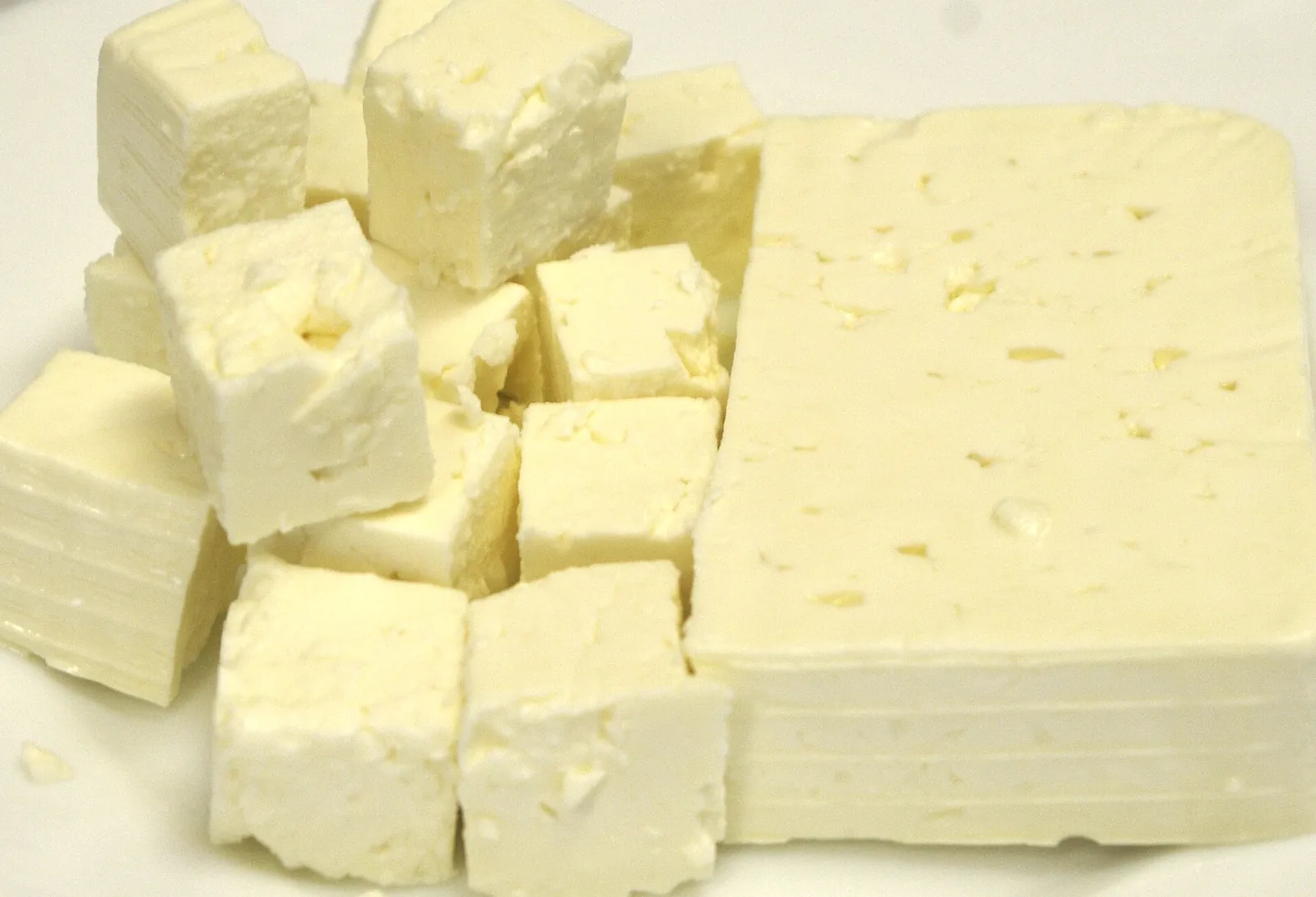
The name "feta" is protected in the EU for Greek cheese only. In the US it is not, which is why a tub labeled feta can be anything from a Greek sheep's milk block to a cow's milk crumble made in Wisconsin.
That gap is the whole shopping problem. A US store can legally sell both, so the label words do the work that the law does not. Authentic here means the protected Greek cheese, not that cow's milk feta is bad: it is a different product with a different flavor, and it is often fine in a salad.
What authentic feta is by law
Authentic feta is a Protected Designation of Origin (PDO) cheese, and the EU rules fix its milk, its place and its minimum cure. Under the regulation that registered the name in 2002, feta is made exclusively from ewe's milk or from a mixture of ewe's and goat's milk, from mainland Greece and the department of Lesbos. The product specification in the EU's eAmbrosia register adds the numbers: goat's milk may not exceed 30 percent of the total, the milk must come from the listed regions (Peloponnese, Thessaly, Epirus, Macedonia, Thrace, central and mainland Greece and Lesbos), and the cheese must be ripened and preserved in brine for at least two months.
The specification also describes the cheese itself: white, rindless, with a slightly acidic taste and a rich smell, and sold in wooden or metal drums or in food-grade packaging. It allows raw or pasteurized milk. For the full profile, see the feta page.
How to spot authentic feta on the label
To spot authentic feta on the label, look for these words and treat missing ones as a reason to read further.
| On the package | What it tells you |
|---|---|
| "Feta PDO" or "Protected Designation of Origin" | The EU-protected name, so Greek sheep's or sheep's and goat's milk |
| "Product of Greece" | The country of origin, which the PDO requires |
| Ingredients: sheep's milk, goat's milk, salt, cultures, rennet | Matches the specification; "pasteurized cow's milk" does not |
| "Feta-style," "salad cheese," "white cheese" | Not the protected name |
| "Imported feta" with no milk named | Read the ingredient list; origin alone does not name the milk |
The PDO and PGI guide explains what the protected-name seals promise, and how to read a cheese label covers the rest of the words on a package.
What US feta can be
US feta can be whatever the maker calls feta, because federal cheese standards do not define it. Part 133 of the Code of Federal Regulations, the FDA's list of cheese standards, has sections for cheddar, blue cheese, Gorgonzola and many others, but none for feta (the section numbered 133.141, which you might expect, is Gorgonzola). So a US-made feta is usually cow's milk, sometimes sheep's or goat's, and the milk should be on the ingredient list.
Cow's milk feta tends to be milder and creamier, and it is often cheaper. Dairy Farmers of Wisconsin, whose makers use cow's milk, says the cheese is aged in whey and brine. Nothing about that is deceptive when the label says where it was made. The thing to avoid is paying a Greek price for a cheese that does not state Greek origin or sheep's milk.
The brine check
The brine check is simple: authentic feta is ripened in brine and should be sold in it. The specification requires brine ripening and preservation for at least two months, and the brine is what keeps a block moist and sliceable. A block sitting in liquid is a good sign. Dry vacuum-packed blocks exist and can be fine, but dry pre-crumbled feta in a tub has no brine to protect it, dries out faster and tastes flatter.
Buy a block when you can and crumble it yourself. At home, keep leftovers submerged in their brine in a covered container; if the brine is gone, a little salted water works.
Texture and taste as a final check
Authentic feta, judged by taste and texture, is tangy, salty and a little sharp, with a creamy, crumbly body that is still sliceable. Sheep's milk is richer than cow's milk, so Greek feta usually feels fuller on the tongue, and goat's milk in the blend adds a gamier edge. A rubbery, bland, very white cheese that squeaks is more likely a mild cow's milk version. You cannot taste before you buy a sealed package, but at a cheese counter you can ask for a sample.
Mistakes that cost you when buying feta
The common mistakes when buying feta are about wording, not quality.
Treating "imported" as Greek
"Imported feta" does not mean Greek. Other countries make white brined cheeses, and the protected name travels only with Greek production. Look for the country by name and the PDO words. The Balkan white cheeses guide covers the brined relatives that go by other names, and feta vs. goat cheese separates two cheeses people mix up.
Assuming PDO means pasteurized
PDO does not mean pasteurized. The specification allows raw or pasteurized milk. If you are pregnant or otherwise at higher risk from Listeria, check for "pasteurized" on the label and read cheese during pregnancy and pasteurized vs. raw cheese.
Skipping the ingredient list
Skipping the ingredient list is the easiest way to be fooled, because front-of-pack words like "Greek style" or "Mediterranean" are marketing and the ingredient list is the legal statement. Milk, salt, cultures and rennet is the short, expected list.
Questions about spotting authentic feta
These are the questions that come up most about spotting authentic feta.
What milk is authentic feta made from?
Authentic feta is made from sheep's milk, or sheep's milk with up to 30 percent goat's milk. The EU specification does not allow cow's milk.
How can you tell if feta is real Greek feta?
You can tell real Greek feta by the words "Feta PDO" and "Product of Greece" and by an ingredient list of sheep's milk, or sheep's and goat's milk. A "feta-style" label means it is not the protected name.
Can feta be made outside Greece?
Feta can be made outside Greece, but in the EU only Greek cheese can use the name. In the US the name is not defined, so US makers can sell cheese as feta, usually from cow's milk.
Is feta supposed to be sold in brine?
Feta is supposed to be ripened in brine for at least two months, and blocks are best sold and kept in it. Dry crumbles lose moisture and flavor faster.
Is cow's milk feta bad?
Cow's milk feta is not bad, just different: milder, creamier and usually cheaper. It is not authentic Greek feta, and it should say where it was made.
Choosing authentic feta
Choosing authentic feta comes down to a short routine: find "Feta PDO" and "Product of Greece," confirm sheep's milk (with goat's at most 30 percent) in the ingredients, and buy a block in brine. If you only need salty crumbles for a salad, a US cow's milk block in brine is a fair, cheaper pick. Next, see what else Greece makes in Greek cheeses beyond feta.
Sources
- Commission Regulation (EC) No 1829/2002 registering Feta as a PDO, EUR-Lex, European Union
- Feta, PDO-GR-0427: product specification, eAmbrosia, European Commission
- 21 CFR 133.141 Gorgonzola cheese and 21 CFR Part 133, Legal Information Institute, Cornell Law School
- Feta, Dairy Farmers of Wisconsin