
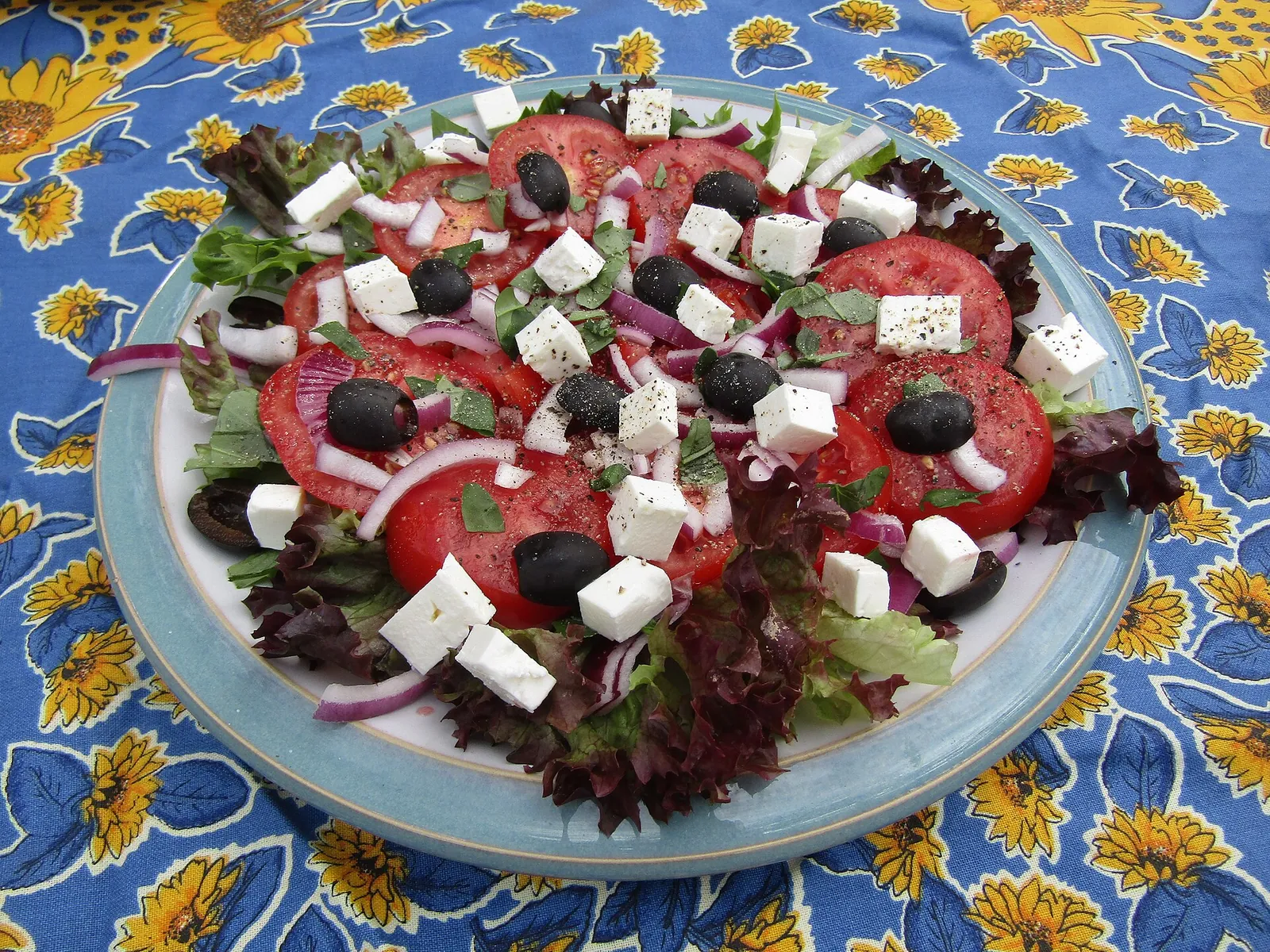
The overlap is small. Greek feta may contain up to 30 percent goat's milk, and both are white, tangy and good over a salad.
Salt tells them apart fastest. Feta spends at least two months in salt water, and USDA lists 323 milligrams of sodium in an ounce of it, against 130 in soft goat cheese. Calories are a tie, at about 75 an ounce.
Feta vs goat cheese at a glance
Here is feta vs goat cheese at a glance, with USDA figures per ounce for feta and for soft goat cheese, the closest match to fresh chèvre.
| Feta | Fresh goat cheese | |
|---|---|---|
| Milk | Sheep's, or sheep's with up to 30% goat's | Goat's |
| Set with | Rennet | Acid, from culture or added acid |
| Aging | At least 2 months in brine of about 7% | None; eaten fresh |
| Texture | Firm, sliceable, crumbly | Soft, creamy, spreadable |
| Flavor | Salty, tangy, peppery | Mild, lactic, tangy |
| Water | 55% | 61% |
| Sodium | 323 mg | 130 mg |
| Calcium | 140 mg | 40 mg |
| Protein | 4.0 g | 5.3 g |
| Fat | 6.1 g | 6.0 g |
| Calories | 75 | 75 |
| Keeps | In its brine, which stops it drying out | A few weeks |
Is feta goat cheese?
Feta is not goat cheese, though Greek feta may contain goat's milk: the product specification allows pure sheep's milk or sheep's milk with up to 30 percent goat's milk, as the feta guide explains. Goat cheese names a milk, not a recipe. USDA lists soft, semisoft and hard goat cheeses separately, and the chèvre guide covers the French originals. Dairy Farmers of Wisconsin says its feta makers use cow's milk, so a US feta can have no goat's milk at all.
How feta and goat cheese are made
Feta and goat cheese are made by different routes: rennet and brine for feta, acid for fresh goat cheese. Feta curd is set with rennet, drained, salted and cured in brine of about 7 percent salt for at least two months. Fresh goat cheese is a lactic, or acid-set, cheese: the University of Wisconsin's Center for Dairy Research lists chèvre as one whose curd forms by acid at about pH 4.6, and the American Cheese Society says such cheeses carry over 50 percent moisture and keep only a few weeks.
The difference shows in USDA's calcium figures: 493 milligrams per 100 grams in feta against 140 in soft goat cheese. Acid pulls calcium out of the curd. In a 2025 halloumi-type study, calcium fell from 680 to 72 milligrams per 100 grams as the pH dropped from 6.53 to 4.40.
Milk, salt and flavor in feta vs goat cheese
Sheep's milk is richer than goat's, and that sets feta apart before the salt does. USDA lists sheep's milk at 7.0 grams of fat and 6.0 grams of protein per 100 grams, goat's milk at 4.1 and 3.6, and whole cow's milk at 3.25 and 3.15. The feta specification adds that sheep's and especially goat's milk carry fatty acids such as caproic and caprylic acid, behind a richer smell and a peppery taste.
Salt does the rest. Feta's 1,139 milligrams of sodium per 100 grams is about 2.9 percent salt, 2.5 times soft goat cheese's 459. Fresh goat cheese tastes of milk and lactic tang, a profile the American Cheese Society calls mild with a tangy finish, while feta tastes salty and peppery. For the full milk comparison, see goat vs. sheep vs. cow's-milk cheese.
When to use feta and when to use goat cheese
Use feta when you want salt and a firm crumble, and goat cheese when you want cream and tang. Feta suits Greek salad, roasted vegetables, spanakopita and baked tomatoes. Goat cheese suits toast and crostini, pizza and tarts, pasta, omelets and warm salads.
Neither flows like mozzarella. Feta holds its block, and fresh goat cheese softens without stretching, as the melting cheese guide explains.
How to swap feta and goat cheese
To swap goat cheese for feta, use the same weight and add salt, because soft goat cheese carries about 40 percent of feta's sodium. By USDA's figures, 4 ounces needs about 1/3 teaspoon of salt to match. Freeze the log for 15 minutes so it crumbles cleanly.
To swap feta for goat cheese in a spread, soak the feta for 20 minutes in cold water, pat it dry and mash 4 ounces with 1 to 2 tablespoons of olive oil or plain yogurt. It stays saltier and grainier, so skip added salt. The substitute finder lists other swaps.
What most feta vs goat cheese advice gets wrong
Most feta vs goat cheese advice treats the two as twins, and three details break that.
Calories are a tie, and salt is not. USDA lists about 75 calories an ounce for both. Feta carries 323 milligrams of sodium and 140 of calcium; soft goat cheese carries 130 and 40, with 5.3 grams of protein against 4.0.
"Goat cheese" is not one cheese. USDA lists hard goat cheese at 29 percent water and 452 calories per 100 grams, nothing like a fresh log. For a feta swap, buy the fresh kind.
Raw milk can hide in feta, not in fresh goat cheese. The PDO allows raw milk, while federal law requires cheese aged under 60 days to be pasteurized, the American Cheese Society notes, so fresh goat cheese is pasteurized. The CDC lists feta as a safer choice only when it is pasteurized, so read the label if you are pregnant; see cheese during pregnancy.
Questions about feta vs goat cheese
These quick answers cover what people ask most about feta vs goat cheese.
Is feta goat cheese?
Feta is not goat cheese: Greek feta is mainly sheep's milk, with goat's milk capped at 30 percent, while goat cheese is made entirely from goat's milk.
What is the difference between feta and goat cheese?
The difference between feta and goat cheese is milk, method and salt: feta is brined, rennet-set and salty, while fresh goat cheese is acid-set, creamy and milder.
Can you substitute goat cheese for feta?
You can substitute goat cheese for feta if you add salt, about 1/3 teaspoon per 4 ounces, and accept a creamier, milder result.
Which is saltier, feta or goat cheese?
Feta is saltier than goat cheese, at 323 milligrams of sodium an ounce against 130 for soft goat cheese in USDA data.
Which is healthier, feta or goat cheese?
Feta and goat cheese have the same calories, about 75 an ounce, so the difference is sodium: feta carries more than twice as much, and soft goat cheese carries more protein.
Choosing between feta and goat cheese
Choosing between feta and goat cheese comes down to salt and texture: pick feta for a salty, crumbly bite and fresh goat cheese for something creamy and mild. Adjust the salt first when you swap.
Sources
- Feta, PDO-GR-0427: product specification (English), European Commission eAmbrosia register
- Cheese Definitions & Categories, American Cheese Society
- Glossary of Terms for Cheesemakers, University of Wisconsin Center for Dairy Research
- The effect of pH on the microstructure, rheological and functional properties of halloumi-type cheese (Food Chemistry: X, 2025), via PubMed Central
- Feta, Dairy Farmers of Wisconsin
- Preventing Listeria Infection, Centers for Disease Control and Prevention
- USDA FoodData Central, SR Legacy rows: feta, goat cheese, soft, goat cheese, semisoft, goat cheese, hard, milk, sheep, milk, goat and milk, whole, USDA