
Coming home from another country, you must declare all food to U.S. Customs and Border Protection.
The hard part is not the law, it is the cold and the smell. Cheese that spends a day in a bag needs to be wrapped, sealed and kept cool. Those steps matter more for soft cheese than for hard.
Travel with cheese through TSA security
To travel with cheese through TSA security, sort your cheese into two groups. The TSA lists solid cheese as allowed in carry-on and checked bags. Creamy cheese, such as spreadable cheese, is allowed in carry-on only up to 3.4 ounces, and in any amount in checked bags.
| Type | Carry-on | Checked bag |
|---|---|---|
| Solid cheese (a wedge of cheddar, Manchego or Parmesan) | Allowed | Allowed |
| Creamy cheese (spreads, soft cheese in a tub) | Up to 3.4 oz (100 ml) | Any amount |
A TSA officer can still decide at the checkpoint that an item needs a closer look, so pack cheese where it is easy to take out. If you are unsure where your cheese falls, a firm block is solid and a spreadable cheese is creamy.
How to pack cheese for a flight
To pack cheese for a flight, wrap it so it stays contained, protected and cool. A hard wedge in its original wrapping inside a zip bag is fine for a short trip. For a longer one, ask the shop to vacuum-seal it, which holds in the smell and protects the cut surface.
- Put the cheese in the middle of the bag, padded by soft clothing, not against the outside shell.
- For a day of travel, add a small frozen gel pack in a bag. Ice that melts to liquid can be a problem at security, so frozen gel packs are the safer choice, and the TSA's liquid rules are worth checking before you go.
- Keep a soft or creamy cheese in a rigid container so it does not crush.
- Keep cheese cool. Perishable food should not sit out more than 2 hours, or 1 hour above 90°F, according to the USDA, so a cheese carried in a warm bag all day is a risk.
Buy cheese at the end of the trip, and put it in the fridge when you arrive. If you are driving a long way instead, the transport cheese guide covers coolers and ice packs in detail.
Bring cheese into the US from abroad
To bring cheese into the US from abroad, the rule is simple: declare all food to CBP when you arrive. Customs forms ask about food, and answering honestly is the point. An item that is declared and turns out to be restricted may be taken away, but a failure to declare can bring penalties.
Which cheeses are allowed depends on agency rules that can change, and this page does not list them. Before you buy, read the CBP page on agricultural products and, if your question is about a particular cheese, ask the agency directly. The cheese you plan to buy and the country you buy it in can both matter.
Other countries have their own rules for what you can carry in and out, so check the destination's customs site before you buy cheese there as a gift.
Which cheeses travel best
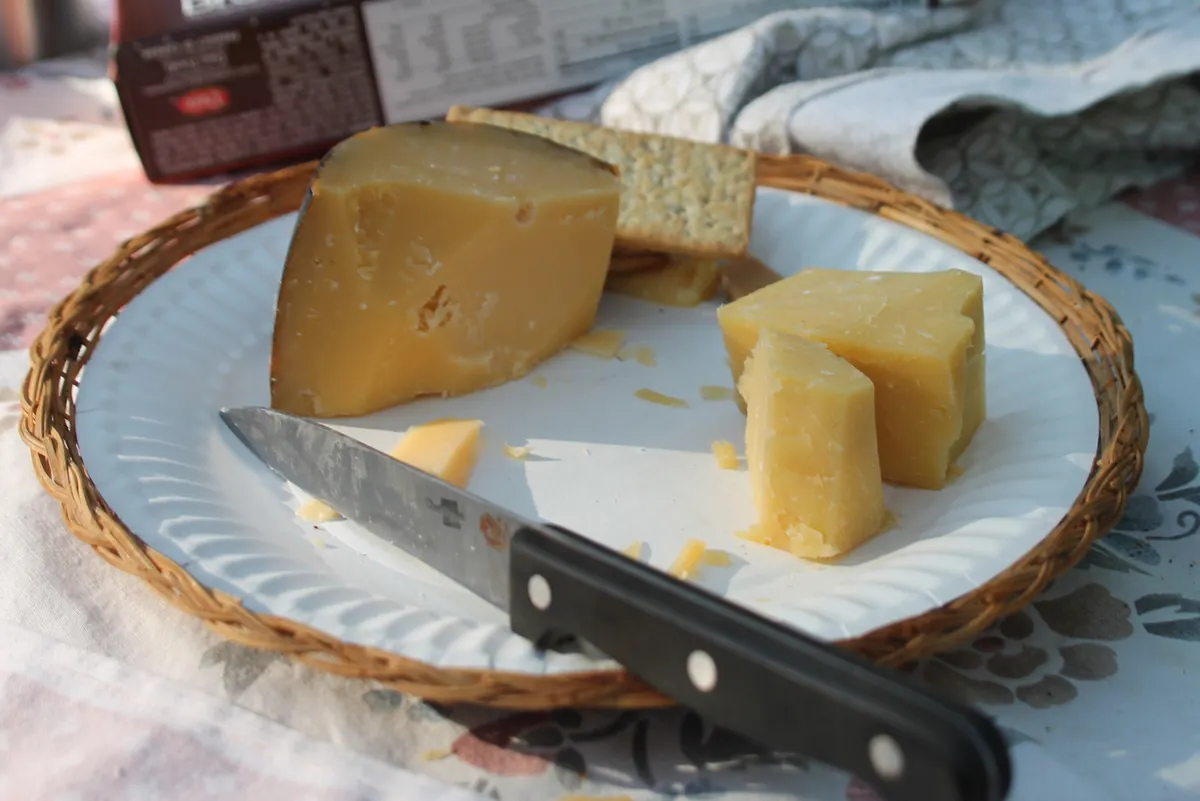
Which cheeses travel best is mostly a question of structure. A firm, low-moisture wedge such as aged cheddar, Parmesan, aged Gouda or Manchego survives hours out of the fridge better than a soft cheese, because it has less moisture and is less fragile. A runny brie or a fresh goat cheese is the riskiest to carry. The storing cheese guide explains how to handle each type once you are home.
For a gift or souvenir, a small vacuum-packed piece of a firm cheese is the easy choice. It is also the one most likely to be treated as a solid cheese at security.
Travel with cheese mistakes to avoid
Travel with cheese mistakes tend to cluster at the airport and at arrival. The most common are putting a tub of soft cheese in a carry-on over 3.4 ounces, packing a loose wedge with no sealing, and leaving the cheese in a hot hotel room or rental car.
Another is hiding the cheese from customs on the way home. If you declare it, the worst case is that it is taken. If you do not, you risk much more.
When you get home, check the cheese before eating. If it feels warm or smells wrong after a long trip, discard it. For mold on firm cheese, the USDA says to cut off at least 1 inch around and below the spot; see the prevent mold guide for the rules.
Questions about traveling with cheese
These questions about traveling with cheese come up most before holiday trips.
Can you bring cheese on a plane?
You can bring cheese on a plane: solid cheese is allowed in carry-on and checked bags, and creamy cheese is allowed in carry-on up to 3.4 ounces, or any amount in checked bags.
Can you put cheese in checked luggage?
You can put cheese in checked luggage, according to the TSA, both solid and creamy cheese. Wrap it well and pad it, since a checked bag is not refrigerated and may be out of the cold for many hours.
Is soft cheese allowed in carry-on?
Soft cheese in a carry-on is allowed if it is creamy cheese under 3.4 ounces (100 ml) or solid enough to count as solid cheese. For anything larger and spreadable, use a checked bag.
Do you have to declare cheese at customs?
You have to declare cheese at customs when you enter the United States, because CBP requires you to declare all food. Say yes on the form and let the officer decide.
How long can cheese stay unrefrigerated while traveling?
Cheese can stay unrefrigerated for about 2 hours, or 1 hour above 90°F, by the USDA rule for perishable food. Keep it with a frozen gel pack on longer trips.
What is the best cheese to bring home from a trip?
The best cheese to bring home from a trip is a firm, vacuum-sealed piece, which holds up to the trip and is easier to pack. Declare it when you arrive.
Plan your cheese travel
To travel with cheese, pick a firm wedge, have it sealed, carry it with a frozen gel pack, and declare it on the way back into the US. Check the TSA and CBP pages a few days before you fly, since rules are updated, then refrigerate it as soon as you are unpacked.
Sources
- Cheese, Solid, Transportation Security Administration
- Cheese, Creamy, Transportation Security Administration
- Bringing Agricultural Products into the United States, U.S. Customs and Border Protection
- Leftovers and Food Safety, USDA Food Safety and Inspection Service
- Molds on Food: Are They Dangerous?, USDA Food Safety and Inspection Service