
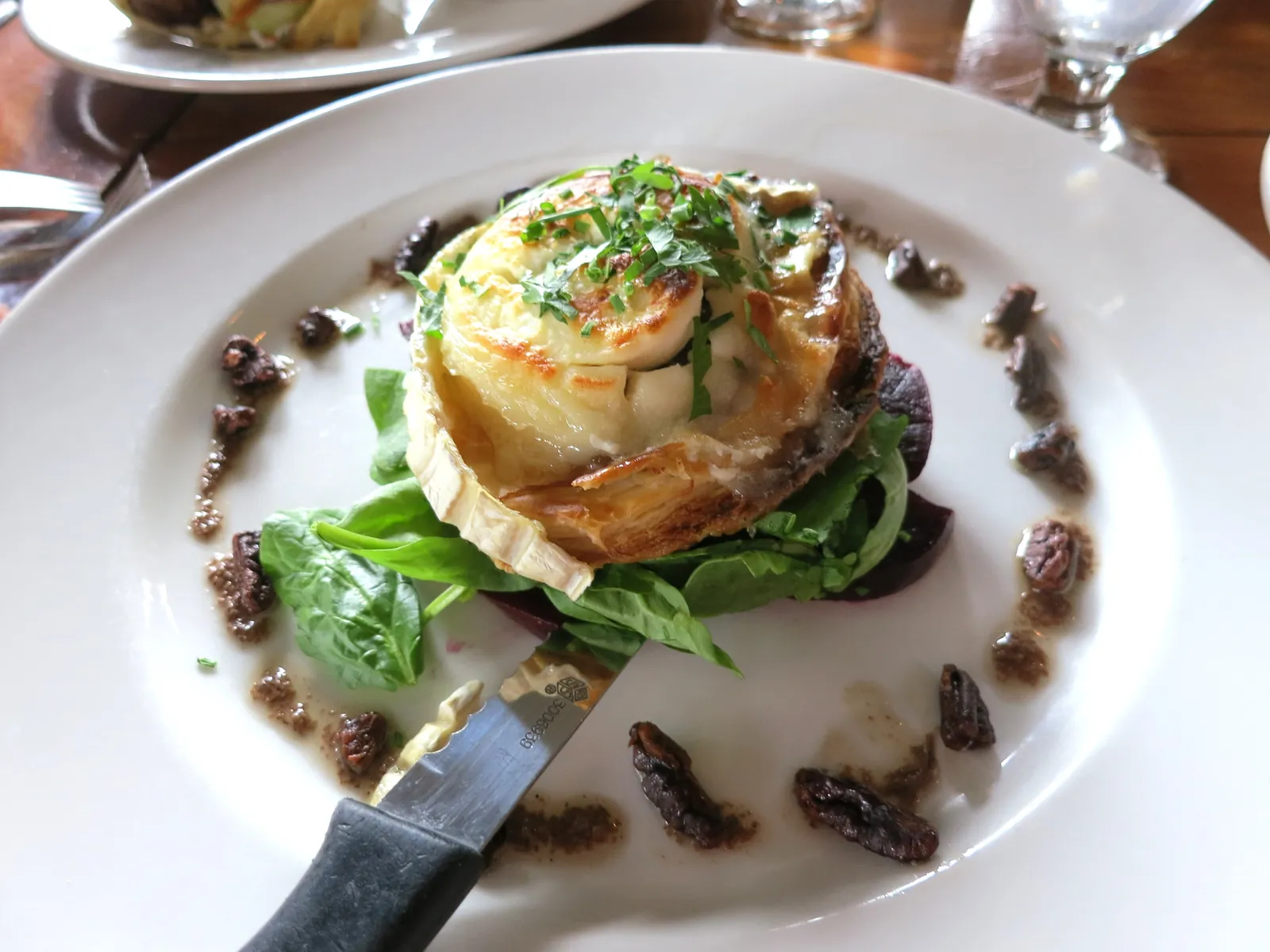
They are quicker than a custard-filled quiche because there is no shell to blind-bake and no egg filling to set, only a base that has to stay crisp.
That is the whole job of this page: a free-form tart you can build in 25 minutes, served warm as a starter or with a salad as lunch. If you want the custard version in a pan, the quiche page covers it.
Savory cheese tarts at a glance
This savory cheese tarts table covers the basics of the free-form recipe below.
| Free-form onion, Gruyère and goat cheese tart | |
|---|---|
| Yield | 6 servings as a starter or 4 as lunch |
| Active time | 25 minutes |
| Total time | About 1 hour 10 minutes |
| Oven temperature | 400°F (200°C) |
| Best cheese | Gruyère with a little goat cheese |
| Make ahead | Onions up to 3 days; assemble just before baking |
How to make savory cheese tarts
Savory cheese tarts are made here on store-bought all-butter puff pastry, with a galette variation using shortcrust further down.
Ingredients for savory cheese tarts
The ingredients for savory cheese tarts below fill one sheet-pan tart.
- 1 sheet (about 9 oz or 255 g) all-butter puff pastry, thawed in the refrigerator
- 2 tablespoons (28 g) butter
- 2 large yellow onions (about 1 lb or 450 g), thinly sliced
- 1/2 teaspoon kosher salt
- 1 teaspoon fresh thyme leaves
- 1 teaspoon balsamic or sherry vinegar
- 4 oz (115 g) Gruyère, coarsely grated
- 2 oz (55 g) fresh goat cheese, crumbled
- 1 tablespoon (15 ml) milk or 1 beaten egg, for brushing the rim
- Black pepper and a handful of arugula, to finish
Steps for making savory cheese tarts
These steps for making savory cheese tarts start with the onions, which need the longest and can be done ahead.
- Melt the butter in a wide skillet over medium-low heat, add the onions and salt, and cook 25 to 30 minutes, stirring often, until deep golden and jammy.
- Stir in the thyme and vinegar, cook 1 minute, and cool the onions for 10 minutes so they do not melt the pastry.
- Heat the oven to 400°F (200°C) with a rack in the lower third, and line a baking sheet with parchment.
- Unfold the puff pastry onto the parchment, score a border 3/4 inch (2 cm) in from the edge without cutting through, and prick the inside with a fork.
- Bake the bare pastry 10 minutes until it has puffed at the rim and the center looks set and pale gold.
- Press the center down gently with the back of a spoon if it has risen, then scatter half the Gruyère over it as a seal.
- Spread the onions over the cheese, add the rest of the Gruyère, and dot with the goat cheese.
- Brush the rim with milk or beaten egg and bake 12 to 15 minutes more until the rim is deep golden and the cheese is bubbling in places.
- Cool 5 minutes on the sheet, finish with pepper and arugula, and slice into rectangles.
The best cheese for savory cheese tarts
The best cheese for savory cheese tarts is a melting cheese for body plus a tangy one for contrast. Gruyère is the melter: it browns and stays creamy instead of turning oily, with a nutty flavor that suits onions, mushrooms and leeks. Other good melters are fontina, young cheddar and Comté. Guidance for how each melts is in the best melting cheeses.
Soft goat cheese adds acid that cuts through the pastry's butter, and it does not melt into a layer so much as soften into pockets. Feta works the same way but is saltier, so skip added salt. A little Parmigiano-Reggiano scattered on top gives a salty crust. A blue cheese such as Stilton makes a bold tart with pear or onion, but use it sparingly, at about 2 oz for this size.
Grate cheese from a block, since pre-shredded cheese carries anti-caking starch and melts less evenly (why pre-shredded cheese melts poorly). Avoid fresh mozzarella unless you pat it dry; it releases water that makes the base soggy.
Keeping the base crisp on a savory cheese tart
A crisp base on a savory cheese tart depends on three things: pre-baking, a barrier and a dry filling. Baking the bare pastry for 10 minutes sets the base before anything wet touches it. A layer of grated cheese under the topping acts as a seal, and a hot oven with the sheet on a low rack browns the bottom.
The filling should be dry. Cook onions, mushrooms and peppers until their liquid has gone, and salt tomatoes and zucchini and blot them. Wet topping on cold pastry is the main reason tarts come out pale and limp in the middle.
Savory cheese tart variations and galettes
Savory cheese tart variations change the topping or the pastry while the method stays the same.
- Galette: use shortcrust instead, roll it to a 12-inch (30 cm) round, pile the filling in the center leaving a 2-inch (5 cm) border, fold the edges over, and bake 35 to 40 minutes at 400°F.
- Tomato and mozzarella: use low-moisture mozzarella, slice tomatoes thin, salt and blot them, and add basil after baking.
- Mushroom and Gruyère: sauté 10 oz (280 g) mushrooms until dry and golden before using.
- Pear and blue: replace the onions with thin pear slices and 2 oz crumbled blue.
If you stir eggs and cream into the filling to make it custard, it is a quiche and it needs to reach 160°F inside; follow the quiche recipe for that. For a bite-size cheese pastry, see gougères.
Making savory cheese tarts ahead, storing and reheating
Making savory cheese tarts ahead is easy for the parts, but they are best baked the same day, though the parts keep. Caramelize the onions up to 3 days ahead, and keep the pastry cold until it goes in the oven. Baked tarts keep in the refrigerator for 3 to 4 days when stored within 2 hours of baking, which matches USDA's leftovers guidance for egg dishes, and a tart brushed with egg wash is no exception.
Reheat slices on a baking sheet at 375°F (190°C) for 8 to 10 minutes. Anything with egg in it should be heated to 165°F per FSIS. The microwave turns puff pastry soft.
Questions about savory cheese tarts
These questions about savory cheese tarts cover pastry, cheese and soggy bottoms.
What is the difference between a tart and a galette?
A savory tart is baked in a pan or on a sheet with a formed edge, while a galette is free-form, with the pastry folded over the filling. Galettes are quicker, and the recipe above is closer to a galette in spirit.
What cheese is best for savory cheese tarts?
The best cheese for savory cheese tarts is Gruyère, with goat cheese or feta for tang. Fontina, Comté and young cheddar are good melting alternatives.
Is store-bought puff pastry fine for savory cheese tarts?
Savory cheese tarts work well on store-bought all-butter puff pastry, which saves the most time. Keep it cold and thaw it in the refrigerator.
What stops a savory cheese tart from getting soggy?
A savory cheese tart stays crisp if you bake the pastry bare for 10 minutes first, seal it with grated cheese, and cook watery toppings dry.
Can savory cheese tarts be made ahead?
Savory cheese tarts can be partly made ahead: the onions keep for 3 days. Bake the tart shortly before serving for the crispest base.
Savory cheese tarts: next step
Savory cheese tarts need three decisions: a melting cheese, a dry topping and a pastry baked before the toppings go on. Start with the onion, Gruyère and goat cheese tart here, then swap the topping next time.
Sources
- Shell Eggs from Farm to Table, USDA Food Safety and Inspection Service
- Safe Minimum Internal Temperature Chart, USDA Food Safety and Inspection Service
- What You Need to Know About Egg Safety, U.S. Food and Drug Administration