
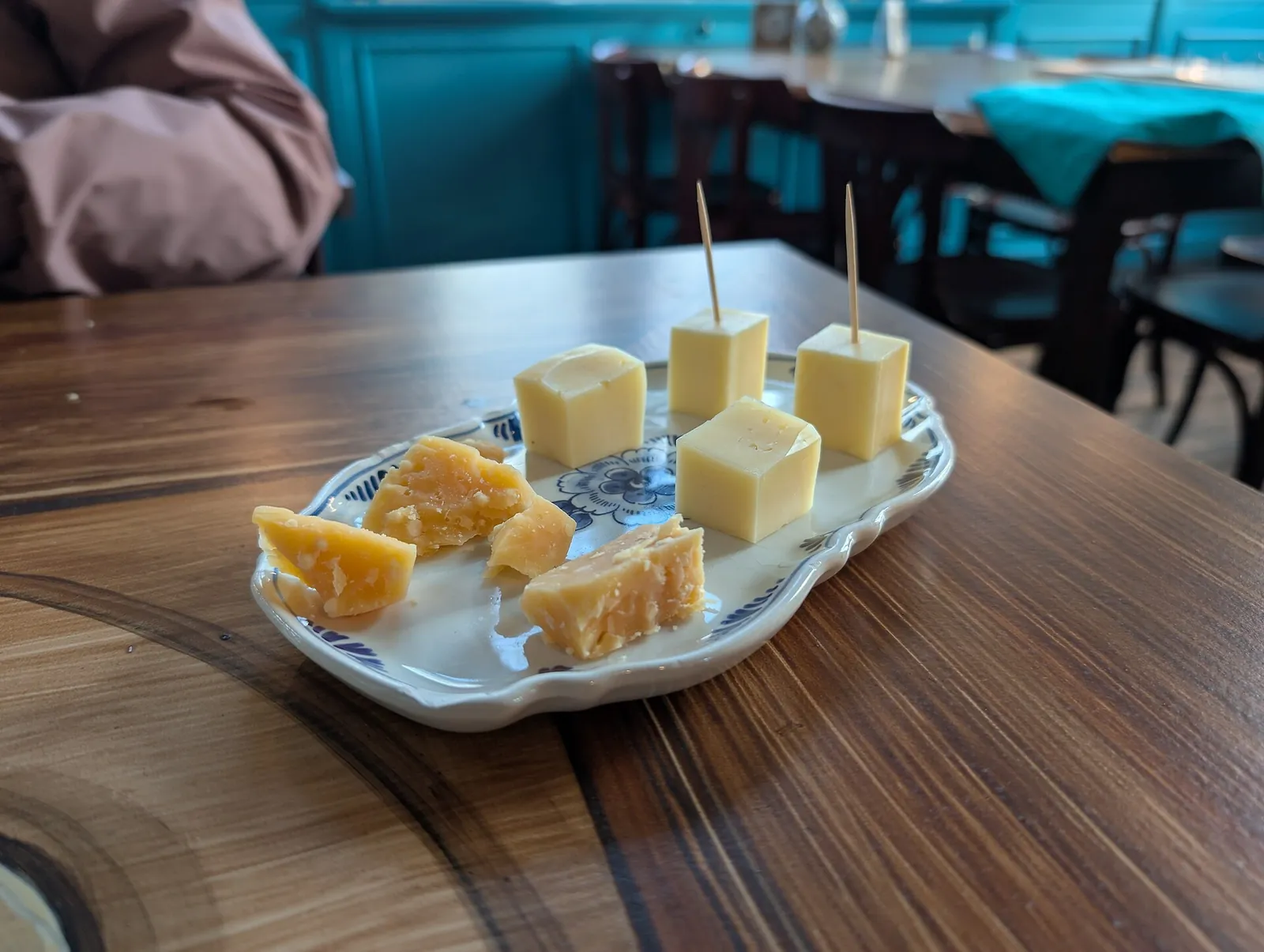
Light with light, bold with bold, and sweet against salt when the cheese is at the loud end.
Intensity is a more useful starting point than color or country because it explains most failed pairings. A big red wine buries a fresh mozzarella, and a delicate white disappears next to a blue. This page gives a scale for the cheese, a partner for each step, and the one rule that has exceptions.
A scale to pair cheese by intensity
This scale to pair cheese by intensity sorts common cheeses into four steps, with a partner for each. It is guidance, not a law, and a cheese can sit between two steps.
| Step | Cheeses | Drinks that match | Foods that match |
|---|---|---|---|
| Mild | Fresh mozzarella, ricotta, young Gouda, Havarti, mild cheddar | Crisp white, dry sparkling wine, light lager, green tea | Fresh fruit, honey, cucumber, plain crackers |
| Medium | Aged cheddar, Gruyère, Manchego, Comté, Parmigiano-Reggiano | Fuller white, light to medium red, amber ale | Nuts, apples, quince paste, crusty bread |
| Strong | Washed rinds such as Époisses and Taleggio, very aged Gouda, Pecorino Romano | Rich red, strong ale, aged spirits | Dried fruit, dark honey, chutney, cured meat |
| Boldest | Roquefort, Stilton, Gorgonzola piccante, Cabrales | Sweet or fortified wine, stout, whiskey | Figs, honey, dark chocolate, walnuts |
The cheddar page shows how one cheese moves up the scale as it ages.
How to judge a cheese's intensity
How to judge a cheese's intensity comes down to three signals: age, salt and smell. The longer a cheese ages, the more concentrated and sharper it tends to taste. A salty cheese reads as stronger than an unsalted one of the same age. A cheese that smells strong from across the counter will be strong in the mouth.
Use the sniff test in the store. If the cheese has almost no smell, it is mild. If you can smell it through the wrapper, plan for a bold partner. Age labels help within one cheese: a young cheddar and a two-year clothbound sit on different steps, as the aged versus young cheddar guide explains.
Pairing mild cheeses by intensity
Pairing mild cheeses by intensity means keeping the partner light, bright and quiet. Fresh and young cheeses carry delicate milk flavors, so a crisp white wine, a dry sparkling wine or a light lager lets them come through. Fresh fruit and a little honey work for the same reason.
The mistake is reaching for a big red or a strong chutney because it is on the table. The Institute of Culinary Education makes the same point, noting that even a soft triple-cream, rich in texture but delicate in flavor, can be overwhelmed by a bold red wine. If you want a list of cheeses at this end of the scale, the mild cheeses guide has them.
Pairing medium cheeses by intensity
Pairing medium cheeses by intensity is the forgiving middle, where most cheeses and most drinks meet. Aged cheddar, Gruyère and Manchego have enough flavor to hold up to a fuller white or a light to medium red, and enough restraint not to fight a nutty ale.
A university study offers evidence that this middle is the easiest ground. Researchers at the University of Adelaide had 46 consumers rate pairings of eight wines and eight cheeses, and English cheddar came out as the easiest cheese to match, followed by Gruyère (see the UC Davis summary of the study). When you are unsure, a medium cheese is the safe pick for a board.
Pairing strong cheeses by intensity
Pairing strong cheeses by intensity needs a partner with real weight: a rich red, a strong ale, a dark honey or a chutney. Washed rinds and very aged cheeses are salty and savory, so a partner with fruit or sweetness gives the palate somewhere to rest.
Match does not have to mean copy. A boldly salty cheese can take a sweet partner that is just as intense, and that contrast reads as balance. The beer and cheese guide covers strong ales and stouts in more detail.
Blue cheese and sweet wine: when intensity pairing flips
Blue cheese and sweet wine show that intensity pairing is not always like with like. The same study found that blue cheese dominated red wines, and that Gorgonzola dominated every red wine in the test. It also found that blue cheese and sweet wines were well matched, and the experts who proposed the pairing reasoned that a sweet wine does not make the blue mold taste harsh and that the two have similar intensity.
So for the boldest cheeses, skip the heavy red and go sweet: a late-harvest or fortified wine, or a spoon of honey. The port and blue cheese page and the blue cheese pairing guide go deeper.
Intensity pairing mistakes to avoid
Intensity pairing mistakes usually come from the drink, not the cheese. The same research found that some wines overpower almost anything: Gewürztraminer and a botrytised dessert wine dominated every cheese they were paired with. A powerful wine is a poor choice for a mild cheese for the same reason.
Two other habits cause trouble. One is judging by the name instead of the age, so a two-year cheese gets a mild partner. The other is serving a board with one drink. Offer a light and a bold option, such as a dry sparkling wine and a fuller red, so every cheese on the cheese board has a fit. Put the mildest cheese first and the strongest last, so the first bites are not flattened.
Non-alcoholic options by intensity
Non-alcoholic options follow the same scale, so there is no need for a separate rule. A mild cheese suits sparkling water with citrus or a light tea, and a strong cheese suits a dark, sweet or bitter drink such as strong iced tea or a tart juice. The non-alcoholic pairings guide has specific matches.
Questions about pairing cheese by intensity
These questions about pairing cheese by intensity come up often when people first try the idea.
What does it mean to pair cheese by intensity?
To pair cheese by intensity means choosing a drink or food of similar strength to the cheese, so neither overwhelms the other.
Is a strong cheese always paired with a strong wine?
A strong cheese is not always paired with a strong wine. Blue cheese often pairs better with a sweet wine than a heavy red, because the study above found blues dominated red wines but matched sweet ones well.
What pairs with a mild cheese?
A mild cheese pairs with light, crisp partners such as dry sparkling wine, a crisp white, light lager, fresh fruit and a little honey.
Which cheese is easiest to pair?
The easiest cheese to pair, in the UC Davis summary of an Adelaide study, was English cheddar, followed by Gruyère.
Does the intensity of a cheese change with age?
The intensity of a cheese rises with age, because the flavor tends to concentrate, so a young and an aged version of one cheese need different partners.
Pair by intensity at your next tasting
To pair by intensity at your next tasting, taste the cheese first, place it on the scale, and choose one partner on the same step or a sweet partner for the loudest cheeses. Start with a medium cheese and a medium wine, then move one step in either direction. For drinks across the board, read the wine and cheese pairing guide, and for how texture changes the picture, see pairing cheese by texture.
Sources
- Summary 223: Ideal wine and cheese combinations, UC Davis Viticulture and Enology (summarizing Bastian et al., Australian Journal of Grape and Wine Research, 2009)
- Understanding Cheese Pairings, Institute of Culinary Education
- Wine and food pairing, Wikipedia (weight and intensity matching)