
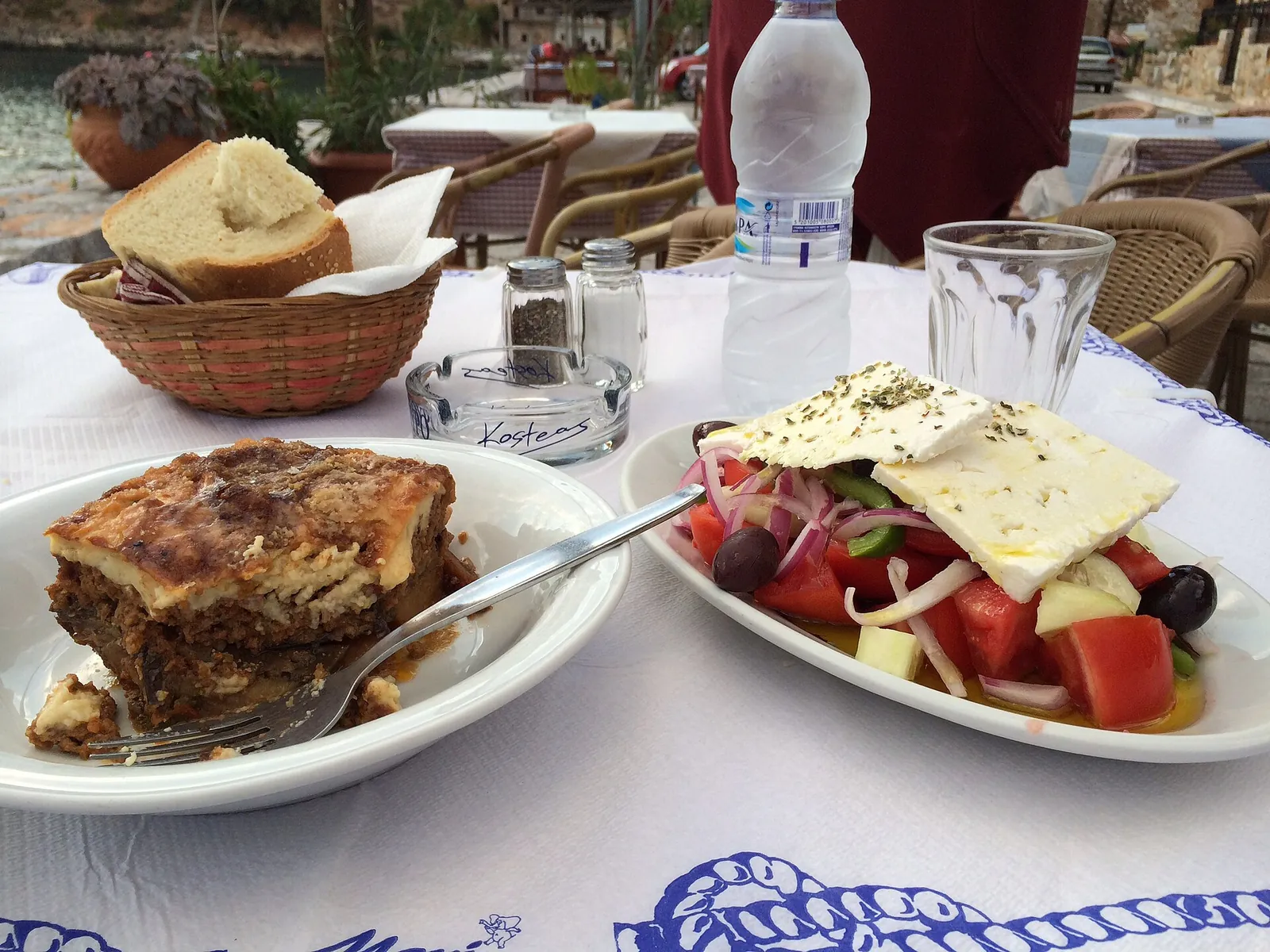
The pyramid most people mean by the diet places cheese in the middle tier, eaten in small portions, while vegetables, fruit, beans, whole grains and olive oil do the heavy lifting.
That framing explains how to use it. A little salty feta over a bean salad or a shaving of pecorino on pasta fits the pattern; a plate of cheese as the whole meal does not. This page is general information, not medical advice.
How the Mediterranean diet treats cheese
How the Mediterranean diet treats cheese is spelled out on the Oldways Mediterranean diet page. Oldways created the Mediterranean Diet Pyramid in 1993 with the Harvard School of Public Health and the World Health Organization, as an alternative to the USDA's original food pyramid. It lists "poultry, eggs, cheese, and yogurt" in moderate portions, daily to weekly, and advises choosing plain Greek yogurt and smaller amounts of traditional, artisan cheeses, noting that fermented dairy is common around the Mediterranean.
Two points follow from that wording. The pyramid does not ban cheese, and it does not give it a daily target either. The pattern the guidance describes is plant-centered, with some animal foods, and cheese is one of the smaller ones.
Mediterranean diet cheeses worth buying
Mediterranean diet cheeses are mostly sheep's, goat's and water buffalo milk cheeses, made in small dairies for local use. These are common picks, with the page that covers each:
- Feta is a Greek brined cheese made from sheep's milk, or sheep's milk with up to 30 percent goat's milk, if it carries the protected name. It crumbles onto salads.
- Halloumi is the cheese you grill, and it holds its shape over heat.
- Manchego is Spain's sheep's-milk cheese, usually served in thin slices.
- Ricotta is a whey cheese, soft and mild, and a good fit for toast, pasta and fruit.
- Pecorino Romano is a salty sheep's-milk grating cheese, so a little goes a long way.
- Fresh mozzarella is the soft white cheese of southern Italy, good with tomatoes.
- Mizithra and manouri are Greek cheeses worth a look beyond feta, and the Greek cheeses page covers more.
Many of these are salty, which matters for blood pressure. Cheese and blood pressure covers the numbers.
Portion sizes for cheese in a Mediterranean diet
Portion sizes for cheese in a Mediterranean diet are not set by the pyramid beyond "moderate," so use a practical guide. On a cheese board, 1 to 2 ounces per person is the standard appetizer amount on this site's cheese per person page. Used as a seasoning, a tablespoon of grated pecorino or a handful of crumbled feta covers a whole dish.
Cheese also brings saturated fat. USDA data and the 10 percent guideline are on the saturated fat in cheese page, which is why small amounts of strongly flavored cheese suit the pattern better than large amounts of a mild one.
What research says about Mediterranean diet and cheese
Research on the Mediterranean diet and cheese comes from two directions. Reviews of the diet itself, such as the 2004 Heart review on the French paradox, point to a pattern rich in fruits, vegetables, nuts and alpha-linolenic acid that showed cardiovascular benefits in intervention trials, with no particular role for cheese.
On cheese alone, a 2021 meta-analysis of cohort studies in Scientific Reports covering 554,323 participants found higher cheese intake associated with a relative risk of 0.91 for coronary heart disease compared with lower intake (95 percent confidence interval 0.84 to 0.99). Those are observational associations, and the authors rate confidence as moderate at best. The full story is on the French paradox page.
Mediterranean diet cheese mistakes
Mediterranean diet cheese mistakes usually come from treating the diet as a flavor, not a pattern.
Too much, too often. The pyramid says moderate portions, so a daily pile of feta on a plain salad is not the same as a sprinkle on a bean and vegetable dish.
Buying the wrong cheese. Look for sheep's or goat's milk cheeses from the region over generic "Mediterranean-style" blends, which are often cow's milk.
Forgetting salt. Brined cheeses like feta and halloumi are salty, so skip extra salt in the dish and taste before adding any. A salad with feta, olives and capers can already carry plenty, which is worth remembering if you are watching sodium.
Questions about cheese in a Mediterranean diet
These answers cover the most common questions on cheese in a Mediterranean diet.
Can you eat cheese on a Mediterranean diet?
Yes, you can eat cheese on a Mediterranean diet. The Oldways pyramid lists cheese in moderate portions, daily to weekly.
What is the best cheese for a Mediterranean diet?
The best cheese for a Mediterranean diet is a traditional one in small amounts, such as feta, manchego, ricotta or pecorino, as Oldways recommends smaller amounts of traditional artisan cheeses.
Is feta cheese Mediterranean diet friendly?
Feta cheese fits the Mediterranean diet well, as it is a traditional Greek cheese, but it is salty, so use it as an accent.
Is yogurt or cheese better on a Mediterranean diet?
Yogurt or cheese on a Mediterranean diet are both fine, and Oldways singles out plain Greek yogurt and smaller amounts of cheese.
Does the Mediterranean diet allow cheese if you have high cholesterol?
The Mediterranean diet allowing cheese with high cholesterol is a question for your doctor or dietitian, since it depends on your own numbers.
Cheese in a Mediterranean diet, in short
Cheese in a Mediterranean diet works best as a small, flavorful addition. Start with one traditional cheese, such as feta or manchego, and build the meal around vegetables, beans and olive oil.
Sources
- Mediterranean Diet, Oldways
- Jakobsen MU et al. Intake of dairy products and associations with major atherosclerotic cardiovascular diseases, Scientific Reports, 2021
- Ferrières J. The French paradox: lessons for other countries, Heart, 2004