
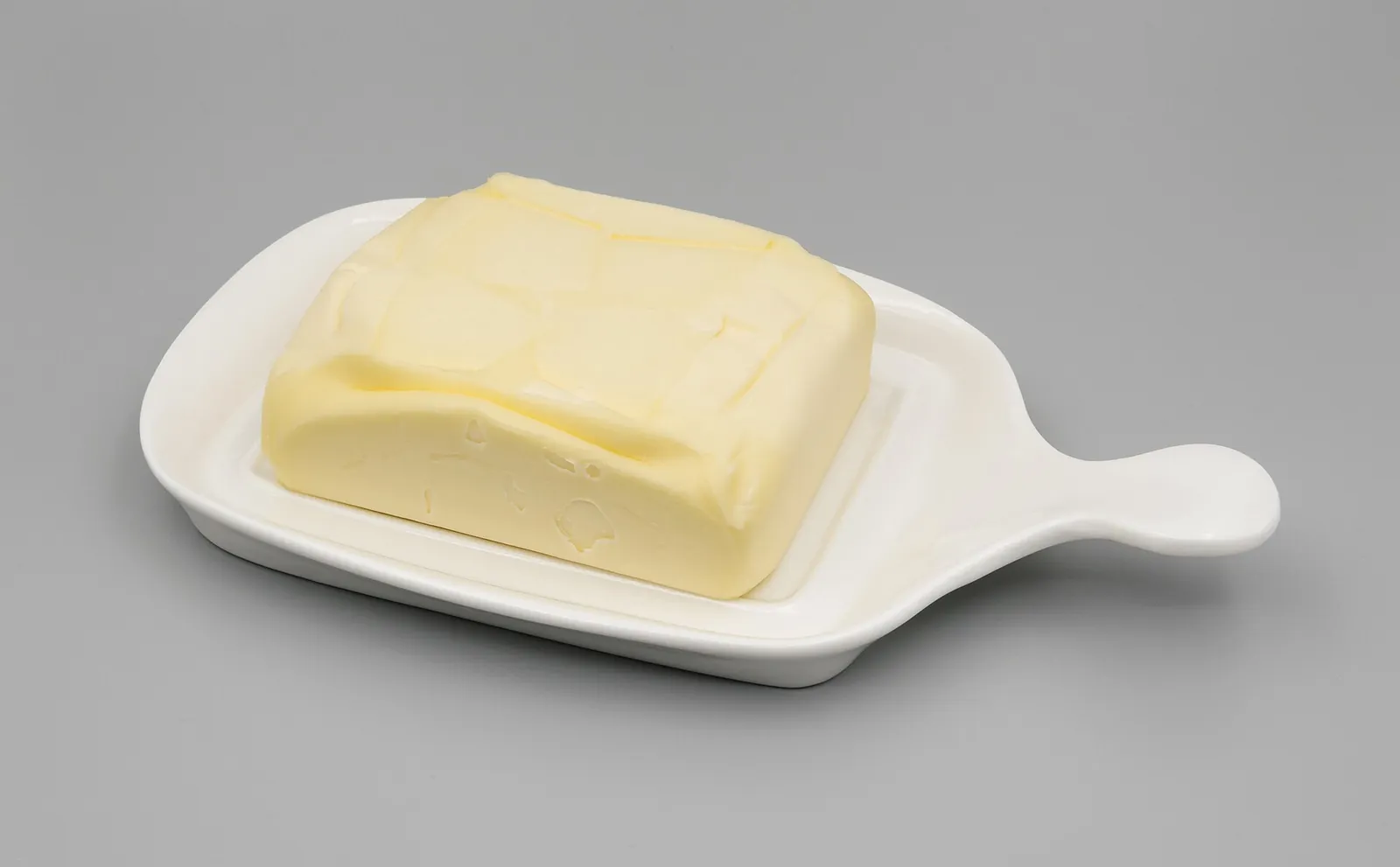
A few cheeses, such as part-skim ricotta and cottage cheese, have far less.
Whether that matters is a live research question. The standing advice is to keep saturated fat under 10 percent of daily calories, yet reviews of large cohort studies have not found cheese to raise heart disease risk the way its fat content would predict. This page covers the numbers, the limit and what that evidence can and cannot show. This page is general information, not medical advice.
How much saturated fat is in cheese
How much saturated fat is in cheese depends mostly on the fat and moisture of the type. This table lists USDA SR Legacy values for one ounce (28 g) and the share of the 20 g Daily Value in 21 CFR 101.9.
| Cheese, 1 oz | Saturated fat | Share of 20 g Daily Value |
|---|---|---|
| Goat cheese, hard | 7.0 g | 35% |
| Colby | 5.7 g | 29% |
| Cheddar | 5.3 g | 27% |
| Swiss | 5.2 g | 26% |
| Brie | 4.9 g | 25% |
| Mozzarella, whole milk | 3.9 g | 20% |
| Feta | 3.8 g | 19% |
| Cheddar, reduced fat | 3.6 g | 18% |
| Mozzarella, part skim | 2.9 g | 15% |
| Ricotta, part skim | 1.4 g | 7% |
| Cottage cheese, 1% | 0.2 g | 1% |
Moisture explains much of the spread. Cheddar and Swiss lose water as they age, which concentrates the fat in each ounce, while ricotta and cottage cheese stay wet and are often made from skim or part-skim milk. Nonfat versions of cheddar, Swiss and American list 0 grams.
The saturated fat limit in the Dietary Guidelines
The saturated fat limit in the Dietary Guidelines for Americans 2020 to 2025 is less than 10 percent of calories per day, starting at age 2, as summarized in a Nutrition Today article by the guidelines' authors. The same document recommends fat-free or low-fat milk, yogurt and cheese. On a 2,000-calorie day, 10 percent is 200 calories, or about 22 grams, so four ounces of cheddar would use nearly all of it.
Newer guidance leans differently on dairy fat. The 2025 to 2030 guidelines tell people who eat dairy to include full-fat dairy with no added sugars, yet keep the 10 percent ceiling, as the cheese and keto page notes. Both versions treat cheese as part of a whole eating pattern, not as a food measured alone.
What the dairy matrix research shows
What the dairy matrix research shows is that the same grams of saturated fat can behave differently depending on the food around them. The "matrix" is the food's structure: in cheese, fat sits inside a protein network along with calcium, and fermentation changes the mix.
A 2024 narrative review in Frontiers in Nutrition by Taormina, Unger and Kraft, covering studies from 2013 to 2023, found that most studies reported no association between regular-fat dairy foods such as cheese and cardiometabolic outcomes. Its authors concluded that regular-fat dairy can fit inside an overall healthy eating pattern, and noted that effects on LDL cholesterol were inconsistent across analyses.
A 2021 meta-analysis in Advances in Nutrition by Chen and colleagues pooled 55 prospective cohort studies. Higher cheese intake was associated with a lower risk of coronary heart disease (relative risk 0.90, 95% CI 0.84 to 0.97) and, borderline, of stroke (0.94, 0.88 to 1.00). The authors rated the evidence low to moderate quality and saw no harmful associations.
What the evidence does not show
What the evidence does not show is that cheese is protective or that saturated fat no longer matters. Cohort studies find associations: people who eat more cheese may also differ in income, diet and habits, and the studies cannot settle cause. The reviews above also mix full-fat and lower-fat cheese and rarely track portions, so they say little about a daily 4 ounces.
The lipid trials point the same careful way. Short feeding trials find cheese raises LDL cholesterol less than butter with the same fat, but they last weeks, not years. The cheese and cholesterol page covers those trials in detail. Where the reviews disagree or are thin, the Dietary Guidelines limit still stands.
Cutting saturated fat in cheese without giving it up
Cutting saturated fat in cheese is mostly a matter of choosing type and portion, not quitting.
- Use less of a strong cheese. An ounce of Parmesan (4.2 g) grated over a dish covers a lot of flavor for little fat.
- Switch the everyday cheese. Part-skim mozzarella has 2.9 g an ounce against 3.9 g in whole-milk mozzarella, and part-skim ricotta has 1.4 g.
- Try reduced fat, with a trade-off. Reduced-fat cheddar drops from 5.3 g to 3.6 g, though the texture and melt change.
- Count the whole day. Butter, meat and baked goods also add saturated fat, and the healthiest cheeses page ranks options across nutrients.
Mistakes about saturated fat in cheese
Mistakes about saturated fat in cheese run in both directions. One is treating "the research is nuanced" as permission for unlimited cheese: an ounce a day and a pound a day are different questions, and the studies mostly describe ordinary servings.
The other is assuming low-fat cheese is always better. Nonfat cheese often has more sodium per ounce than its full-fat twin (USDA lists nonfat cheddar at 284 mg against 185 mg), which matters for cheese and blood pressure. Check the whole label.
Questions about saturated fat in cheese
These are short answers to common questions about saturated fat in cheese.
Is cheese high in saturated fat?
Cheese is high in saturated fat for most full-fat types. USDA lists 5.3 grams per ounce for cheddar and 5.2 for Swiss, while part-skim ricotta has 1.4 and 1% cottage cheese 0.2.
How much saturated fat should you have a day?
Saturated fat should stay under 10 percent of daily calories under the Dietary Guidelines, and the label Daily Value is 20 grams. Ask a doctor or dietitian about your own target.
Is the saturated fat in cheese different from butter?
Saturated fat in cheese appears to act differently from the same fat in butter on LDL cholesterol in short trials, which researchers link to the dairy matrix. The effect is on blood lipids, not proven for disease.
Does cheese cause heart disease?
Cheese has not been shown to cause heart disease. A 2021 meta-analysis of 55 cohort studies found higher cheese intake associated with lower coronary heart disease risk, though these are associations.
Which cheese has the least saturated fat?
The cheese with the least saturated fat is cottage cheese or nonfat cheese, at 0.2 grams or less per ounce in USDA data. Among aged cheeses, part-skim mozzarella has about 2.9 grams.
Saturated fat in cheese: where to start
Saturated fat in cheese is easy to manage once you know the numbers: read the label per ounce, measure a portion, and favor flavorful cheeses you use sparingly. If you have high cholesterol or heart disease, follow your clinician's advice, and see the French paradox for how cheese fits wider heart-health patterns.
Sources
- Snetselaar LG, de Jesus JM, DeSilva DM, Stoody EE. Dietary Guidelines for Americans, 2020-2025, Nutrition Today, 2021
- Chen Z et al. Dairy Product Consumption and Cardiovascular Health: A Systematic Review and Meta-analysis of Prospective Cohort Studies, Advances in Nutrition, 2021
- Taormina VM, Unger AL, Kraft J. Full-fat dairy products and cardiometabolic health outcomes: Does the dairy-fat matrix matter?, Frontiers in Nutrition, 2024
- 21 CFR 101.9, Nutrition labeling of food, Cornell Legal Information Institute
- USDA FoodData Central (SR Legacy): Cheese, cheddar (173414), U.S. Department of Agriculture