
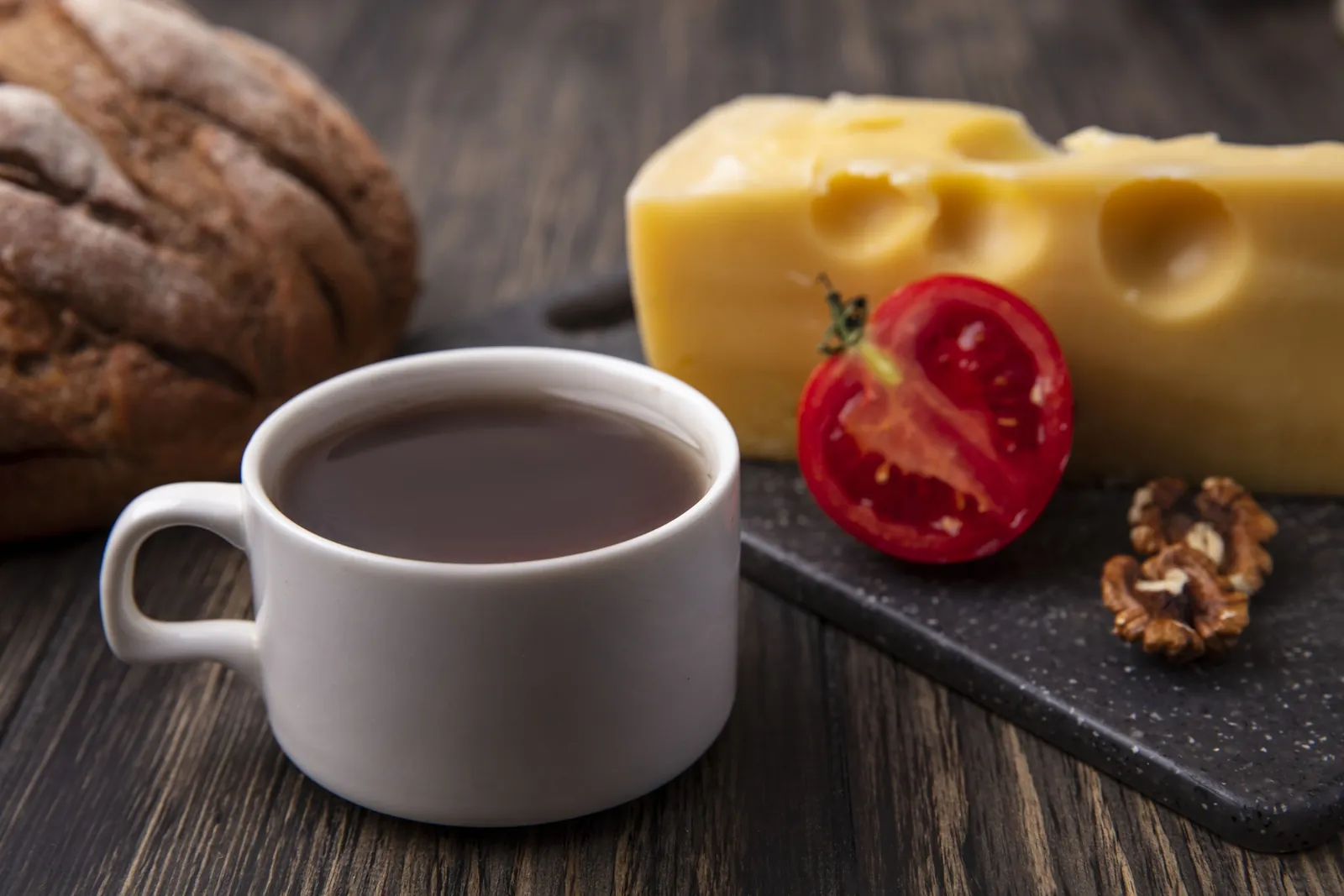
In Finland the pairing is old enough to have a name, leipäjuusto, the "coffee cheese."
The logic is the same as with wine. Coffee brings bitterness, acidity and roast. Cheese brings fat, salt and protein. The fat rounds the bitterness off, and the salt makes the coffee taste a little sweeter. What goes wrong is mismatched weight, so the sections below sort the cheeses by how much the coffee can take.
Coffee and cheese pairings at a glance
This coffee and cheese table lists the matches by cheese style, with the roast that suits each and the reason.
| Cheese | Coffee | Why it works |
|---|---|---|
| Aged Gouda | Medium roast, black | Caramel and nut notes meet caramel and nut notes |
| Parmigiano-Reggiano | Medium to dark roast | Salty crystals against roast bitterness |
| Mascarpone | Espresso | Cream softens bitterness, as in tiramisu |
| Leipäjuusto | Any hot coffee | The traditional Finnish match |
| Mild fresh cheese | Light roast, black | Acidity brightens it without burying it |
| Blue cheese | Dark roast or espresso | Needs a strong coffee, and a sweet note on the side |
Leipäjuusto, the traditional coffee cheese
Leipäjuusto is the one cheese with a documented coffee tradition: a Finnish fresh cheese, baked in a flat disc, eaten with coffee. According to Wikipedia's entry on bread cheese, the traditional Finnish way is that "a few pieces are placed in a cup, with hot coffee poured on." The Swedish name, kaffeost, literally means "coffee cheese."
The cheese is mild and chewy, so it does not fight the coffee. It softens in the heat but keeps its shape, and you eat the pieces with a spoon as the coffee cools. The full story, including the Wisconsin version sold as bread cheese or juustoleipä, is on the leipäjuusto page. Outside Finland you will more likely find it at Nordic markets or as Wisconsin bread cheese, and plain black coffee is the right choice. Skip milk, since the cheese supplies the softness.
Coffee with aged and nutty cheese
Coffee with aged and nutty cheese is the safest place to start. Aged Gouda has butterscotch and caramel notes, Gruyère and Comté lean toasty and nutty, and Parmigiano-Reggiano is salty and crystalline. A medium roast with caramel or nut notes echoes all of them. Brew it black, taste the cheese first, then the coffee, and notice that the coffee seems less bitter afterward.
Choose cheeses with at least a year of aging for this. A young, rubbery Gouda has no depth for the coffee to meet. Cheese age changes the flavor a great deal, and a good aged Gouda is worth the extra money here.
Coffee with creamy and sweet cheese
Coffee with creamy and sweet cheese is what tiramisu already does. According to Wikipedia's tiramisu entry, the dessert is ladyfingers soaked in coffee and covered with a cream of egg yolks, sugar, mascarpone and cocoa powder, probably invented in the late 1960s or early 1970s in northeastern Italy. The tiramisu page covers it in detail.
You can rebuild the idea at the table without baking: a spoonful of mascarpone sweetened with a little honey or sugar, an espresso, and a few crisp cookies. Fresh ricotta with a drizzle of honey works too. Keep the sweetness light, or it flattens the coffee.
Matching roast to cheese
Matching roast to cheese comes down to intensity. Light roasts are more acidic and fruity, so they suit fresh, tangy cheeses and a plain mild one. Medium roasts, with caramel and nut flavors, suit aged Gouda, Gruyère and Comté. Dark roasts and espresso are bitter and smoky, and need either a very salty cheese or a creamy sweet one to calm them down.
Blue cheese is the hardest case. A strong dark roast can hold its own, but plain blue and black coffee is a fight. Add a sweet partner such as honey or dried fig, and the match makes sense. The blue cheese guide explains why blues are so salty and sharp.
Coffee and cheese mistakes to avoid
Coffee and cheese mistakes are mostly about heat and sugar. Scalding coffee numbs your palate and melts soft cheese into a mess, so let a cup cool for a few minutes first. Flavored coffees (vanilla, hazelnut) fight with the cheese, so use plain beans. And sugar or milk in the coffee changes the match: with mascarpone it is fine, with aged Gouda it tends to mute the cheese.
Do not serve a delicate fresh cheese with espresso, either. The cheese disappears. And for a gathering, put out a small tasting of three coffees and three cheeses rather than a full board, since coffee is filling and it gets cold fast.
Questions about coffee and cheese
These questions about coffee and cheese come up most.
Does coffee go with cheese?
Coffee goes with cheese when the weights match: nutty aged cheeses with medium roasts, and creamy sweet cheeses like mascarpone with espresso. In Finland the pairing is traditional, with leipäjuusto served in a cup of hot coffee.
What is coffee cheese?
Coffee cheese is a name for leipäjuusto, the Finnish baked fresh cheese, in Swedish kaffeost. Pieces go into a cup and hot coffee is poured over them, per Wikipedia.
What cheese goes best with coffee?
The cheese that goes best with coffee is a nutty aged one such as aged Gouda, Gruyère or Parmigiano-Reggiano, paired with a medium roast.
Can you put cheese in coffee?
You can put cheese in coffee in the Finnish way: a mild, baked cheese like leipäjuusto softens in hot coffee. Do not try it with melting cheeses, which turn stringy or oily.
What is a non-alcoholic alternative to wine with cheese?
A non-alcoholic alternative to wine with cheese is coffee or tea, or the options on the non-alcoholic pairings page.
Try coffee and cheese tonight
To try coffee and cheese, brew a medium roast, cut shards of aged Gouda, and taste the cheese first. Then add mascarpone with an espresso for the sweet side, or find leipäjuusto for the Finnish version. For other pairings, see the pairing guide.
Sources
- Bread cheese, Wikipedia
- Kaffeost (bread cheese in coffee), Wikipedia
- Tiramisu, Wikipedia