
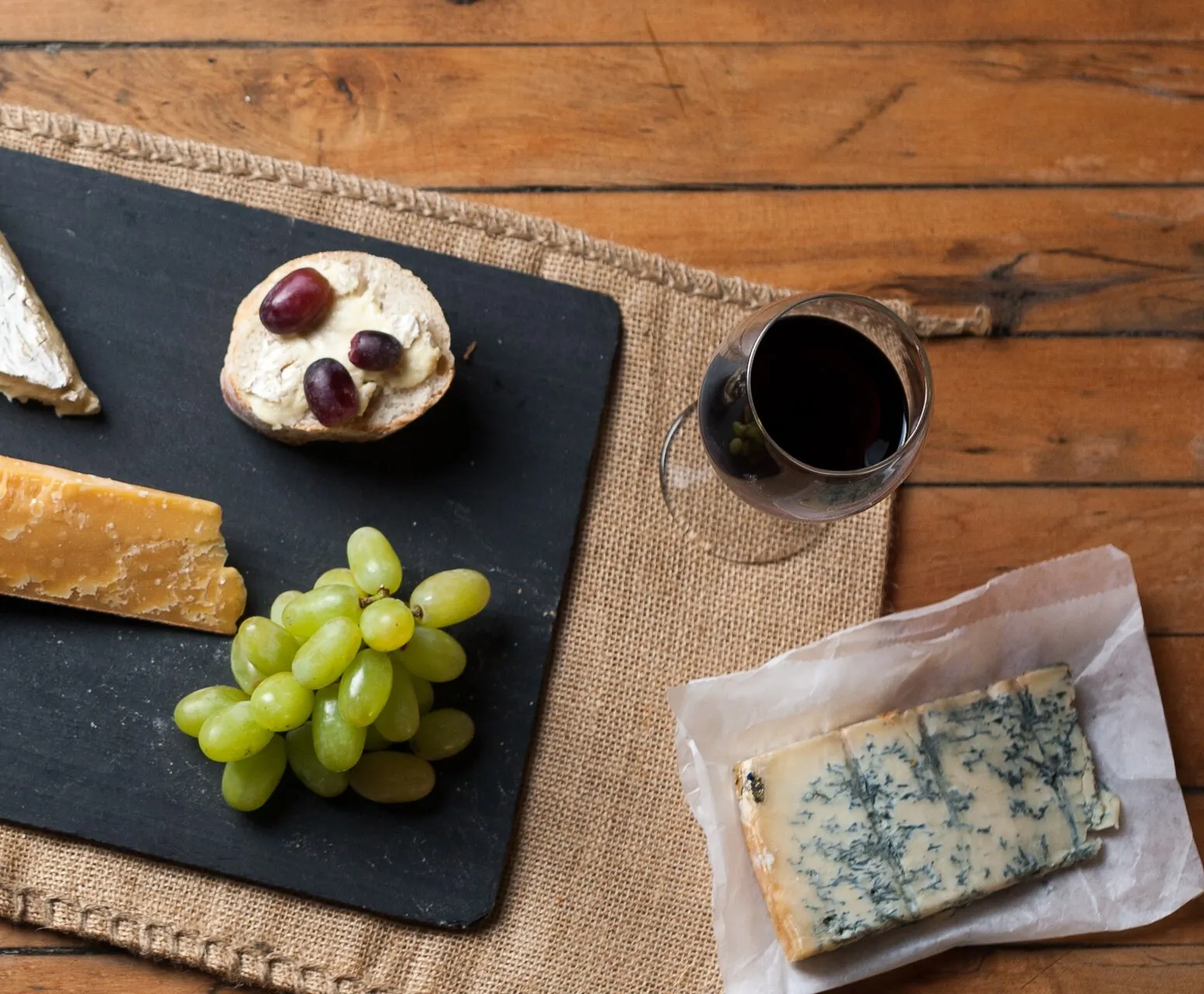
Plan 1 to 2 ounces of cheese per guest if dinner follows, 4 to 6 ounces if the cheese is the meal, and taste from mild to strong.
Matching intensity beats matching color. A delicate cheese disappears next to a big red, and a strong blue flattens a light white, so the cheeses should climb in strength as the wines do. Region is the tiebreaker, and the official bodies behind Crottin de Chavignol, Comté and Manchego all point to wines from their home areas; the wine and cheese pairing guide covers the basics.
Wine night cheeses at a glance
Wine night cheeses at a glance climb from light to strong, with a wine style beside each rung.
| Step | Cheese style | Examples | Wine style that suits it |
|---|---|---|---|
| 1. Light | Fresh goat cheese | Chèvre, young Crottin de Chavignol | Crisp, high-acid white such as Sancerre |
| 2. Mild to medium | Bloomy rind | Brie, Camembert | Sparkling wine or an unoaked Chardonnay |
| 3. Medium | Firm and nutty | Comté, Gruyère, Manchego, aged Gouda | Medium-bodied red with soft tannins, or a full-bodied white |
| 4. Strong | Aged hard | Parmigiano-Reggiano at 24 months and up | Structured red, or a sparkling red such as Lambrusco |
| 5. Strongest | Blue | Stilton, Gorgonzola, Roquefort | Sweet or fortified wine such as Port or Sauternes |
The best cheeses for wine night, and what to buy
The best cheeses for wine night each fill one rung of the ladder, so buy one from each and mind its weak spot.
Fresh goat cheese
Fresh goat cheese opens the night because it is the lightest cheese on the board and its tang suits a crisp white. Buy a plain log or a young Crottin de Chavignol; the AOP brochure describes young ones as lightly goaty and slightly floral and mature ones as walnut and hazelnut, so ask which you are buying. Weak spot: it is easy to overpower, so serve it before any red.
Brie or Camembert
Brie or Camembert gives the board its soft, creamy center and suits sparkling wine. Buy a small whole wheel that is slightly firm rather than runny. Weak spot: in the Australian study below a white-mold cheese dominated the wines, so pair it with bubbles or a full white, not a delicate one.
Comté, Manchego or aged Gouda
Comté, Manchego or aged Gouda is the board's workhorse, because firm cheeses of medium strength match the widest range of wines. Buy a piece with a stated age of a year or more for the most flavor, and cut thin planks or small chunks. Weak spot: very old pieces turn drier and stronger, so pour a red with them, not a light white.
Blue cheese
Blue cheese closes the night because it is the strongest cheese and needs the sweetest wine. Buy a small wedge of Stilton, Gorgonzola or Roquefort and serve it with honey, pears or walnuts. Weak spot: it is salty and not for every guest, so keep one milder cheese beside it.
Match cheese and wine by intensity
Match cheese and wine by intensity, meaning pair the strength of one with the strength of the other, and cheese age is the easiest dial to read. The Parmigiano-Reggiano Consortium's own pairing chart shows the dial turning on a single cheese. Wheels over 12 months suit sparkling wines or light whites. At 24 months it moves to reds with smooth tannins or Lambrusco, and past 40 months, it says, white wines step aside for full-bodied reds with bold tannins. Beyond 60 months it calls for rich, sweet, structured wines such as tawny Port, Madeira or Sauternes. The older, saltier and smellier any cheese is, the bolder its partner should be, as the pairing by intensity guide explains.
Classic cheese and wine pairs
Classic cheese and wine pairs usually come from one place, and the official bodies for four protected cheeses recommend wines from home; more are in the regional pairings guide.
- Crottin de Chavignol and Sancerre. The AOP's own brochure says the goat cheese is best paired with a Sancerre.
- Aged Comté and Vin Jaune. The Comté interprofession says Vin Jaune works fully only with long-aged Comté, while Jura crémants suit wheels with a melting or crumbly texture and aromas that are not too intense.
- Manchego and a medium-intensity aged red. The Manchego council recommends aged reds of medium intensity, or dry or barrel-aged whites from La Mancha, where the grapes grow in the fields the sheep graze.
- Aged Parmigiano-Reggiano and Lambrusco. The consortium lists structured sparkling reds such as Lambrusco Reggiano for 24-month wheels.
- Blue cheese and sweet wine. The strongest cheeses call for the sweetest wines, the idea behind Stilton and Port and Roquefort and Sauternes; the port and blue cheese guide explains why it works.
How much cheese and wine for a wine night
Plan 1 to 2 ounces of cheese per guest when dinner follows a wine night and 4 to 6 ounces when the cheese is the meal, spread across three to five cheeses, as the cheese per person guide advises. Four cheeses cover most groups: one fresh, one bloomy, one firm and one blue. For the wine, the National Institute on Alcohol Abuse and Alcoholism defines a standard drink of table wine as 5 fluid ounces, so a 750 mL bottle pours about five glasses or about a dozen 2-ounce tasting pours. A four-wine tasting for six guests at 2 ounces a pour uses about 48 ounces, so one bottle of each wine leaves room for seconds. Keep water on the table, and refill from the fridge instead of leaving cut cheese out more than 2 hours, as University of Nebraska-Lincoln Extension advises.
The order to taste cheese and wine
The order to taste cheese and wine runs from light to strong, and from sparkling to sweet.
- Start with sparkling wine or a crisp white and the fresh goat cheese; the Manchego council notes that cava, a sparkling wine, helps cleanse the palate between bites.
- Move to the bloomy rind with a fuller white or more sparkling wine.
- Pour the medium red with the firm cheese.
- Serve the aged hard cheese with the most structured red.
- Finish with the blue and the sweet wine.
Take the cheese out of the fridge about 30 minutes ahead, and sip the wine on its own before the first bite of each cheese so you know what the cheese changes.
What most wine and cheese advice gets wrong
Most wine and cheese advice gets the color rule wrong and ignores intensity.
The experts disagree on red versus white
The experts disagree on red versus white, and two peer-reviewed studies landed on opposite sides. In a 2005 Canadian study, 27 wine and food professionals rated nine cheeses against 18 wines, and white wines came closest to the ideal more often than reds, though judges varied considerably. In a 2009 Australian study of 46 consumers, red table wine was marginally more versatile than white. Treat color as a coin toss and intensity as the rule.
Strong cheeses overpower wines
Strong cheeses overpower wines, and the Australian study found the most versatile cheeses were the medium ones. Cheddar and Gruyère matched the widest range of wines, while a white-mold cheese and a blue dominated the wines they were paired with. Sweet wines were among the hardest to match in both studies, so keep Port or Sauternes for the blue, and give the bloomy cheese a sparkling or full-bodied white that can stand up to it.
A bite of cheese changes the wine
A bite of cheese changes the wine you taste next, so judge a tannic red both alone and with cheese. In a French study of 31 consumers, cheese eaten between sips cut how long astringency and sourness dominated Madiran, a tannic red, and lengthened its red fruit aroma.
Questions about cheese for wine night
These are the questions about cheese for wine night that hosts ask most.
What cheese goes best with wine?
The cheese that goes best with wine is one that matches the wine's intensity, and a firm medium cheese such as Gruyère or cheddar is the most versatile choice across wines.
What cheese goes with red wine?
Firm cheeses such as Manchego, aged Gouda, cheddar and aged Parmigiano-Reggiano go with red wine, and cheese softens a tannic red's edge; the red wine and cheese guide has more matches.
What cheese goes with white wine?
Fresh goat cheese, Brie, Camembert and young Comté go with white wine, crisp whites with the fresher cheeses and fuller whites with the nutty ones; see the white wine and cheese guide for details.
How much cheese per person for a wine night?
Plan 1 to 2 ounces of cheese per person for a wine night when dinner follows, and 4 to 6 ounces when the cheese is the meal.
In what order should you taste cheese and wine?
Taste cheese and wine from light to strong, with fresh cheeses and sparkling or crisp white wine first, firm cheeses and reds in the middle, and blue cheese with sweet wine last.
Plan your cheese for wine night
Plan your cheese for wine night around four wines and four cheeses, such as a fresh goat cheese log, a small Brie, a wedge of Comté or Manchego and a piece of Stilton or Gorgonzola. For six guests that is about 1.5 to 3 ounces of each if dinner follows, or 6 to 9 ounces of each if the cheese is the meal. Use the pairing guide to look up the wine for any cheese you add.
Sources
- Wine and Parmigiano Reggiano, Consorzio del Formaggio Parmigiano Reggiano
- Crottin de Chavignol AOP brochure, Crottin de Chavignol AOP; Comté et Vins du Jura AOC, Interprofession du Comté; Las 3 formas de maridar un Queso Manchego, Consejo Regulador de la D.O.P. Queso Manchego
- King M. and Cliff M., Evaluation of ideal wine and cheese pairs using a deviation-from-ideal scale with food and wine experts, Journal of Food Quality 28(3), 2005
- Bastian S. et al., Comparisons between Australian consumers' and industry experts' perceptions of ideal wine and cheese combinations, Australian Journal of Grape and Wine Research 15(2), 2009
- Galmarini M. et al., Use of Multi-Intake Temporal Dominance of Sensations (TDS) to Evaluate the Influence of Cheese on Wine Perception, Journal of Food Science 81(10), 2016
- What Is A Standard Drink?, National Institute on Alcohol Abuse and Alcoholism
- Charcuterie Boards and Food Safety, University of Nebraska-Lincoln Extension