
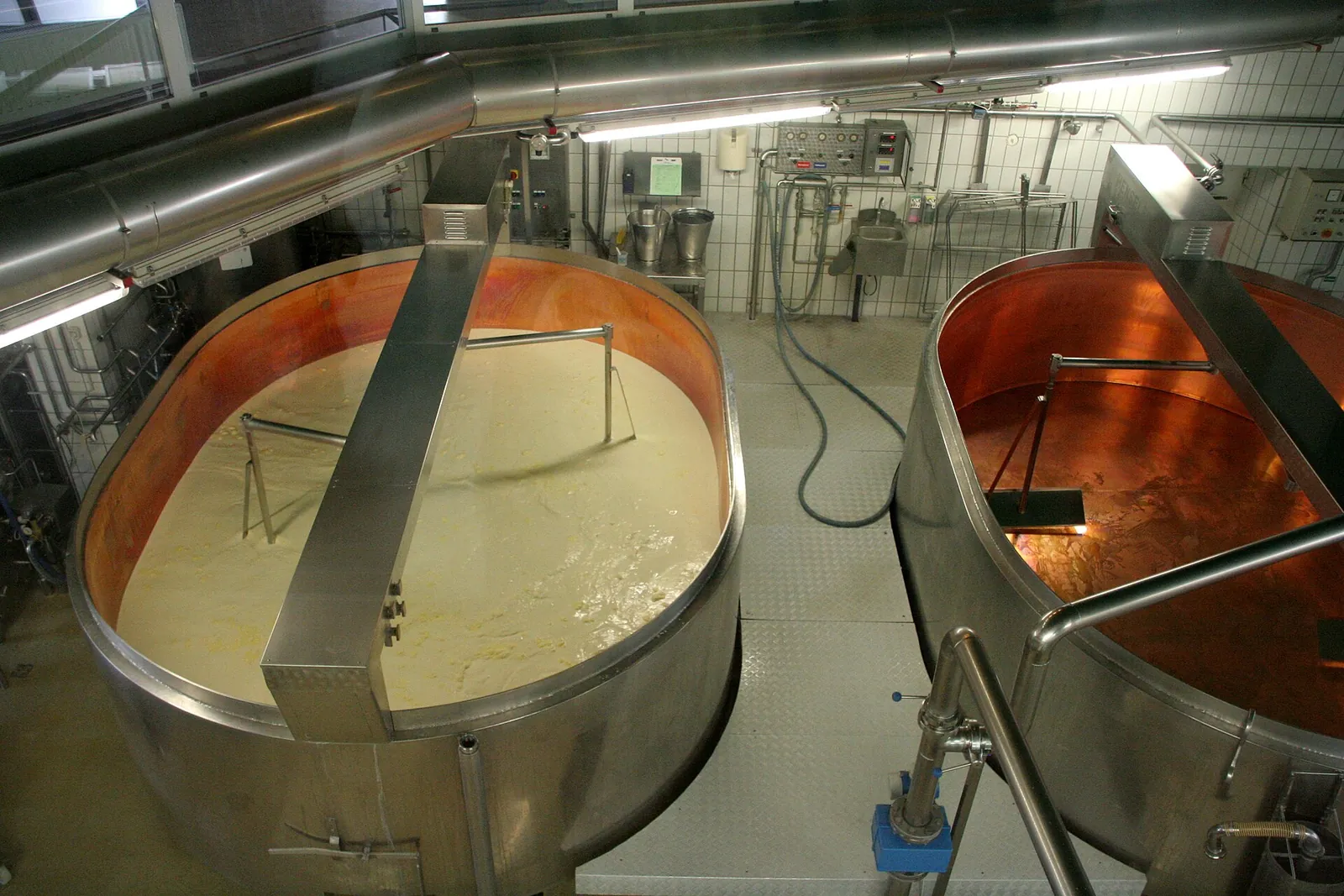
This page maps that family, lists the main cheeses with their style, and links to the guides for each.
Swiss cheese at a glance
Here is Swiss cheese at a glance: the main cheeses, their style and whether the name is protected.
| Cheese | Milk | Style | Protected name |
|---|---|---|---|
| Emmentaler | Cow | Semi-hard, large holes, mild and nutty | AOP |
| Gruyère | Cow | Hard, nutty, the fondue cheese | AOP |
| Appenzeller | Cow | Hard, herb-brine washed, spicy | No AOP listed |
| Raclette du Valais | Cow | Semi-hard, made to melt | AOP |
| Sbrinz | Cow | Extra-hard, granular | AOP |
| Tête de Moine | Cow | Semi-hard, shaved in rosettes | AOP |
| Vacherin Mont d'Or | Cow | Soft, spruce-banded, winter | AOP |
| Vacherin Fribourgeois | Cow | Semi-hard, melting | AOP |
The Swiss cheese tradition
The Swiss cheese tradition is built on cow's milk: cow's milk is used in about 99 percent of the cheeses Switzerland produces, with the rest from sheep and goats. Summer pasture in the Alps shaped the style, since large hard wheels keep through winter.
Two dishes carry the cheese into daily life. Fondue was first documented in a 1699 Zürich manuscript titled "To cook cheese with wine," and is often considered the national dish. Raclette comes from Valais, where melting cheese before a fire was attested in the 16th century, according to an overview of Swiss cuisine.
For the full tour, the Swiss cheese guide goes beyond the holes, and the Alps guide compares Swiss cheese with French and Italian neighbors.
Swiss cheese by style
Swiss cheese by style falls into hard, semi-hard, extra-hard and soft, and the names sort neatly into those groups.
Hard and semi-hard Swiss cheese
Hard and semi-hard Swiss cheese is the largest group. Gruyère is the benchmark melter, and Emmental is the one with the holes. The Swiss vs. Gruyère vs. Emmental page explains why the three get confused. Appenzeller is washed in a secret herb brine, which gives it a spicier edge, and Raclette is made to melt.
Extra-hard Swiss cheese
Extra-hard Swiss cheese is Sbrinz, aged for years until it is dense and granular enough to shave or grate. It sits in the same space as Parmigiano-Reggiano, and the Sbrinz page has the details. Tête de Moine is a different kind of hard cheese, shaved into frilly rosettes with a tool called a girolle.
Soft Swiss cheese
Soft Swiss cheese is mostly Vacherin Mont d'Or, a winter cheese banded in spruce bark and often baked whole. The Vacherin comparison separates the Swiss cheese from its French namesake.
How Emmentaler gets its holes
Emmentaler gets its holes from bacteria: Propionibacterium freudenreichii gives off gas as it metabolizes lactate, and tiny hay dust particles in the milk give the gas places to collect, according to an overview of Emmental. The AOP version must use raw cow's milk, only water, salt, starter cultures and rennet, and age at least four months.
That rule is why a holey American "Swiss" slice tastes different from the real thing: the style is copied, the process and the long cellar aging are not.
Cooking with Swiss cheese
Cooking with Swiss cheese starts with fondue and raclette. A fondue usually blends Gruyère with a second cheese and white wine, and the fondue recipe shows the method. For raclette, heat the cheese round and scrape it onto plates with boiled potatoes, cornichons and pickled onions, as the dish is traditionally served; the raclette at home page has the setup.
Emmental melts mildly and works for sandwiches and gratins, and a rind of Gruyère or Sbrinz adds depth to soup. Tête de Moine is not for melting at all: shave it thin with a girolle, or with a vegetable peeler, over bread or fruit so the rosette warms in your fingers and releases its aroma.
Serve a Swiss board with dark bread, pickles, cured ham, apple and pear, and a dry white wine such as a Chasselas or a Riesling. Start with the mild Emmental, move to Gruyère and Appenzeller, and finish with the strongest cheese, usually aged Sbrinz. Allow about 1 to 2 ounces per person as an appetizer, and a little more if the board is the meal.
How to buy Swiss cheese in the US
To buy Swiss cheese in the US, read the label. "Swiss cheese" on a deli slice is a style, often made in the US, while "Gruyère AOP" or "Emmentaler AOP" means the real cheese from Switzerland. A protected name means a set area and method, and the PDO and PGI guide explains the labels.
Gruyère, Emmental, Appenzeller and Raclette are easy to find at large cheese counters. Sbrinz and Tête de Moine take a specialty shop.
What most Swiss cheese guides get wrong
Most Swiss cheese guides get one thing wrong: they say Swiss cheese has holes. Only Emmentaler does. Gruyère, Appenzeller and Sbrinz are firm and dense, and Raclette and Vacherin are made to melt or spoon.
The second miss is the idea that all of it is mild. Appenzeller and aged Sbrinz are sharp and savory, and the mildness belongs to Emmental.
Questions about Swiss cheese
These are the most common questions about Swiss cheese.
What is real Swiss cheese?
Real Swiss cheese is Emmentaler, the holey cheese from Switzerland, and the country also makes Gruyère, Appenzeller, Sbrinz and others.
Does all Swiss cheese have holes?
Not all Swiss cheese has holes: Emmentaler does, but Gruyère and Sbrinz are firm and dense.
What is the best Swiss cheese for fondue?
The best Swiss cheese for fondue is Gruyère, often blended with Vacherin Fribourgeois or Emmental.
Is Swiss cheese made from cow's milk?
Swiss cheese is almost always cow's milk, at about 99 percent of Swiss production.
Where to start with Swiss cheese
Start with Swiss cheese by buying a wedge of Gruyère AOP and one of Appenzeller, then taste them side by side. Next, use the cards below to open each cheese.
Sources
- List of Swiss cheeses, Wikipedia (milk share, AOP status, cheese by style)
- Swiss cuisine, Wikipedia (fondue and raclette history)
- Emmental cheese, Wikipedia (holes, AOP rules)
- Raclette, Wikipedia (traditional serving)