
Strictly, Finland belongs to the wider Nordic group, but it is covered here too.
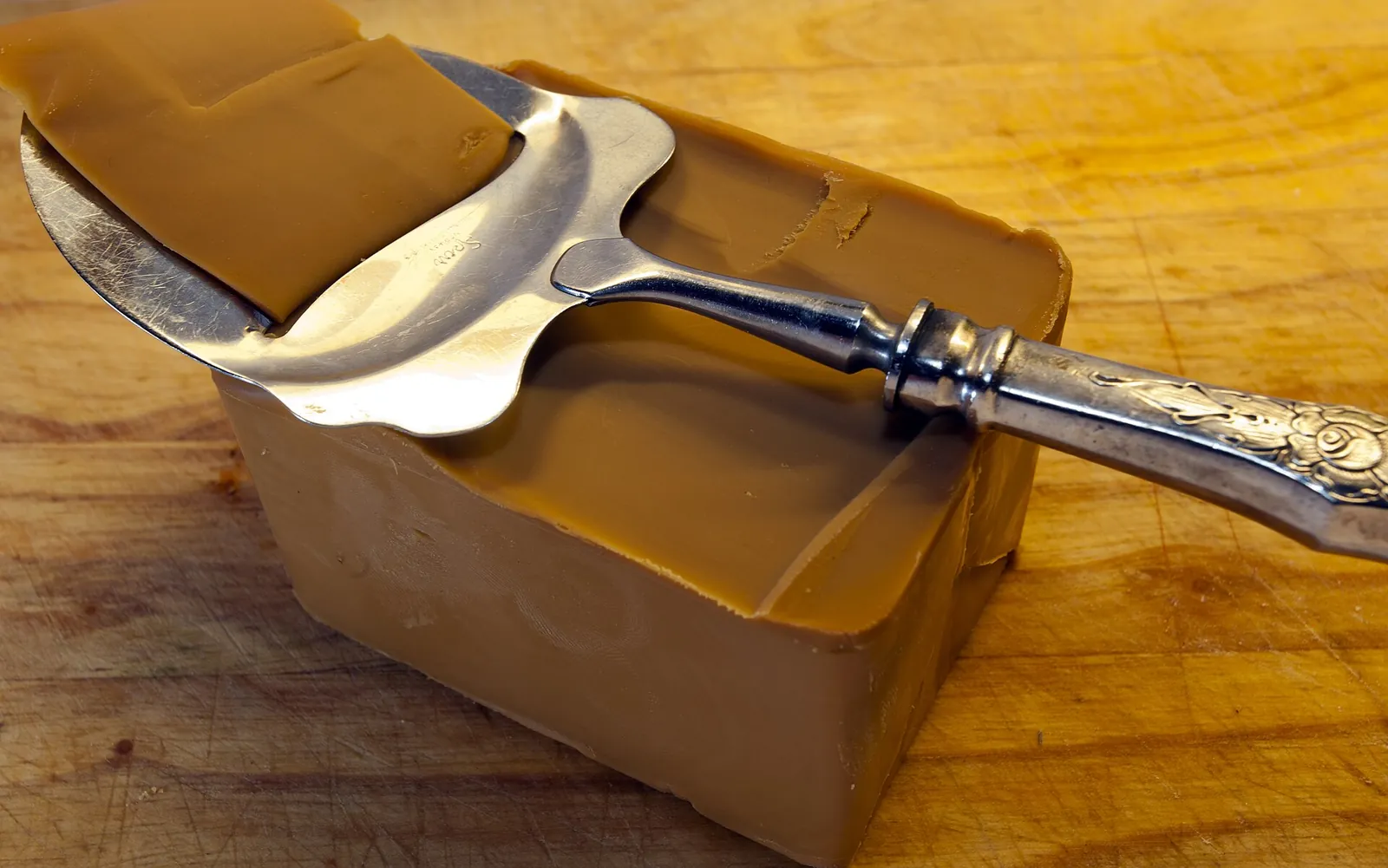
Most of these cheeses are cow's milk and meant to be sliced thin. A cheese slicer, called an ostehøvel in Norway, is the one tool worth owning.
Scandinavian cheeses at a glance
This table of Scandinavian cheeses names the country, the style and the one fact to remember.
| Cheese | Country | Style | Remember |
|---|---|---|---|
| Brunost | Norway | Sweet, fudge-like brown whey cheese | Made by boiling whey, milk and cream |
| Jarlsberg | Norway | Mild, nutty, large holes | Developed in the 1950s |
| Västerbotten | Sweden | Hard, granular, aged | Minimum 12 months; a trademark |
| Prästost | Sweden | Small-eyed cow's milk cheese | Trademark registered in 2001 |
| Danablu | Denmark | Soft, salty blue | PGI protected |
| Danbo | Denmark | Semi-soft, often caraway | PGI since 2017 |
| Havarti | Denmark | Creamy, mild table cheese | Ages from mild to sharp |
| Leipäjuusto | Finland | Baked fresh "bread cheese" | Squeaks; served with cloudberry |
Norway: brunost and Jarlsberg
Norway's best-known cheeses are brunost, the brown cheese, and Jarlsberg, the holey Swiss-style one. They could hardly be more different.
Brunost is made by boiling milk, cream and whey for hours so the water evaporates and the milk sugar caramelizes, which gives its brown color and sweetness. The modern version dates to 1863, when milkmaid Anne Hov of Gudbrandsdalen added cream to the whey. Gudbrandsdalsost, the most popular type, mixes cow's and goat's milk, while Fløtemysost has no goat's milk and is milder. The gjetost and brunost page sorts out the labels you will see in the US. Shave it thin on toast or a waffle, the way Norwegians do.
Jarlsberg was developed in the 1950s at the Agricultural University of Norway. It is mild, sweet and nutty, and it melts well. It is now made in Norway, Ireland and the USA, so check the package for origin. See the Norway page for more.
Sweden: Västerbotten and Prästost
Sweden is known for aged, hard cheese, and Västerbotten is its star. It is a hard, firm and granular cow's milk cheese with tiny holes, aged at least 12 months and usually 14, with a Parmesan-like salty taste and some bitterness. It is made at one dairy in Burträsk, owned by Norrmejerier, and the name is a registered trademark, not a PGI.
Prästost, "priest cheese," is a Swedish pasteurized cow's milk cheese whose roots go back to tithe payments in the 16th to 19th centuries. The Präst trademark was registered in 2001. Herrgårdsost and Svecia are other Swedish cheeses in the same family, though this page gives no more detail on them.
Denmark: Danablu, Havarti and Danbo
Denmark's Danablu, Havarti and Danbo are mild, creamy cheeses and one famous blue. Danablu was developed by Marius Boel in the early 20th century as a Roquefort-style cheese, made from homogenized cow's milk. It is a PGI, meaning it must be made in Denmark from Danish milk. It is saltier and sharper than a mild blue and less funky than Roquefort. Crumble it into salads or dressings.
Havarti is the creamy, mild table cheese: young it slices neatly for sandwiches, aged it turns saltier with hazelnut notes. Danbo is a semi-soft cow's milk cheese that was awarded PGI status in 2017, and the traditional version has caraway seeds. Aged Danbo, called Gamle Ole, is eaten on bread with raw onion rings and meat aspic. See the Denmark page for the full list.
Finland: leipäjuusto
Leipäjuusto is Finland's "bread cheese," a fresh round disk, 2 to 3 centimeters thick, baked or grilled until brown or charred. It comes from southern Ostrobothnia, northern Finland and Kainuu, and it was traditionally made from cow's colostrum but is now made from cow's milk.
The leipäjuusto page has the full story. It squeaks against the teeth when fresh, and Finns eat it warm with cloudberry jam, dip it in coffee, or dice it like feta in salads. Iceland also has a Nordic cheese tradition, but it is outside this page.
Scandinavian cheese protected names and labels
Scandinavian cheese protected names are few, so read labels with care. Danablu and Danbo are PGI names, which means the name belongs to Denmark. Västerbotten is protected as a trademark owned by a dairy, not by an EU designation. Jarlsberg is a brand made in several countries. Brunost has no protected status mentioned in the source used here. The PDO and PGI guide explains the difference.
What most Scandinavian cheese advice gets wrong
Scandinavian cheese advice usually says "brown cheese is goat cheese." It is not always. Fløtemysost has no goat's milk at all, and the goat tang varies by type.
The second mistake is slicing thick. Brunost, Jarlsberg and Havarti are best in thin, wide slices on crispbread or open-faced sandwiches. A cheese slicer gives uniform slices, and a thick chunk of brunost is overwhelmingly sweet.
Buying Scandinavian cheeses in the US
Scandinavian cheeses in the US are easiest to find at larger grocery stores for Jarlsberg and Havarti, and at specialty counters for Danablu, which is sold as Danish Blue. Brunost usually appears as Ski Queen gjetost. Västerbotten and leipäjuusto are rarer; try Nordic import stores, and expect leipäjuusto sometimes under "juustoleipä."
Questions about Scandinavian cheeses
These questions about Scandinavian cheeses come up often.
What is the most famous Scandinavian cheese?
The most famous Scandinavian cheese is probably Jarlsberg from Norway, with Danish blue and Havarti close behind.
What is brown cheese in Scandinavia?
Brown cheese in Scandinavia is brunost, a Norwegian cheese made by boiling whey, milk and cream until it caramelizes.
Is Västerbotten protected?
Västerbotten is protected as a registered trademark owned by Norrmejerier, not as a PGI.
Is Danish blue cheese protected?
Danish blue cheese, Danablu, is a PGI, so it must be made in Denmark from Danish milk.
What is Finnish squeaky cheese?
Finnish squeaky cheese is leipäjuusto, a baked fresh cheese often served with cloudberry jam.
Where to start with Scandinavian cheeses
To start with Scandinavian cheeses, buy a block of Jarlsberg and a wedge of Ski Queen gjetost, and put thin slices of both on crispbread. Add Danish Blue if you like blue cheese.
Sources
- Brunost, Wikipedia
- Västerbottensost, Wikipedia
- Danablu, Wikipedia
- Danbo cheese, Wikipedia
- Prästost, Wikipedia
- Leipäjuusto, Wikipedia
- Geographical indications and quality schemes explained, European Commission