
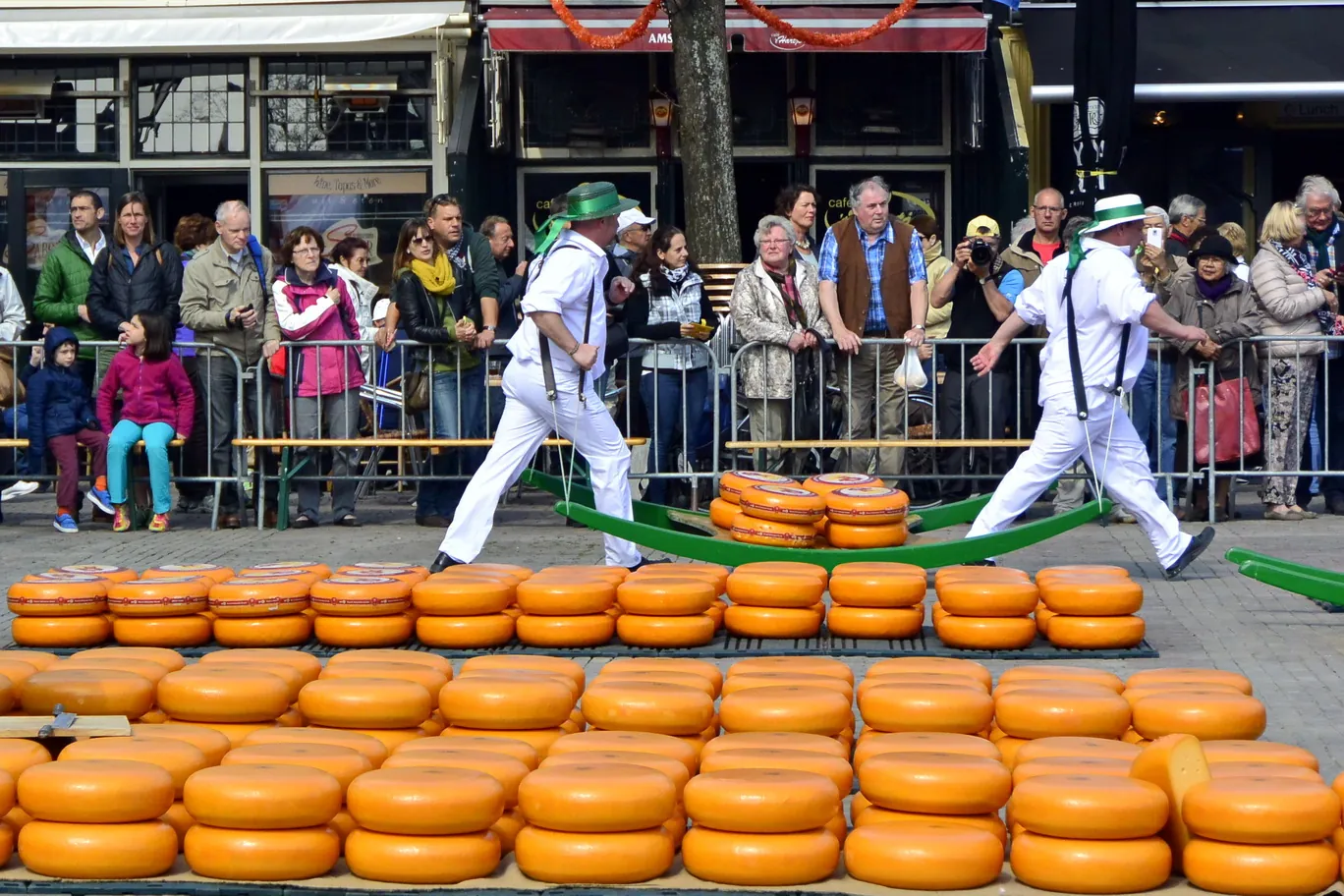
The rest of the tradition adds spiced Leyden, holey Maasdam and raw-milk Boerenkaas.
The simplest rule for buying it is to read the age first. A Gouda aged four weeks and one aged two years share a name and little else.
Dutch cheese at a glance
Dutch cheese is easiest to sort by protected name, and this table lists the main ones. The names and years follow the EU register of protected names, including the European Commission page on Gouda Holland.
| Cheese | Protected name | Character |
|---|---|---|
| Gouda Holland | PGI, 2010 | Semi-hard, sweet young, caramel old |
| Noord-Hollandse Gouda | PDO, 1996 | Less salty, North Holland milk only |
| Edam Holland | PGI, 2010 | Leaner, mild, ball shape |
| Noord-Hollandse Edammer | PDO, 1996 | North Holland Edam |
| Boerenkaas | TSG, 2007 | Raw-milk farmhouse cheese |
| Boeren-Leidse met sleutels | PDO, 1997 | Cumin-flavored Leyden |
| Kanterkaas | PDO, 2000 | Friesland edge cheese, cumin or clove versions |
Gouda, the center of Dutch cheese
Gouda is the center of Dutch cheese, and the protected versions have clear rules. The European Commission says Gouda Holland is a naturally matured, semi-hard cheese from milk of dairy farms across the Netherlands, mostly from Holstein-Friesian cows. Milk is cooled to 6°C on farms, delivered within 72 hours and pasteurized at least 72°C for 15 seconds. The cheese is brined and then matures in open air, from a sweet, soft young cheese to a firmer, deeper golden one that can take more than a year to mature fully.
Noord-Hollandse Gouda is the PDO twin: milk only from the province of Noord-Holland, and a less salty cheese. Plain "Gouda" is generic, which is why the label word "Holland" matters. The Gouda page covers aging stages and buying, and the Cheddar vs. Gouda comparison helps if you are deciding between the two.
Edam, the red-waxed ball
The red-waxed Edam is the lean, mild cousin of Gouda: a ball coated in red wax. Edam Holland is a PGI from 2010, and Noord-Hollandse Edammer a PDO from 1996. The fat range of Edam is 40 to 44 percent in dry matter against 48 to 52 for Gouda. For a side-by-side look, see Gouda vs. Edam. The wax is not eaten.
Leyden, Kanterkaas and spiced Dutch cheese
Spiced Dutch cheese is a distinct family. Leyden (Leidse kaas) is flavored with cumin and caraway seed, and the protected Boeren-Leidse met sleutels is a PDO from 1997. Kanterkaas is a hard cheese from Friesland, protected since 2000, with versions flavored with cumin or cloves. Friese nagelkaas is the clove cheese. The spice cuts through the mild, sweet base, so try it with dark bread and mustard.
Maasdam, the Dutch holey cheese
Maasdam is the Dutch holey cheese, an Emmental-style semi-firm cow's milk cheese, sweeter and softer than the Swiss original. It is a sandwich and snack cheese. The Maasdam page has the profile, and Leerdammer vs. Maasdam compares it with the best-known brand.
Boerenkaas and farmhouse Dutch cheese
Boerenkaas means farmhouse cheese, and it is made from raw, unpasteurized milk. It has a TSG (traditional specialty guaranteed) from 2007. Because it is raw milk, it is a different cheese from factory Gouda, with a fuller, more varied flavor. Beemster is a hard cheese from cows grazed on sea-clay polders, Graskaas is a seasonal cheese from the first spring milk, and Dutch Limburger is a soft, smelly cheese from the old Duchy of Limburg.
How to buy Dutch cheese in the US
To buy Dutch cheese in the US, start at a cheese counter that cuts to order, because wedges of the same Gouda can differ by years. Then look for "Gouda Holland" or "Edam Holland" for the protected cheeses, and check the age on the label. Young is mild and sliceable, matured is firmer, and old (oud) is hard with crunchy crystals. Raw-milk cheeses sold in the US must age at least 60 days, which is why most Boerenkaas comes in as aged wheels. The PDO and PGI guide explains the labels.
How to eat Dutch cheese
Dutch cheese is eaten on bread, on boards and cubed with mustard, and the Dutch also serve it at breakfast and lunch in thin slices. Young Gouda and Maasdam melt well on toast, while old Gouda is better cut in small chunks, because the crystals and the deep flavor are the point and heat would flatten them. A good Dutch cheese plate needs only three or four wedges. Keep leftover wedges wrapped in wax paper in the refrigerator and take them out half an hour before serving. Try three Goudas, young, matured and old, side by side. Add a cumin Leyden and an Edam for contrast. Pair aged Gouda with beer, bold reds or dark chocolate, and young Gouda with apples and pears.
What most Dutch cheese advice gets wrong
Most Dutch cheese advice gets the names wrong. "Gouda" and "Edam" alone are generic and say nothing about origin. Edam is not the same as Gouda, since it is leaner. And Gouda made in plastic foil is not Gouda Holland, which the product dossier excludes.
Questions about Dutch cheese
These are the questions about Dutch cheese that come up most often.
What is the most famous Dutch cheese?
The most famous Dutch cheese is Gouda, which goes from mild when young to caramel-sweet when old.
What is the difference between Gouda and Edam?
The difference between Gouda and Edam is fat: Edam is leaner, firmer and milder.
Is Gouda a protected name?
Gouda alone is not protected, but Gouda Holland is a PGI and Noord-Hollandse Gouda is a PDO.
What is Boerenkaas?
Boerenkaas is Dutch farmhouse cheese made from raw milk, with an EU TSG label.
What is Leyden cheese?
Leyden cheese is a Dutch cow's milk cheese flavored with cumin and caraway.
Where to start with Dutch cheese
To start with Dutch cheese, buy a young and an old Gouda Holland and taste them together. The Netherlands country page lists more.
Sources
- Gouda Holland PGI and Noord-Hollandse Gouda PDO, European Commission
- List of European cheeses with protected geographical status, Wikipedia
- List of Dutch cheeses, Wikipedia