
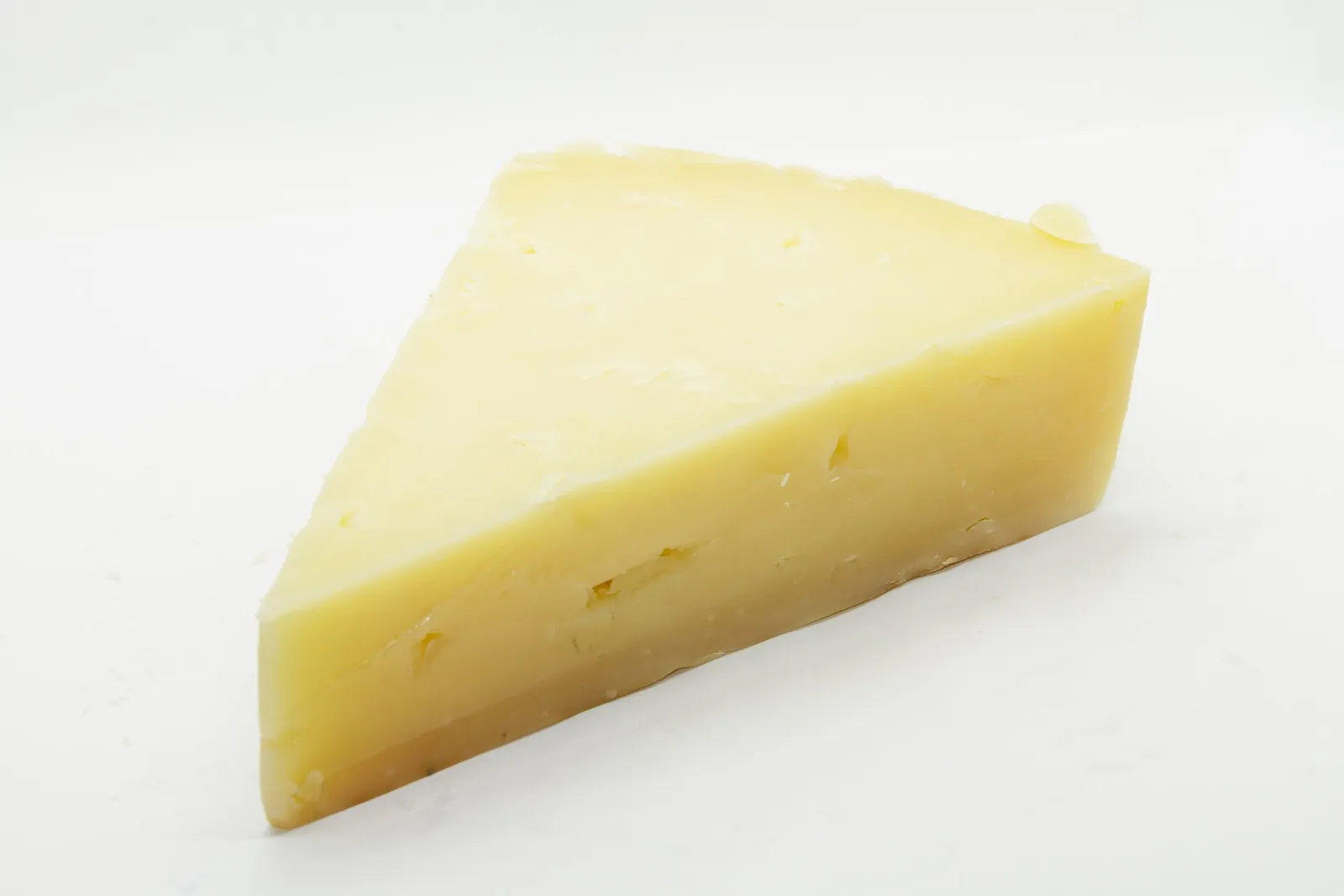
Both are firm cow's milk cheeses that go from mild to aged and grow crunchy crystals with time, so people treat them as stand-ins. They are built differently in the vat, and that decides how each tastes, melts and ages.
Cheddar vs Gouda at a glance
This Cheddar vs Gouda table compares the two cheeses by origin, standards, age and USDA data.
| Cheddar | Gouda | |
|---|---|---|
| Origin | Cheddar, Somerset, England; made worldwide | The Netherlands; also made in the US |
| Protected names | West Country Farmhouse Cheddar (PDO); the word cheddar is not protected | Gouda Holland (PGI), Noord-Hollandse Gouda (PDO) |
| Key step | Cheddaring: slabs of curd turned and stacked | Washed curd, then brining |
| Maximum moisture (US) | 39% | 45% |
| Minimum milkfat in solids (US) | 50% | 46% |
| Calories per ounce (USDA) | 114 | 101 |
| Protein per ounce (USDA) | 6.5 g | 7.1 g |
| Fat per ounce (USDA) | 9.4 g | 7.8 g |
| Sodium per ounce (USDA) | 185 mg | 232 mg |
| Flavor | Milky and mild young; sharp, tangy, savory aged | Mild and creamy young; nutty and caramel-sweet aged |
The real differences between cheddar and Gouda
The real differences between cheddar and Gouda start in the vat. For cheddar, the US standard describes the curd matting into one mass that is cut into slabs, then piled and turned so whey drains and acid develops. That is cheddaring, and it gives a dense cheese with a tangy edge. Gouda skips it: the curd is washed, which rinses off some of the milk sugar and acid, and the cheese is brined and ripened as a semi-hard wheel. The Gouda page covers the Dutch rules, and the cheddar page covers cheddaring and the Somerset origin.
The standards show the result. US cheddar may hold no more than 39 percent moisture, while Gouda may hold 45, so Gouda starts softer and more pliable. USDA's generic entries put cheddar at 9.4 g of fat and 185 mg of sodium per ounce and Gouda at 7.8 g and 232 mg, a reminder that Gouda is not always the richer cheese on the label.
Names differ in protection too. West Country Farmhouse Cheddar is a PDO registered with the EU in 1996, but the plain word cheddar is free for anyone, so an American or Canadian cheddar is a real cheddar. Gouda Holland is a PGI with its own rules, and the plain word Gouda is not protected either.
Cheddar vs Gouda flavor and aging
Cheddar vs Gouda flavor splits along the same line as the process. Young cheddar is milky and buttery, a sharp is bold and tangy, and an extra sharp turns deeper, nuttier and crumbly, sometimes with white crystals. Young Gouda is mild and creamy, and aged Gouda turns hard and nutty with caramel notes.
Age labels differ. Cheddar uses mild, medium, sharp and extra sharp, which Tillamook ties to about 2 to 6 months, over 9 months and 15 to 24 months, and the aged vs young cheddar guide lists them. Gouda uses Dutch words: jong at 4 weeks, belegen at 4 months and oud at 10 months and older. An oud Gouda and an extra sharp cheddar can both be crunchy, but one tastes of sharp tang and the other of toffee.
Cheddar vs Gouda for melting
Cheddar vs Gouda for melting favors young Gouda, because the cheese with more moisture and a softer protein network flows more easily. The University of Wisconsin's Center for Dairy Research notes that fat globules break up the protein network so a cheese melts more readily, and cheddar's 39 percent moisture cap keeps it firmer than Gouda's 45.
Sharp cheddar still melts well, and it carries more flavor into a sauce. For mac and cheese, blend a sharp cheddar with a young melter, or use young Gouda alone for a creamier, sweeter result. Aged versions of either resist a smooth melt, so grate them in small amounts.
Which to buy: cheddar or Gouda
Which to buy, cheddar or Gouda, depends on the job:
- Grilled cheese and burgers: medium or sharp cheddar, which stays creamy and adds tang.
- Mac and cheese: sharp cheddar with a young melter, or young Gouda for a sweeter sauce.
- Cheese board: aged Gouda for caramel and crunch, extra sharp or clothbound cheddar for savory depth.
- Snacking and kids: mild cheddar or young Gouda.
- Less fat per ounce: Gouda, 7.8 g against 9.4 g in USDA data.
- A swap: they trade in most cooking with a change in tang versus sweetness, and the substitute finder lists other matches.
What most cheddar vs Gouda advice gets wrong
Most cheddar vs Gouda advice repeats three shortcuts: that cheddar is always sharper, that Gouda is always the richer one, and that they differ only in taste.
Sharp is a label, not a cheese. Mild cheddar is milky and gentle, and only the sharp and extra sharp grades have the bite people associate with the name.
Gouda is not always richer. The Dutch specification for Gouda Holland calls for 48 to 52 percent fat in dry matter, but USDA's generic entries show more fat per ounce in cheddar, because cheddar holds less moisture.
The difference is also physical. Moisture caps of 39 and 45 percent mean the two behave differently in a sauce and on a board, not only on the tongue.
Questions about cheddar vs Gouda
These are quick answers to common questions about cheddar vs Gouda.
What is the difference between cheddar and Gouda?
The difference between cheddar and Gouda is process and flavor: cheddar is made by stacking curd slabs and tastes tangy and sharp, while Gouda is made with washed curd and tastes sweeter and creamier.
Which melts better, cheddar or Gouda?
Young Gouda melts better than cheddar, since US standards allow Gouda up to 45 percent moisture against 39 for cheddar. Sharp cheddar still melts well but a little firmer.
Which is healthier, cheddar or Gouda?
Cheddar is not simply healthier than Gouda, or the reverse: USDA lists cheddar at 114 calories, 9.4 g of fat and 185 mg of sodium per ounce and Gouda at 101, 7.8 g and 232 mg, so Gouda is lighter in fat and cheddar lower in sodium.
Can you substitute cheddar for Gouda?
You can substitute cheddar for Gouda in most recipes, but cheddar adds tang where Gouda adds sweetness, and it melts a bit less smoothly.
Does aged Gouda taste like cheddar?
Aged Gouda does not taste like cheddar, because it turns caramel-sweet and nutty where aged cheddar turns sharp and savory, though both can develop crunchy crystals.
Choosing between cheddar and Gouda
Choosing between cheddar and Gouda is easiest with a side-by-side tasting: buy a sharp cheddar and a young Gouda, then an extra sharp and an oud Gouda, and compare. If you are weighing Gouda against another Dutch cheese, Gouda vs Edam is the next comparison.
Sources
- 21 CFR 133.113, Cheddar cheese, Legal Information Institute, Cornell Law School
- USDA FoodData Central (SR Legacy): Cheese, cheddar (173414) and Cheese, gouda (171241)
- Product specification: West Country Farmhouse Cheddar (PDO), UK Department for Environment, Food and Rural Affairs
- The Melt and Stretch of Cheese (Dairy Pipeline, Winter 2000), Center for Dairy Research, University of Wisconsin-Madison
- How long do you age your cheddar cheeses?, Tillamook