
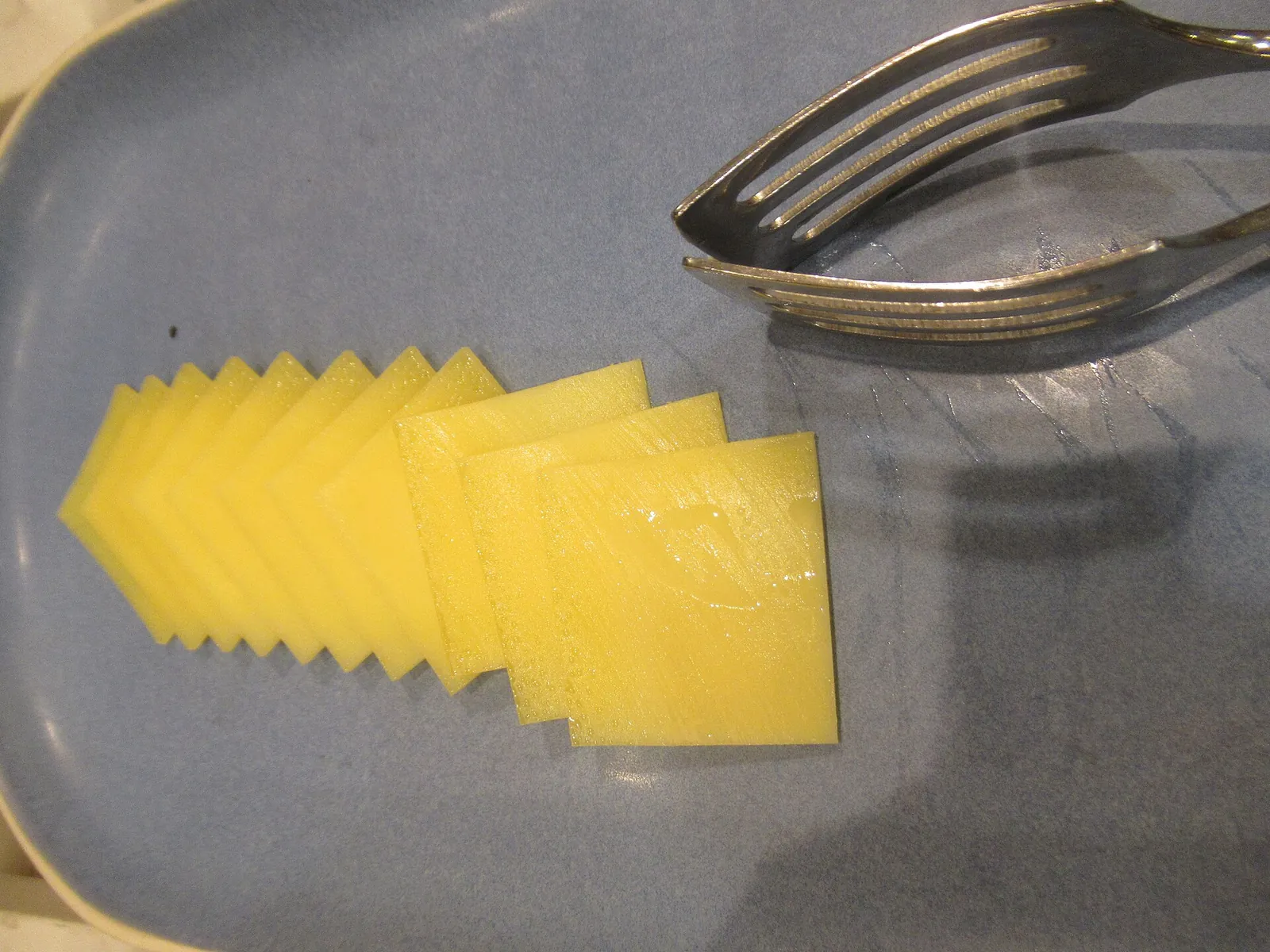
That is a modest piece, about the size of a pair of dice, and it is smaller than most people cut at the counter.
There are really two kinds of serving. The label serving, set by the FDA, is what the calories and sodium on the pack refer to. The dairy serving, set by the Dietary Guidelines, is bigger and is meant for planning a day's food. This page is general information, not medical advice.
The FDA cheese serving size
The FDA cheese serving size comes from the reference amounts in 21 CFR 101.12, which makers use to set the serving on a label. The table lists these amounts for cheese:
| Cheese type | Reference amount | Label serving shown as |
|---|---|---|
| Most cheese (cheddar, Swiss, mozzarella, brie, blue, processed) | 30 g | 1 oz (28 g) for bulk cheese, or pieces for slices and sticks |
| Cream cheese and cheese spread | 30 g | tablespoons |
| Grated hard cheese (Parmesan, Romano) | 5 g | tablespoons |
| Cottage cheese | 110 g | cup |
The rule's wording for bulk cheese is "1 oz (28 g/visual unit of measure)," so 28 grams is simply 30 grams rounded to a clean ounce. The reference amount is a standard, not advice on how much to eat, and a tablespoon of grated Parmesan weighs far less than a tablespoon of cream cheese.
Cheese serving size in the Dietary Guidelines
The cheese serving size in the Dietary Guidelines matches the label ounce. The 2025 to 2030 serving chart counts 1 ounce of cheese as one dairy serving, the same as 1 cup of milk or ¾ cup of yogurt. It sets 3 dairy servings a day from 1,600 calories up, and 2 to 2½ at 1,000 to 1,400 calories, a range that covers many young children. Earlier editions and the retired MyPlate site counted 1½ ounces of natural cheese as one cup-equivalent, which is why older charts and the label ounce disagree. Cheese is only one way to meet the dairy group, alongside milk and yogurt.
What an ounce of cheese looks like
What an ounce of cheese looks like depends on the cheese, so these cues are rough guidance, not measurements:
- Hard cheese (cheddar, Swiss, Gouda): a block about the size of a pair of dice, or a slice about a third of a deck of cards in thickness.
- Shredded cheese: roughly a loosely packed quarter cup.
- Grated Parmesan: a tablespoon or two of fine grating is a few grams, close to the 5 g reference amount.
- Soft spreads (cream cheese): about 2 tablespoons.
- Sliced cheese: one deli slice is often about an ounce, and one packaged slice is often closer to ¾ of an ounce, so read the label.
- Cottage cheese: about half a cup (110 g).
A kitchen scale beats any visual cue. If you will portion cheese often, weigh a few pieces once and train your eye on those.
What an ounce of cheese contains
What an ounce of cheese contains varies by type, so the serving size says little without the numbers. USDA FoodData Central lists per ounce:
| Cheese (USDA entry) | Calories | Fat | Sodium |
|---|---|---|---|
| Cheddar | 114 | 9.4 g | 185 mg |
| Mozzarella, whole milk, low moisture | 90 | 7.0 g | 201 mg |
| Parmesan, grated | 119 | 7.9 g | 511 mg |
| Pasteurized process American | 104 | 8.7 g | 474 mg |
Grated Parmesan is salty by the ounce, but a tablespoon is far lighter than an ounce, so a sprinkle adds little. Processed slices carry about two and a half times the sodium of cheddar. The calcium in cheese and low-sodium cheese pages go further, and the saturated fat page covers the fat question.
Cheese portions for a board or a meal
Cheese portions for a board or a meal are bigger than a label serving, because a party is not a snack. The site's cheese per person guide suggests about 1 to 2 ounces per person as an appetizer and 4 to 6 ounces when cheese is the meal, and the board builder plans about 2 ounces and 5 ounces. Those are quantities to buy for guests who also eat other food, not recommended servings.
For a board, the useful trick is the opposite of grazing: cut a few slices ahead, put out a small knife per cheese, and add fruit, nuts or bread so people fill up on more than cheese.
What most cheese portion advice gets wrong
Most cheese portion advice repeats shortcuts that do not match the labels.
"A serving is a matchbox." A matchbox is a loose cue for about an ounce of hard cheese, and it fails for shredded, soft and grated cheese.
"The label serving is the right amount." The FDA's 30 g is a reference amount that makers use, and the Dietary Guidelines' 1½ ounces is a different measure. Neither is a personal limit.
"Cheese is cheese." An ounce of grated Parmesan has about 511 mg of sodium and an ounce of low-sodium cheddar has 6 mg in USDA data, so portions mean more for some cheeses than others.
"Ounces are easy to eyeball." A chunk cut at the counter often runs 2 to 3 ounces. Weigh once.
If you have a health condition such as high blood pressure or high cholesterol, ask your doctor or a registered dietitian what amount fits you.
Questions about cheese portion sizes
These are quick answers to common questions about cheese portion sizes.
How big is one serving of cheese?
One serving of cheese is 1 ounce (28 g) for most cheeses, based on the FDA reference amount of 30 g. Grated hard cheese is 5 g and cottage cheese is 110 g.
How much cheese counts as one dairy serving?
One dairy serving is 1 ounce of cheese in the Dietary Guidelines for 2025 to 2030, the same as 1 cup of milk or ¾ cup of yogurt.
How many slices of cheese is one serving?
One serving of sliced cheese is often one to two slices, since the label serving is usually a piece or two that weighs about 1 ounce. Check the label's serving size.
How many calories are in a serving of cheese?
A serving of cheese is about 90 to 120 calories for common types, with USDA listing 114 for cheddar and 90 for low-moisture mozzarella per ounce.
What does a 1 ounce portion of cheese look like?
A 1 ounce portion of cheese is about the size of a pair of dice for a hard cheese, and about a quarter cup loosely packed for shreds. A scale is more reliable.
Cheese portion sizes: the next step
Cheese portion sizes are easiest to manage once you know your own ounce. Weigh one piece of your usual cheese, check the label serving, and decide whether to plan by the 1 ounce label or the 1½ ounce dairy count. For guests, use the board numbers above. This page is general information, not medical advice.
Sources
- 21 CFR 101.12: Reference amounts customarily consumed per eating occasion, Legal Information Institute, Cornell Law School
- Daily Servings by Calorie Level, Dietary Guidelines for Americans 2025-2030, U.S. Department of Health and Human Services and U.S. Department of Agriculture
- USDA FoodData Central (SR Legacy): cheddar, mozzarella, whole milk, low moisture, Parmesan, grated, pasteurized process American, low-sodium cheddar or colby, U.S. Department of Agriculture