
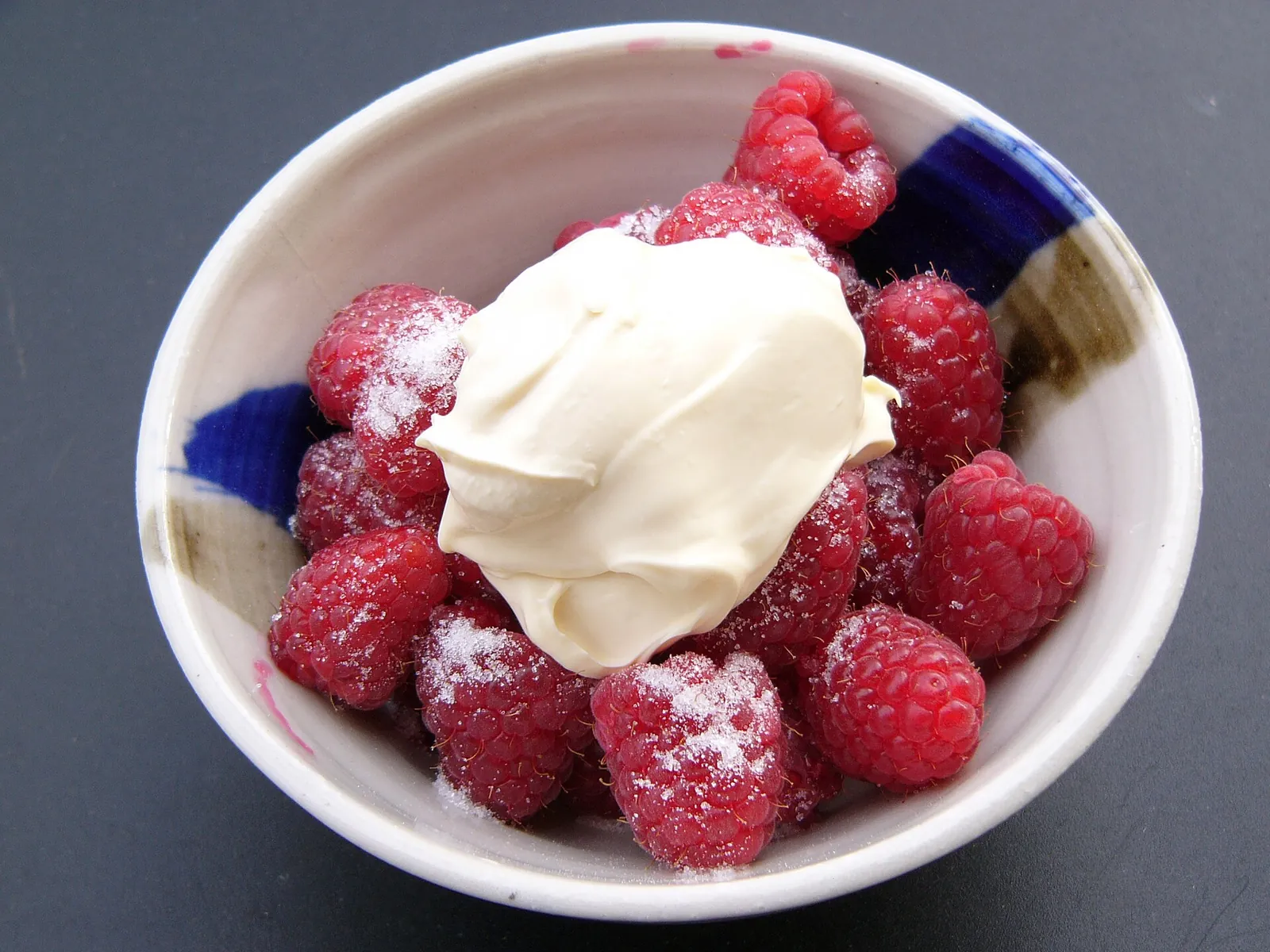
Both are rich and white and both add body to a dish, so recipes treat them as neighbors. They behave differently in the pan and in a dessert, and the reason is how each is made.
Mascarpone vs crème fraîche at a glance
This mascarpone vs crème fraîche table compares the two where they differ, using Italian composition data and cooking sources.
| Mascarpone | Crème fraîche | |
|---|---|---|
| Origin | Lower Lombardy, Italy | France |
| What it is | A fresh cheese | A cultured cream |
| How it is set | Cream heated to 185 to 203°F (85 to 95°C), then acid | Cream fermented with a culture |
| Fat | About 47 g per 100 g (Italian CREA tables) | 30 to 40 percent, up to 45 percent in some products |
| Texture | Thick, spoonable, holds its shape | Lush but fluid, pourable |
| Flavor | Milky, slightly sweet, mild tang | Subtle tang with nutty notes |
| Boiling | Softens and can split | Resists curdling |
| Best for | Tiramisu, fruit, risotto | Pan sauces, soups, stroganoff |
The real differences between mascarpone and crème fraîche
The real differences between mascarpone and crème fraîche start with how they are made. Mascarpone is cream heated to 185 to 203°F (85 to 95°C) and set with acid, as a 2020 paper in Molecules describes, with no culture or rennet. Treccani, the Italian dictionary, names diluted tartaric acid and calls it a specialty of Lower Lombardy. Crème fraîche skips the acid: America's Test Kitchen says it is made by adding cultures to heavy cream and fermenting it to a lush yet fluid consistency, with a subtle tang and nutty notes.
That makes mascarpone a cheese and crème fraîche a cream. Draining removes mostly water, so mascarpone concentrates to about 47 percent fat, and it spoons like thick whipped cream. Crème fraîche keeps its liquid, so it runs from pourable to spoonable. Its fat is generally 30 to 40 percent, as Cook's Illustrated gives it, and America's Test Kitchen says up to 45 percent, against 18 to 20 percent for sour cream.
Flavor follows. Culture gives crème fraîche a fresh tang. Mascarpone has no culture to sour it, so it is milky and slightly sweet, with a tangy finish. Each has more detail on its page: mascarpone covers fat, storage and safety, and cream cheese vs mascarpone compares it with the cheese it is most often confused with.
Mascarpone vs crème fraîche in cooking
Mascarpone vs crème fraîche in cooking is mostly a question of heat. Crème fraîche withstands it: in America's Test Kitchen's test the crème fraîche mixture stayed perfectly creamy while yogurt and sour cream quickly curdled at a simmer, because the higher butterfat coats the proteins and keeps them from binding. That makes it a natural finish for soups, pan sauces, stroganoff and risotto, and it can go 1 for 1 for heavy cream in many recipes.
Mascarpone is fragile once it is warm. At 47 percent fat it softens and thins rather than melting, and it can turn grainy or split if it is beaten hard or boiled, so stir it into hot dishes at the end over low heat. In risotto, about 1/4 cup (2 ounces) for four servings adds body without a cheesy flavor.
Desserts reverse the roles. Mascarpone beaten with egg yolks and sugar makes tiramisu cream, as the tiramisu guide explains, and it tops fruit and makes a thick frosting. Crème fraîche suits tarts and fruit where a tangy, softer cream is wanted. For a homemade mascarpone, how to make quick mascarpone takes cream and lemon juice.
Which to buy: mascarpone or crème fraîche
Which to buy, mascarpone or crème fraîche, depends on the job:
- Tiramisu: mascarpone, for its thick, sweet body.
- Hot sauces and soups: crème fraîche, which resists curdling.
- Risotto: either one; mascarpone adds richness, crème fraîche adds tang.
- Fruit and tarts: mascarpone for sweet and thick, crème fraîche for tangy and soft.
- Frosting and fillings: mascarpone, which holds its shape.
- A swap: see the next section, or the substitute finder.
Substituting crème fraîche for mascarpone
Substituting crème fraîche for mascarpone gives a thinner and tangier result, so it works in sauces and as a fruit topping but not in tiramisu or frosting, which need the body of the cheese. Going the other way, mascarpone can stand in for crème fraîche in a cold dessert, though it is thicker and milder. For a hot sauce, thin it with a little cream and keep the heat low, since it lacks crème fraîche's resistance to boiling. If the choice is between two cheeses instead, compare cream cheese and mascarpone.
What most mascarpone vs crème fraîche advice gets wrong
Most mascarpone vs crème fraîche advice repeats three shortcuts: that both are cultured cream, that mascarpone is the lighter one, and that either can be boiled.
Mascarpone is not cultured. It is cream set with heat and acid, with no culture or rennet, so it lacks crème fraîche's fermented tang.
Mascarpone is the richer one by weight. About 47 grams of fat per 100 grams, against 30 to 45 percent for crème fraîche. Crème fraîche is looser only because it keeps its water.
Only crème fraîche shrugs off boiling. Its fat protects it; mascarpone can split, so add it last, on low heat.
Questions about mascarpone vs crème fraîche
These are quick answers to common questions about mascarpone vs crème fraîche.
What is the difference between mascarpone and crème fraîche?
The difference between mascarpone and crème fraîche is that mascarpone is a thick Italian cheese made from cream set with acid, mild and sweet, while crème fraîche is a French cultured cream, pourable and tangy.
Can you substitute crème fraîche for mascarpone?
You can substitute crème fraîche for mascarpone in sauces and toppings, but it is thinner and tangier. Tiramisu and frosting need mascarpone's thickness.
Can you substitute mascarpone for crème fraîche?
You can substitute mascarpone for crème fraîche in cold desserts and spoonable toppings. It is thicker and milder, and it can split in a hot sauce.
Which is better for sauces?
Crème fraîche is better for hot sauces, because its fat keeps it from curdling at a simmer. Mascarpone works if stirred in at the end over low heat.
Which has more fat, mascarpone or crème fraîche?
Mascarpone has more fat in most cases, about 47 grams per 100 grams, while crème fraîche is generally 30 to 40 percent, and up to 45 in some products.
Choosing between mascarpone and crème fraîche
Choosing between mascarpone and crème fraîche is easiest by temperature: cold and sweet calls for mascarpone, hot and savory calls for crème fraîche. Taste a spoonful of each to hear the difference in tang before you cook.
Sources
- All About Crème Fraîche and Cutting Out Curdling in Cultured Dairy, America's Test Kitchen
- Mascarpone method paper, Molecules, 2020
- Mascarpone, Treccani Vocabolario