
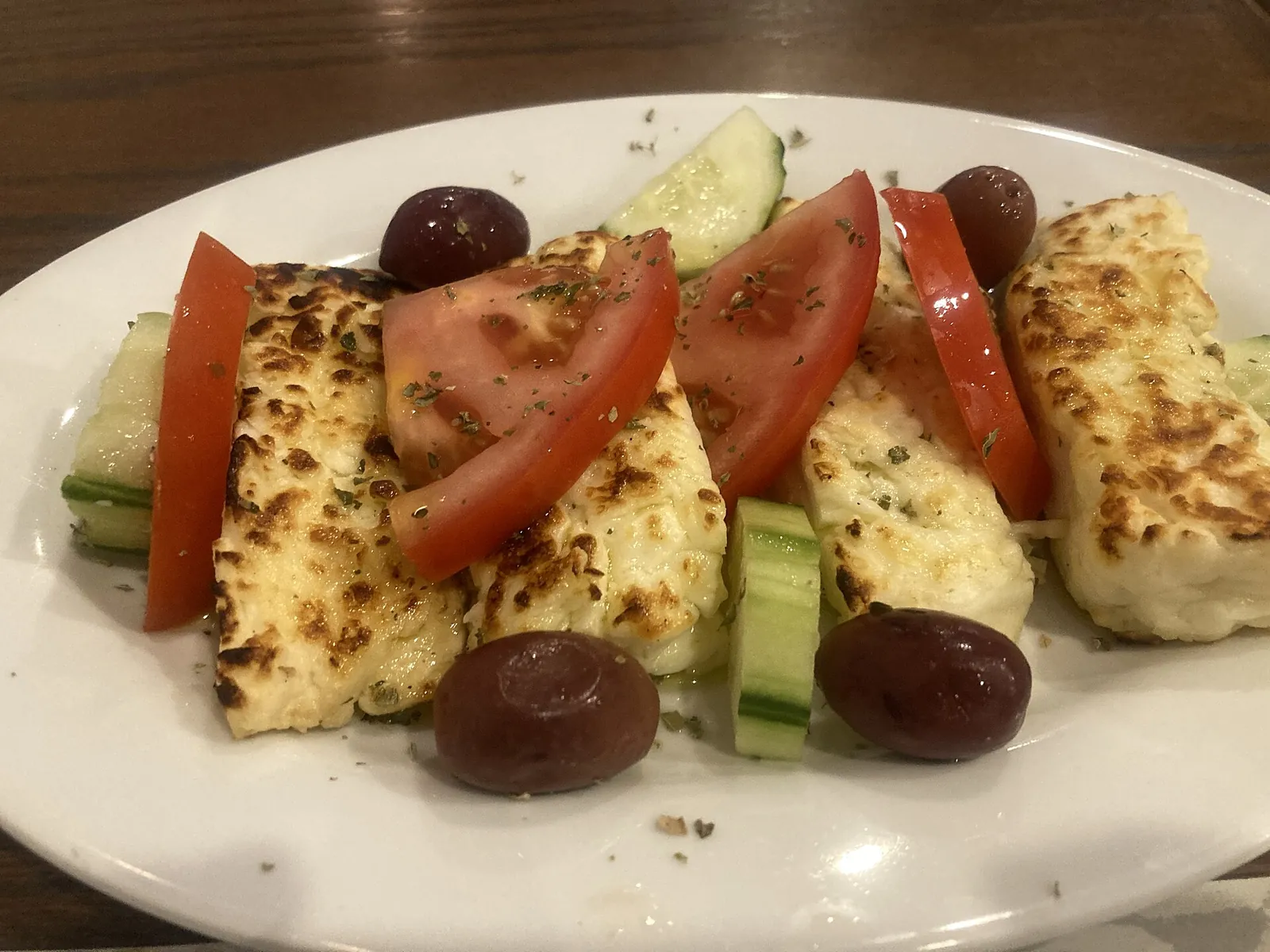
That one fact decides most swaps: halloumi seasons a dish, and paneer takes on the seasoning around it.
They resist melting for different reasons. Halloumi stays above the pH range where a cheese flows, because its curd is cooked in whey and never soured. Paneer comes from milk that is heated and then curdled with acid, which locks its whey proteins to its casein. The full profiles are in the halloumi and paneer guides.
Halloumi vs paneer at a glance
Here is halloumi vs paneer at a glance, with figures from the PDO document, Indian standards, published research and Norway's food composition table.
| Halloumi | Paneer | |
|---|---|---|
| Origin | Cyprus | India and South Asia |
| Milk | Sheep's and goat's, with or without cow's | Cow's or buffalo's |
| Set with | Rennet, no starter culture | Acid: lemon juice, vinegar or citric acid |
| Heat step | Curd cooked in whey above 194°F (90°C) for 30+ minutes | Milk heated to 185 to 195°F (85 to 90°C), curdled at 160 to 175°F (70 to 80°C) |
| Why it holds its shape | High pH keeps calcium in the protein network | Heat bonds whey proteins to casein |
| Salt | Up to 3% fresh under the PDO; about 476 mg sodium an ounce in Norway's table | None added; about 5 mg sodium an ounce |
| Water | At most 52% when fresh (PDO limit) | About 52 to 56% (typical) |
| Milk fat in dry matter | At least 43% (PDO limit) | At least 50% (Indian standards) |
| Texture | Elastic, dense, squeaky | Soft but firm, spongy |
| Flavor | Salty, milky, minty | Mild, milky, faintly sweet |
| Vegetarian | Only with non-animal rennet; the PDO bans pig rennet only | Yes, no rennet |
| Keeps | Unopened up to a year; opened, 2 weeks in salted water | About a week refrigerated |
Why halloumi and paneer both hold their shape
Halloumi and paneer both hold their shape because neither sits where a cheese flows, but they get there from opposite sides.
Halloumi stays on the high-pH side. Its curd is cooked in whey above 194°F (90°C) for at least 30 minutes, and the PDO ingredient list is milk, rennet, mint and salt, with no starter culture. Dr. Photis Papademas told America's Test Kitchen that the cooking kills the bacteria and deactivates the rennet, so no acid forms and calcium stays bound to the proteins. A 2025 study of halloumi-type cheese made without starter measured pH 6.53, and in frying the cheese held its shape above pH 6.41.
Paneer holds together another way. Paneer curd sets near pH 5.3, according to a review in the Journal of Food Science and Technology, which is where the 2025 halloumi-type cheese melted most, so high pH is not what protects it. Heat is. John Lucey of the University of Wisconsin explains that denatured whey proteins form permanent bonds with casein, giving cheese with less melt, and that acidifying very hot milk gives fresh cheeses such as queso blanco and ricotta, paneer's cousins, that do not melt. In studies the review cites, two milk proteins start bonding near 149°F (65°C) and the interaction peaks at 185°F (85°C), which is why paneer milk is heated that far. The melting cheese guide covers the wider science.
Salt, flavor and texture in halloumi vs paneer
Halloumi is salty and elastic while paneer is unsalted and soft, and the flavor and texture split follows the salt. The PDO caps fresh halloumi at 3 percent salt, and Norway's food composition table lists 1,680 milligrams of sodium per 100 grams, about 476 an ounce, against 19 milligrams, about 5 an ounce, in its paneer entry. Dairy Farmers of Wisconsin describes paneer as a fresh, unsalted cheese with a mild, slightly milky flavor that soaks up the spices and sauces around it.
Texture follows the method. The PDO calls fresh halloumi semi-hard, elastic and easily sliced, and it browns into a crust. Paneer is soft but firm with a spongy, close-knit body. The review adds that cow's-milk paneer is softer and more fragile than the buffalo-milk paneer Indian dairies prefer, so handle it gently.
When to use halloumi and when to use paneer
Use halloumi when the cheese should season the dish, and paneer when the sauce should. Halloumi suits quick, hot cooking: seared slabs with lemon, skewers, salads and wraps, where its salt and mint carry the plate. Flip 1/2-inch slices every couple of minutes, as America's Test Kitchen does, until deeply browned.
Paneer suits spiced, saucy dishes where mildness is the point: palak paneer simmers cubes in spinach sauce, and paneer tikka chars yogurt-marinated cubes on a grill. Fry the cubes briefly first so they firm and brown, then add them to the sauce near the end.
How to swap halloumi and paneer
To swap halloumi for paneer in a curry, soak the halloumi in cold water for 30 minutes, pat it dry and sear the cubes. Stir them in at the end and taste the sauce before adding any salt. Expect a firmer, squeakier bite.
To swap paneer for halloumi on a grill or in a pan, cut thick slabs about 3/4 inch (2 cm) wide, pat them dry and marinate them for 30 minutes in oil, lemon juice and salt. Cook them gently on oiled grates or in a nonstick pan and turn them once. Dairy Farmers of Wisconsin names paneer as a halloumi substitute, though the result is softer.
What most halloumi vs paneer advice gets wrong
Most halloumi vs paneer advice stops at "neither melts" and skips three details.
Halloumi is not always vegetarian. The PDO bans only pig rennet, so other rennet, animal or microbial, is allowed. Paneer is vegetarian by method, because acid sets it. Look for microbial rennet on a halloumi label.
Paneer's milk matters. Buffalo milk makes firm, close-textured paneer; cow's milk makes a softer block that needs pressing and gentle handling.
Low-fat paneer is a poor swap. The review reports that paneer from low-fat milk has a hard, rubbery, chewy body and a bland flavor. Buy full-fat.
Questions about halloumi vs paneer
These quick answers cover what people ask most about halloumi vs paneer.
What is the difference between halloumi and paneer?
The difference between halloumi and paneer is salt and method: halloumi is salty and set with rennet, then cooked in whey, while paneer is unsalted and set with acid in hot milk.
Can you substitute halloumi for paneer?
You can substitute halloumi for paneer if you soak it first and cut the salt in the sauce. It will be firmer and squeakier than paneer.
Can you substitute paneer for halloumi?
You can substitute paneer for halloumi if you marinate it with salt and lemon and cook thick slabs gently. Dairy Farmers of Wisconsin suggests it as a stand-in.
Do halloumi and paneer melt?
Halloumi and paneer do not melt: they soften and brown but keep their shape in a pan or on a grill, for the different reasons above.
Is halloumi healthier than paneer?
Halloumi and paneer are both full-fat cheeses, so the real difference is sodium. Norway's table lists 21.9 grams of fat and 1,680 milligrams of sodium per 100 grams for halloumi, against 24.5 grams of fat and 19 milligrams for paneer.
Choosing between halloumi and paneer
Choosing between halloumi and paneer comes down to salt and sauce: buy halloumi for a salty, seared centerpiece and paneer for a spiced curry or tikka. If you must swap, fix the salt first.
Sources
- Publication of an approved standard amendment, 'Χαλλούμι / Halloumi / Hellim' PDO-CY-01243-AM03, with the single document (OJ C 165, 10.5.2023), Official Journal of the European Union
- The effect of pH on the microstructure, rheological and functional properties of halloumi-type cheese (Food Chemistry: X, 2025), via PubMed Central
- Halloumi: What Is Halloumi Cheese?, America's Test Kitchen
- Paneer: An Indian soft cheese variant: a review (Journal of Food Science and Technology), Kumar, Rai, Niranjan and Bhat, via PubMed Central
- The pros and cons of high-heat treatments, John A. Lucey, University of Wisconsin Center for Dairy Research, in Dairy Foods (2020)
- Paneer and Halloumi, Dairy Farmers of Wisconsin
- Food composition table entries for halloumi and paneer, Matvaretabellen, Norwegian Food Safety Authority